US second quarter GDP 1st revision preview: Consumers are sufficient for 2%
- Annualized GDP expected to slip 0.1% to 2.0%
- Consumer spending remains healthy
- Business investment and sentiment low, dragged down by the China trade dispute

The Bureau of Economic Analysis, a division of the Commerce Department will issue its first revision of annualized second quarter gross domestic product (GDP) on Thursday, August 29th 12:30 GMT, at 8:30 EDT.
Forecast
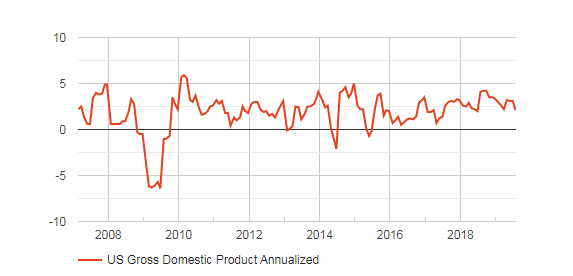
Second quarter annualized GDP is expected to drop to 2.0% from the initial release of 2.1%. First quarter GDP was 3.1%.
FXStreet
US GDP
The US economy saw an unexpected resurgence in the first three months of the year posting a 3.1% expansion after two quarters of declining growth from 4.2% in the second quarter of 2018 to 3.4% in the third and 2.2% in the fourth. Before the release the consensus estimate for the first quarter had been for a continued decline to 2.0%. The better result was prompted by better than anticipated consumer spending and an inventory build that boosted economic activity. Business investment continued to be depressed by the trade war with China and concerns over global growth and its potential impact on the US.
That pattern of active consumer spending coupled to a retiring business sector is the paradigm for the second quarter.
Domestic consumption: the labor market and retail sales
Job creation, rising wages and historic levels of employment have given the American worker and the general population much to cheer about. The tight labor market of the past two years has expanded hiring into corners of the economy untouched by the modest growth of the previous eight years, providing income where there had been little.
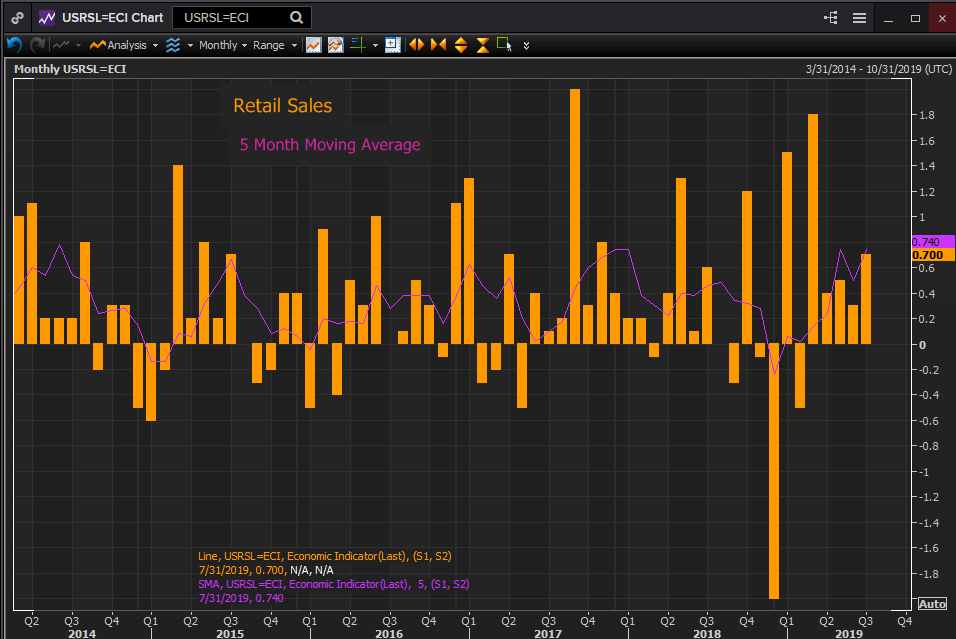
Retail sales increased at more than twice the forecast rate in July, posting a 0.7% gain against a 0.3% forecast.
Reuters
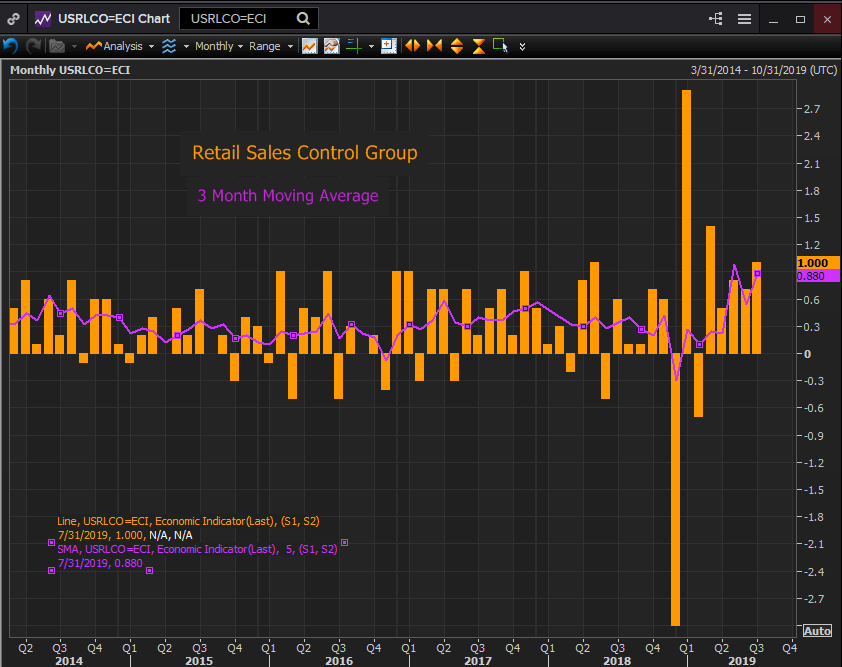
The control group classification, which enters the government’s GDP calculation, rose 1.0%, besting the 0.7% prediction. In the five months from March to July, avoiding the gyatins associated with the partial governmetn shutdown in January, sales averaged 0.74% each and the control group averaged 0.88%.
Reuters
This rate of growth in the approximately 70% of GDP derived from consumption is commensurate with an economy expanding between 2.0% and 2.5%.
Business investment and sentiment
The durable goods category non-defense capital goods ex-aircraft is often cited as a proxy for business investment. Shipments of these goods are used by the Bureau of Economic analysis to calculate business equipment spending and in July they fell by 0.7% the most since October 2016. June’s shipments were revised to flat from 0.3%. Over the year these deliveries are 1.5% higher.
While new orders of these so-called core capital goods rose 0.4% in July against a forecast for a 0.1% decline, the prior month was revised to 0.9% from 1.5%.
Business investment contracted in the second quarter for the first negative since the first three months of 2016. Manufacturing output has declined for two straight quarters.
Sentiment in the business community has been fading for almost a year. In the manufacturing sector the purchasing managers’ index from the Institute for Supply Management has fallen from 60.8 last September, a seven year high, to 51.2 in July, just above the 50 division between expansion and contraction.
The US trade dispute with China, now running up to two years has exacted a far greater toll the attitudes and investment decisions in the business community than in the general population.
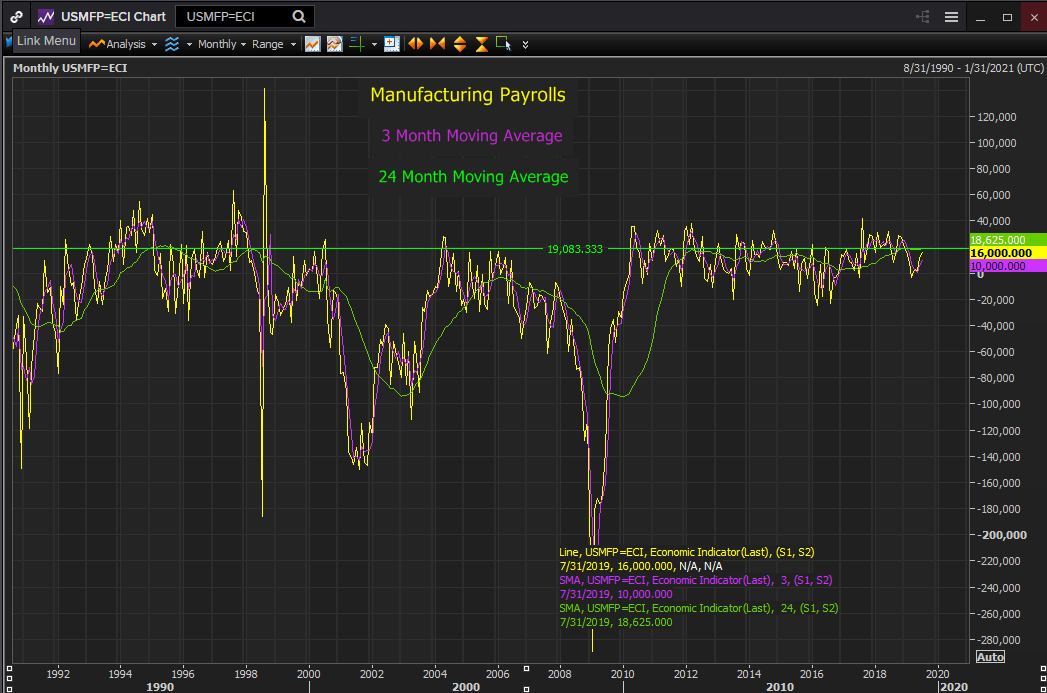
Interestingly, hiring in the manufacturing sector has not followed the downward path of general business investment. Manufacturing payrolls added 16,000 workers in July far ahead of the 5,000 forecast, following June’s 12,000 jump.
Though the three month moving average has fallen from 25,000 last December to 10,000 in July that decline comes after a two year monthly average of 19,000 in January which was the best 24 months in over two decades, since September 1995.
Reuters
Conclusion
The US labor market has remained buoyant over the last year despite the misery inflicted on business planners by the trade war with China. American companies have maintained a high level of hiring because they are responding to domestic consumer demand. The relatively small percentage of US GDP that stems from manufacturing, 12%-15% and the even smaller percentage due to exports 3%-5% are not sufficient to derail overall growth based on an expansive consumer. Their relative decline, however, has probably restricted economic activity to a 2.0%-2.5% range.
Author

Joseph Trevisani
FXStreet
Joseph Trevisani began his thirty-year career in the financial markets at Credit Suisse in New York and Singapore where he worked for 12 years as an interbank currency trader and trading desk manager.
















