US Retail Sales April Preview: As bad as can be but no surprise
- Sales decline expected to deepen, set new records.
- Unemployment, social restrictions, closed businesses block consumption.
- Market reaction likely to be muted despite the two month 20% plunge.
- Dollar will keep its risk premium edge as long as the US and global economies fade.


The title of last month’s retail sales preview was ‘Can consumers stare down unemployment?’ The answer was an emphatic no as sales plunged 8.4% in March more than twice the previous record of -3.9% from November 2008.
Retail sales
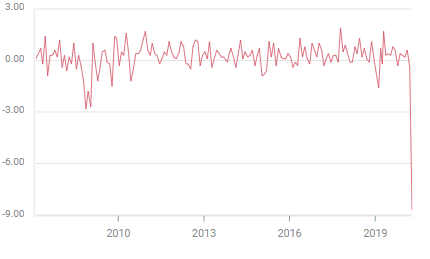
Unemployment and the economic closures ordered by many state governors to combat the spread of the coronavirus did not impact the labor market and retail sector until the second half of the month. By April 1 the nation was fully invested in the fight and the effect on consumption looks to be substantially worse than March.
Retail sales are forecast to decline 12% in April, half again as much as the March plunge and almost equaling the12.4% crushing in the six months of the second half of 2008 when the financial crisis overwhelmed the US economy. In March and April 20% of retail sales will have vanished.
Sales excluding automobiles are expected to drop 8.6% more than doubling the 4.2% decrease in March. The ‘control group’ which mimics the consumption category in the GDP calculation is projected to fall 4.6% also more than twice the 2% decline in March.
Labor market disruption
The collapse of the US labor market under the forced closure of large parts of the retail and service sectors has pulverized the rest of the economy. More than 33 million people have filed for unemployment insurance in the last seven weeks with another 2.5 million expected on Thursday. In April the economy lost two decades of job creation 20.5 million positions in one month.
The unemployment rate jumped 10.3% points to 14.7% in April which surely understates the real level of pain because of its restricted definition. The real or underemployment rate jumped 14.1% points to 22.8%.
Nothing like this has ever been experienced in an industrial economy before. In the opening years of the Depression, 1930 and 1931, it took 13 months for the unemployment rate to rise 10 points.
States take different shutdown paths
In the original series of layoffs in March many employers had rated the chance of rehiring their workers at 75% or better. That estimate from California can no longer be used as a rough guide to returning employment nationwide as states have taken different approaches to their shuttered commercial life.
Georgia and Florida have, at least so far, successfully lifted many of their restrictions without engendering a renewed spread of the coronavirus. Other governors like Whitmer in Michigan and Evers in Wisconsin have refused elide their original shutdown rules.
The movement to limit and eventually end the economic paralysis will need to encompass most of the country before employment can begin to recover.
Consumer sentiment
The Michigan consumer sentiment index is expected to slip to 68 in May from 71.8 in April when it is released on Friday. The current conditions gauge is forecast to rise to 75 from 74.3 and the expectations index is predicted to climb to 71.8 from 70.1.
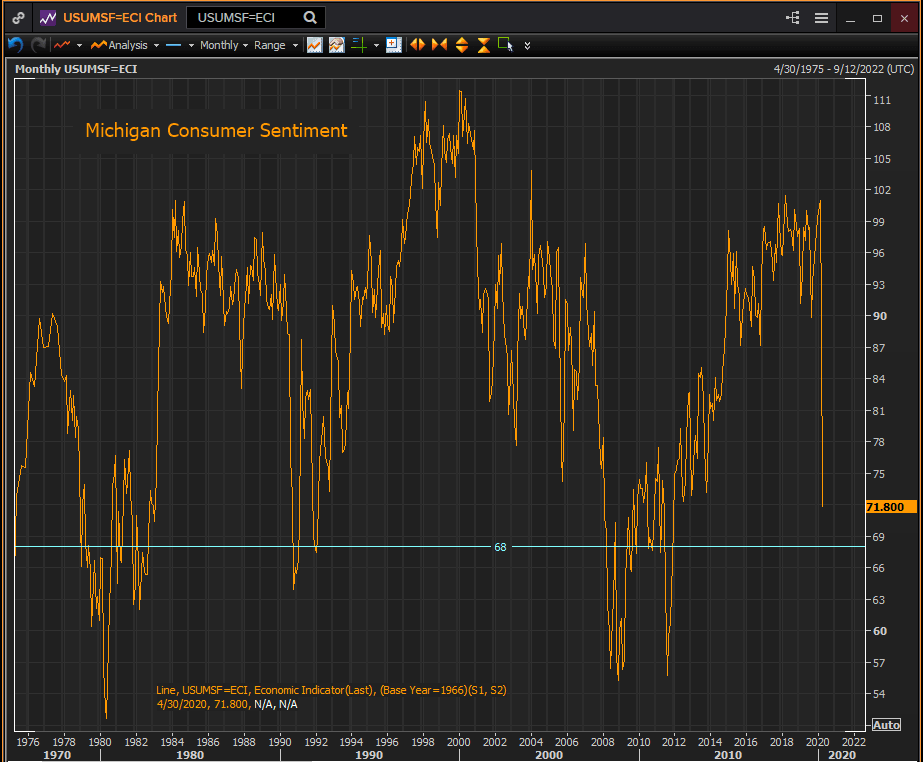
If these predictions prove to be true it may be a sign of hope for the beleaguered consumer sector. While 68, 75 and 71.8 are steep declines from their pre-virus levels the expectations forecast at least, is considerably better than the four year depression in outlook that followed the financial crisis and recession of 2008-2009.
This may be an indication that the battered US consumer has not lost hope in a swift resolution to the current crisis.
If Americans are waiting to see the next act in this public drama, they will certainly respond to good news.
Conclusion: Markets and the dollar
Equity, credit and currency markets are likely to shrug off the April retail sales numbers, terrible as they will be, much as the non-far payrolls figures were ignored. The catastrophic economic impact of the shutdown orders is old news and largely priced into market levels.
It was always known that however bad the statistics in March were, those from April would be far worse. That has happened and no one is surprised.
Author
Joseph Trevisani
FXStreet
Joseph Trevisani began his thirty-year career in the financial markets at Credit Suisse in New York and Singapore where he worked for 12 years as an interbank currency trader and trading desk manager.

















