US Presidential election: The underlying economic issues

The world's biggest political event of the year, the 60th presidential election in the history of the United States, will take place on 5 November 2024. The leading candidates are incumbent Vice President Kamala Harris (Democrat) and former President Donald Trump (Republican). The purpose of the popular vote is to appoint the college of 538 electors who will actually elect the future President, who is scheduled to be inaugurated on 20 January 2025. The election promises to be particularly closely contested. Kamala Harris' entry into the race in July created positive momentum for the Democratic Party, before Donald Trump's support picked up again, increasing his likelihood of winning at the end of the campaign. Voters will also decide on the composition of Congress (with all seats in the House of Representatives up for election, as well as a third of Senate seats). This will have major implications for the new President's ability to implement his or her policies.
While societal issues are at the forefront of public debate, economic issues are equally crucial. On the one hand, the election will have potentially major consequences for the trajectory of US public finances. Secondly, the choice of Jerome Powell's eventual successor as Fed Chairman in 2026 could be part of a wider questioning of the central bank's mandate. Finally, the broadly interconnected directions of industrial, environmental and tariffs policies will hinge on who wins the election, as will their consequences for the rest of the world and, in particular, for the European Union.
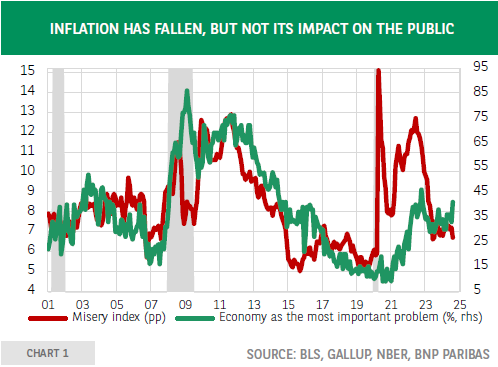
Perceptions of the outgoing administration's economic record will also play a role. The election is taking place against a specific backdrop, with a significant gap between the subdued sentiment of economic agents and the country's positive macroeconomic performance. In August 2024, 44% of Americans cited an economic issue when asked about "the Nation’s most important problem" (Chart 1). This figure has risen sharply since January 2021, when Joe Biden became President. At that time, the figure was 9%, the lowest since 1968.
This article aims to highlight the underlying and potentially decisive economic issues at stake in the US presidential election. We will begin with an overview of the macroeconomic situation in the United States, before looking at the impact of the elections for Congress on the future President's room for manoeuvre. We will then look at the economic policies (industrial, trade and environmental) that have an impact on the United States' attractiveness, but also, and perhaps above all, the repercussions on foreign economic relations. Finally, we will look at the challenges of the policy mix, with its deteriorating budgetary situation and the threats to the independence of its monetary policy.
Author
BNP Paribas Team
BNP Paribas
BNP Paribas Economic Research Department is a worldwide function, part of Corporate and Investment Banking, at the service of both the Bank and its customers.