US Michigan Consumer Sentiment March Preview: Outlook equals consumption
- March sentiment expected to fall upon revision.
- Widespread job losses will drive overall sentiment down.
- Weaker consumer sentiment will likely mean lower consumer spending.

The University of Michigan will release its revised Survey of Consumers for March on Friday March 27th at 14:00 GMT 10:00 EDT
Forecast
The final Consumer Sentiment Index is expected to drop to 90 in March from the preliminary reading of 95.9 and 101 in February and 99.8 in January.
Michigan Consumer Sentiment
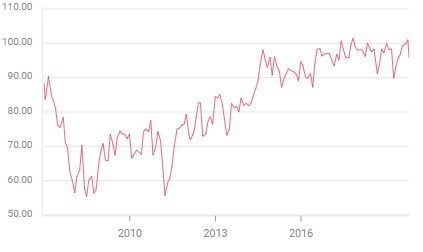
Consumer sentiment and the US economy
The US depends on an employed and optimistic consumer to drive the 70% of economic activity that derives from consumption. Until the viral outbreak both inputs to that equation were at high levels. A booming labor market and rising wages meant consumers were happy and spending.
Job losses, primarily from the enforced closures of many service businesses but also from the population’s voluntary restriction of many of their actions, have soared with more than 3 million people filing for unemployment insurance last week.
The impact of the overturned labor market will be far more widespread than just on the people who lost their jobs. The threat of unemployment may now be the key factor in many decisions made by households and individuals in the next weeks and months.
Under these unusual and uncertain conditions of employment and financial solvency consumers will likely curtail spending until their own and the national situation is clarified. Normally the more worried consumers are the greater will be the suspension of their credit cards and the greater the hit to US economic growth.
Conclusion
Though consumer sentiment is one of the prime ingredients in the US economic outlook and a drop would usually be considered a cause for alarm, these are not normal circumstances.
A serious decline in consumer sentiment is the new operating assumption, if not in March then surely in April.
However, in the current unique situation this may mean less than it would otherwise. Economic statistics are of less importance right now than the progress of the government in curbing the spread of the Coronavirus. The economic basis of this focus is the logical assumption that as soon as the virus threat is diminished or eliminated spending and the economy will return with a flare.
It may or may not be warranted but it is a vote for the resiliency and optimism of the American consumer.
Author

Joseph Trevisani
FXStreet
Joseph Trevisani began his thirty-year career in the financial markets at Credit Suisse in New York and Singapore where he worked for 12 years as an interbank currency trader and trading desk manager.