US Initial Jobless Claims Preview: Will there be a hiring surge?
- Initial claims at 2.4 million would be the lowest since the lockdown escalation began.
- Total claims to be almost 39 million, 23.6% of the workforce.
- Continuing claims forecast to rise 1.9 million to 24.7 million.
- Little indication so far that rehiring has started to reduce unemployment.
- Dollar unlikely to be moved by claims or continuing numbers.

The incipient economic reopening movement that started in Georgia on April 24 has since seen stay-at-home orders lifted in almost all states and some or most business restrictions in many others has not yet diminished the soaring unemployment in the United States.
Initial claims are forecast to add another 2.4 million people to the jobless rolls in the week of May 15 which would bring the total to 38.871 million or 23.6% of the American labor force put out of work in the last nine weeks.

Continuing claims are expected to add 1.932 million to 24.765 million.
Market reaction to labor statistics
The disaster of forcing almost a quarter of the labor force into unemployment was a shock to markets when it began on March 26 with the release of the previous week’s claims number. In the first three weeks of the viral layoff surge forecasts were under reality by 7 million, 9.75 million vs 16.789 million claims, for an average weekly misestimate of 3.25 million.
In the subsequent five weeks the average spread between the number and the estimate has fallen by a factor of almost 12, forecasts each week have been under by an average of -0.275 million.
The surprise administered by those first three claims numbers has largely inured markets to the equally horrendous April non-farm payrolls -20.5 million, unemployment rate 14.7% and retail sales -16.4%, which though better than expected in the labor statistics and worse for consumption did not move markets.
Continuing claims
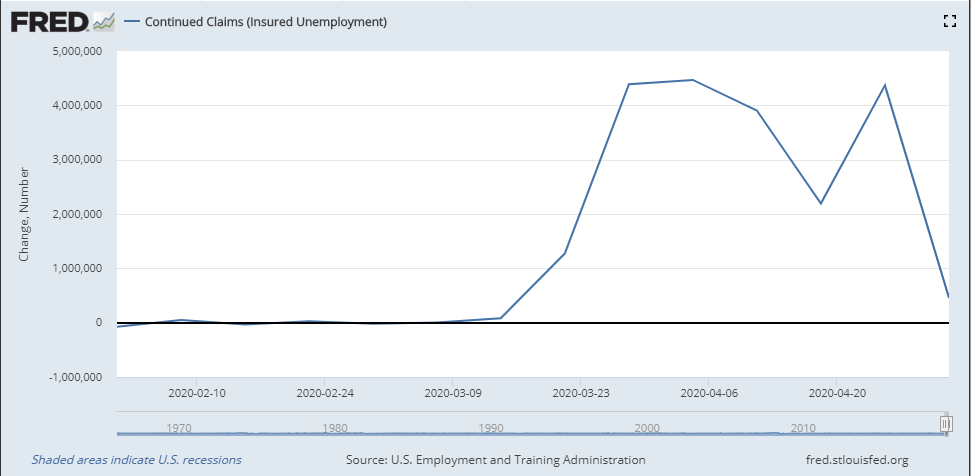
The continuing claims total is one week behind the initial figures and tracks the number of people collecting their 26 weeks of payments.
People leave the rolls when their eligibility expires or they find employment. Secretary Mnuchin said in Tuesday’s Senate testimony that unemployed individuals who are offered a return to their old job and refused would lose their qualification for unemployment insurance.
As states continue to remove restrictions on businesses and rehiring occurs it is expected that the returning workers will leave the continuing claims list. That reduction has not yet happenied.
The variation in the increases to the weekly continuing claims totals has been uneven, running from a high of 4.466 million from March 27 to April 3, to a low of 0.456 million from April 24 to May 1, (see chart below). The average increase for the first month was 3.508 million and for the second 2.229 million. The forecast gain for this week (May 8) is 1.932 million.
Conclusion
Markets have had the US labor and economic catastrophe priced for more than a month and none of the statistics in that period, no matter how egregious, have moved currency, bonds or equities out of their recent trading ranges.
Continuing claims are the key to charting the recovery. As long as more people are being laid off than are rehired it is not underway.
This week’s figures are unlikely to show that improvement but if and when it first arrives, markets will drop their insouciance and respond.
Author

Joseph Trevisani
FXStreet
Joseph Trevisani began his thirty-year career in the financial markets at Credit Suisse in New York and Singapore where he worked for 12 years as an interbank currency trader and trading desk manager.