US Initial Jobless Claims Preview: The tidal wave rolls on
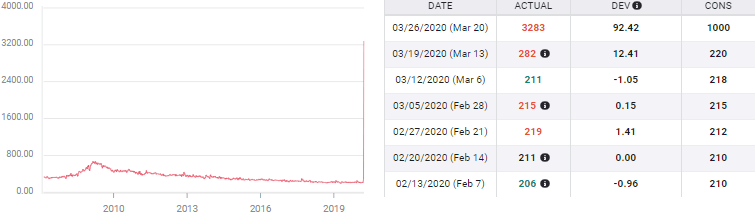
- Claims expected to be another record after last week’s 3.283 million.
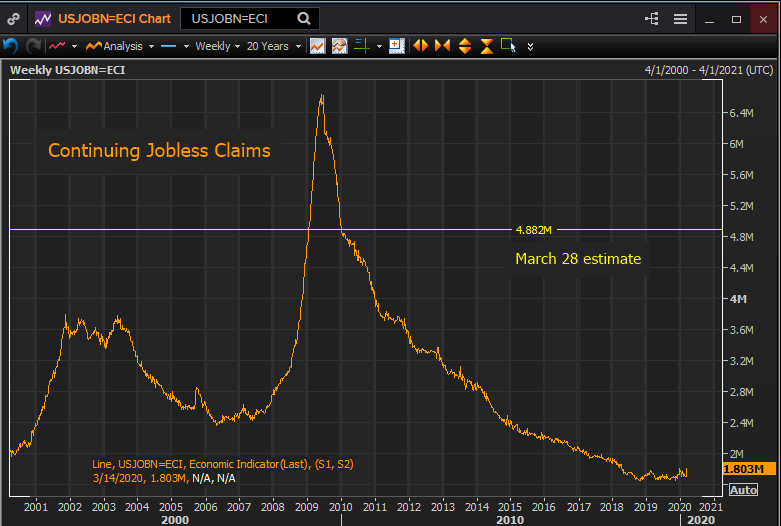
- Continuing claims projected to jump to the highest since January 2010.
- Safety dollar could benefit from fear of deepening slowdown.

The Department of Labor will issue its initial jobless claims for the week of March 28 on Thursday April 2 at 12:30 GMT, 8:30 EDT.
Forecast
Initial claims are expected to rise to 3.5 million from 3.283 million the previous week. The range of the estimates in the Reuters survey of economists is from 1.5 million to 5.250 million. The four-week moving average was 998,250 in the prior week. Continuing claims are predicted to rise to 4.882 million from 1.803 million.
Jobless claims and the US economy
The astonishing collapse of US labor market under the public health emergency of the Coronavirus is expected to have accelerated last week with 3.5 million more workers applying for unemployment insurance.
Many of these positions are not eliminated but because of the extensive drop in public activity their employers no longer have the cash flow to maintain payroll.
The stimulus package passed by Congress and signed by President Trump provides stipends for businesses that are willing to keep payrolls intact but the distribution of the allotted funds has not yet started. As these programs begin in the weeks ahead they should help to limit future layoffs.
Initial jobless claims
Economic impact
Much about the extraordinary situation that the US and much of the world finds itself in depends on the length of the economic closures.
The speed at which the economy returns to normal functioning will be determined by the course of the pandemic, on the evolving assessment of the health risks and the accumulating economic damage. It is obvious that the longer the shutdowns continue the more businesses will fail and temporary layoffs will become permanent job losses.
For the US economy which is 70% based on consumption rising unemployment is devastating to consumer spending and translates quickly into lost employment and production.
The decline in US second quarter GDP is variously estimated to be from 3% to 10%. The New Zealand government has said that it expects a 10% decline in second quarter GDP.
Unemployment may only rise modestly from its February level of 3.5% to 3.8% in March when the Labor Department issues the Employment Situation Report for March on Friday. Department criteria for joblessness are relatively strict, an individual must have looked for work in the prior month, and since many layoffs were immediate they might not be counted. In addition the job losses accelerated during the month and the latter ones may have been missed in the representative sample.
Conclusion and the dollar
Last week’s record initial claims have prepared but not inured markets for disastrous economic data. As long as the claims are within the new parameters the effect of these historic numbers will be judged by context and not absolute values. With that standard there is probably not much that can surprise. But markets are keyed for bad news and with the US dollar the safe-have of choice, bad news is likely to be good news for the greenback.
Author

Joseph Trevisani
FXStreet
Joseph Trevisani began his thirty-year career in the financial markets at Credit Suisse in New York and Singapore where he worked for 12 years as an interbank currency trader and trading desk manager.