US Initial Jobless Claims Preview: Slowly but surely the economy improves
- First time unemployment claims forecast to drop to 846,000 from 881,000.
- Continuing claims to continue down to 12.925 million from 13.254 million.
- August PMI new orders strong, employment indexes rise but remain in contraction.
- Dollar revival supported by improving US economic statistics.

The number of people filing for first time unemployment compensation is projected to decline for the third straight week after unexpectedly jumping above 1 million in the middle of August.
Requests for benefits are expected to be 846,000 in the September 9 week after 881,000 in the previous report. It would be the second week in a row below 1 million but only the third since the pandemic closures collapsed employment in March.
Initial claims
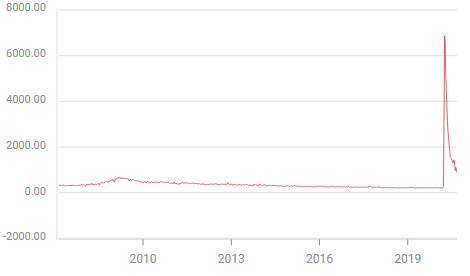
Continuing claims are forecast to drop to 12.925 million in the August 28 week, from 13.254 prior. If accurate recipients will have fallen 52% from their May 8 high of 24.912 million.
Purchasing managers’ indexes
Business sentiment and activity in the manufacturing and service sectors have recovered smartly from the pandemic debacle in the early spring.
The overall manufacturing purchasing managers’ index (PMI) rose to 56 in August from 54.1 in July and is considerably better positioned than where it was in February at 50.1 just after the signing of the US-China trade accord. The new orders index, the barometer of incoming business, jumped to 67.6 in August from 61.5 in July and is now far ahead of February’s 49.8 pre-Covid level. It had been expected to plunge to 53.5.
Sentiment in the service sector slipped to 56.9 in August from 58.1 prior and 57.1 in June. The 57.4 average for the past three months is stronger than the 55.2 average for the five months (October-February) before the lockdowns. The new orders index fell to 56.8 in August but the July result of 67.7 had been the highest on record.
Services PMI
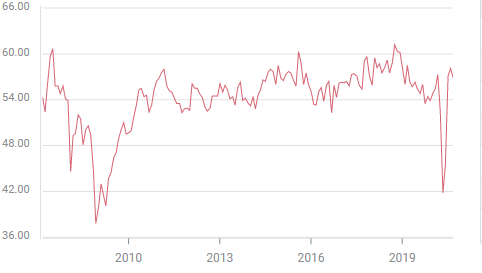
Employment indexes in both sectors continue to lag the improvements in overall activity and new business. Manufacturing rose to 46.4 in August not far from its 46.9 reading in February. The services employment index was 47.9 in August, well below the 55.6 February reading but much better than the 31.9 forecast.
JOLTS
The Job Openings and Labor Turnover Survey (JOLTS) from the US Labor Department which tracks public job vacancies was 6.618 million in July in advance of the 6 million forecast and June 6.001 million. The January and February was just over 7 million.
Conclusion and the dollar
The US economy continues to have a two-tier labor economy. Payrolls rose 1.371 million in August the fourth straight monthly gain bringing the recovery to 47.8% (10.595 million of 22.160 million) of the NFP losses. The unemployment rate dropped to 8.4% down from a high of 14.7% in April.
But through those four months of rehiring initial jobless claims averaged well over a million new filers each week. The disparity is striking. Jobs continue to disappear as small businesses succumb to the cumulative effects of the closures at the same time as more established firms bring workers back.
The six week decline in the US dollar which stalled and partially reversed last week was based on an expected halt to the economic recovery prompted by the jump in initial claims in the middle of August.
That increase has reverted to decline and the US economy has not faltered. Currency markets are waiting for further proof that their supposition was in error. Claims seem ready to oblige.
Author

Joseph Trevisani
FXStreet
Joseph Trevisani began his thirty-year career in the financial markets at Credit Suisse in New York and Singapore where he worked for 12 years as an interbank currency trader and trading desk manager.