US Inflation in June soars well beyond expectations, Powell in the hot seat
- Headline inflation at 5.4% is the highest in 13 years.
- Core inflation rises 4.5%, largest annual rise in three decades.
- Dollar and Treasury yields gain on inflation prospects.
- Federal Reserve Chair Jerome Powell will testify in Congress, Wednesday and Thursday.

The largest jump in overall prices in nearly 13 years and a three decade high in core inflation will likely be uppermost on legislators' minds when Federal Reserve ChairJerome Powell is questioned in Congress on Wednesday and Thursday.
The Consumer Price Index (CPI) soared 5.4% in June over a year earlier, following a 5% gain in May, reported the Bureau of Labor Statistics (BLS) on Tuesday. Analysts in the Reuters survey had forecast a slight drop to 4.9%. It was the largest annual increase since August 2008. On the month prices almost doubled the 0.5% forecast, rising 0.9% following May’s 0.6% gain.
CPI
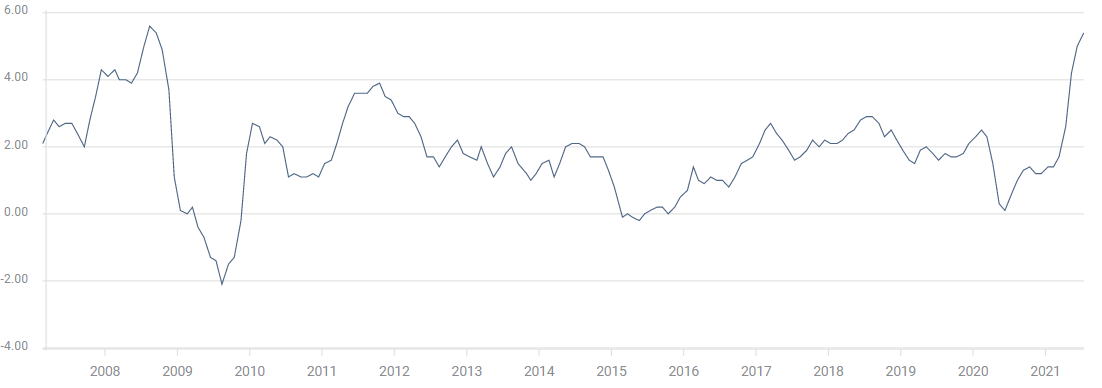
Core inflation, which excludes food and energy costs, jumped 4.5% in the largest annual gain since 1991. Economists had predicted a 4% gain, up from 3.8% in May. Core prices also climbed 0.9% on the month, more than twice the 0.4% forecast after a 0.7% increase in May.
This year’s inflation is already far above the Fed 2% target for the Core Personal Consumption Expenditure Price Index (PCE) that will be reported for June on July 30.
Overall CPI has averaged 3.4% for the six months through June and core is 2.6%.
Inflation factors
Inflation’s extraordinary jump this year is due to several factors.
First in line is the base effect translation from last year’s lockdown driven collapse in consumption. As the economic closures took effect in March, April and May, the annual CPI rate crashed from 2.3% in February to 1.5% in March, 0.3% in April , 0.1% in May and 0.6% in June. Monthly price gains over the past year have brought the base index back to a normal range, hence the exaggerated annual gains.
Second are the production problems stemming from the lockdowns and other measures over the past 18 months. Production and supply chain bottlenecks, combined with labor shortages and high demand have created long-lasting manufacturing delays and price increases.
A worldwide shortage of computer chips, the ubiquitous component of so many manufactured goods, forced several automobile companies to temporarily suspend production.
Inflation composition
Inflation was spread across a range of goods and services.
Used car prices rose 10.5% in June after a 7.3% gain in May and 10% in August, and were about one-third of the total CPI increase. Over the last 12 months used car precise are up a stunning 45.2%. In contrast, new vehicle prices rose 2% in June, which may seem tame but is the largest monthly increase in 40 years.
Food and energy prices rose 0.8% and 1.5% respectively in June. Food prices are up 2.4% on the year in June.
Gasoline alone rose 2.5% last month and has skyrocketed 45.1% in a year. The cost for housing, rental and purchase, climbed 0.5% in June and is 2.6% higher on the year.
Market response
Markets have taken their cues from the Federal Reserve’s insistence that the current spike in inflation, now four months old, can be blamed on the twin engines of base effect and product and labor shortages.
Long-term Treasury yields have dropped sharply over the past two months, giving up more than half of their gains for the year.
The CPI report partially reversed that momentum with the 10-year gaining 5 basis points to 1.417% in late New York trading and the 2-year adding 2 points to 0.255%.
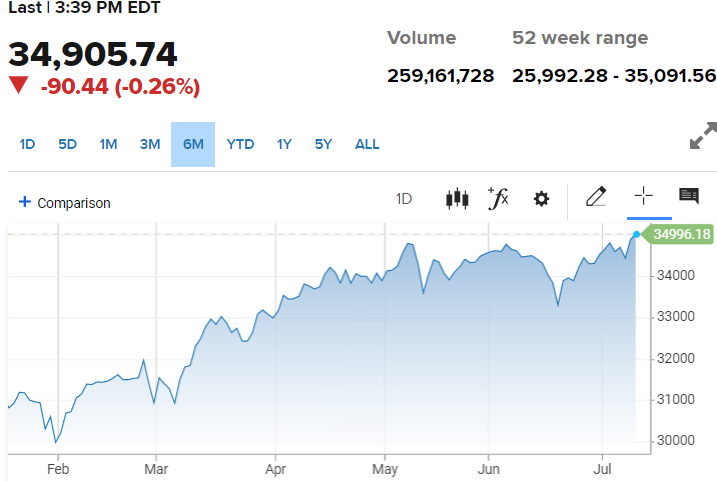
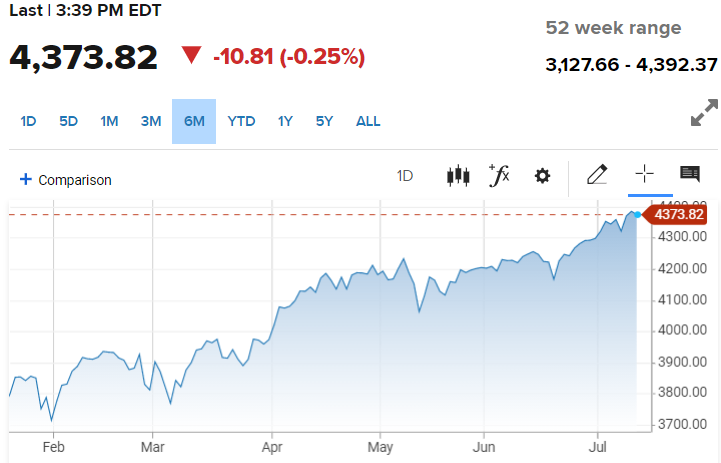
Equities were lower with the Dow losing 90.44 points in afternoon action to 34,905.74 and the S&P 500 sheding 10.81 to 4,373.82, after setting a new 52 week high earlier in the day.
CNBC
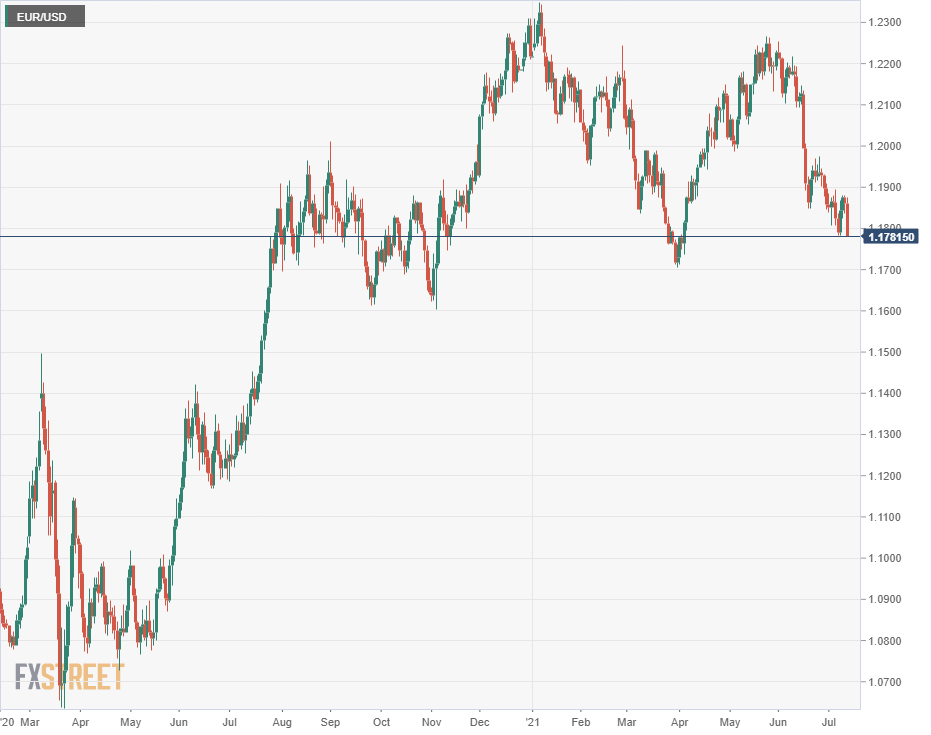
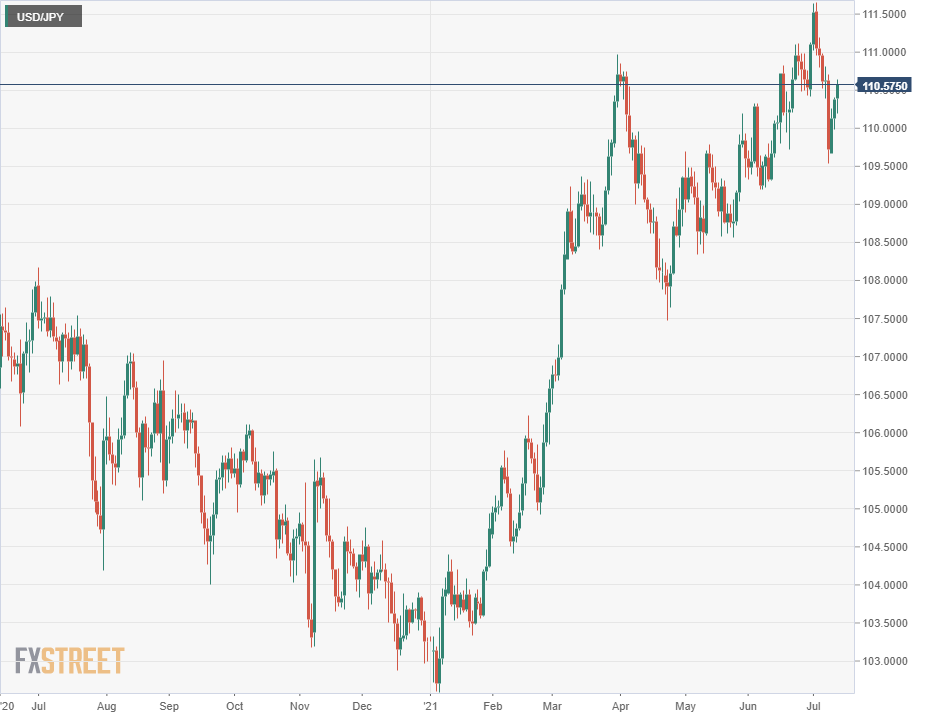
The dollar rose in all major pairs. The EUR/USD fell to 1.1781, its lowest since April 5 and the USD/JPY climbed to 110.57.
Conclusion
The Fed’s conviction that this inflation is a transitory phenomenon will be tested when Chair Jerome Powell appears in Congress this week in his Semiannual Monetary Report to Congress. He will testify in the House on Wednesday and the Senate on Thursday.
Politicians know that inflation is a sure loser with their constituents. Mr. Powell's visits are likely to be far more contentious sessions than anyone expected.
Premium
You have reached your limit of 3 free articles for this month.
Start your subscription and get access to all our original articles.
Author
Joseph Trevisani
FXStreet
Joseph Trevisani began his thirty-year career in the financial markets at Credit Suisse in New York and Singapore where he worked for 12 years as an interbank currency trader and trading desk manager.