US Fourth Quarter GDP Preview: What hath retail sales wrought?
-
US economic growth expected to cool in fourth quarter
-
Delayed reporting on retail sales may have affected GDP calculation
-
GDP forecast to be over 3% for 2018

The Bureau of Economic Analysis a division of the Commerce Department will issue its first estimate for annualized gross domestic product in the fourth quarter at 8:30 am EST, 13:30 GMT on Thursday February 28th. The release was originally scheduled for January 30th but was delayed by the partial government shutdown that ended on January 25th.
Forecast
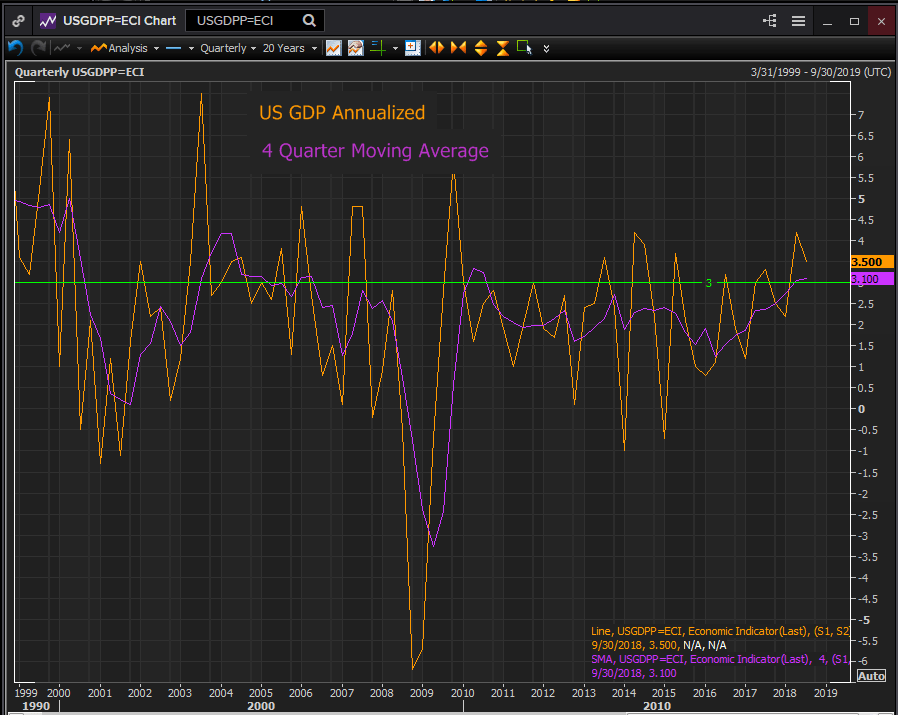
American economic growth is predicted to fall to 2.3% in the fourth quarter from 3.4% in the third. If accurate this 3.025% annual expansion would be the first 3% average annualized expansion since 2004.
Economic growth, reporting and the government shutdown
The month long partial government shutdown in late December and January may have had an uncertain effect on the US economic activity but it had a decided effect on the reporting of that growth. The most important impact seems to have been on the retail sales numbers from the US Census Bureau a division of the Commerce Department.
Before the initial delayed issuance of the retail number on February 14th most estimates were for a continuation of the healthy expansion rates from November. Overall sales were expected to rise 0.2% in December following the prior gain of 0.1%. Sales excluding autos were predicted to rise 0.1% after November’s flat result. The control group, the BEA’s GDP consumption category, sales excluding building materials, motor vehicles and parts, gasoline station receipts and food service, was expected to increase 0.4% after Novembers 1.0% gain.
There were good precedents for this relatively optimistic reading of the December holiday shopping season.
Amazon the world’s largest internet retailer had reported record sales proceeds for the season. The weekly Redbook Index which tracks stores representing 80% of the Commerce Department’s retail sales report recorded a 6% rise each week in same store sales in December. The 9.3% annual gain in the last week of the month was the largest on record. MasterCard noted a 5.1% increase in card purchases over 2017.
Upon release the Commerce Department noted that "data collection and processing were delayed." without detailing how this might have affected the retail sales numbers.
In the event the released figures were far below expectation and in seeming contradiction to the figures from private sources.
Headline sales were -1.2%, 0.2% forecast, and prior 0.1%. Sales ex-autos came in at -1.8%, forecast 0.1%, prior flat. Control group -1.7%, forecast 0.4%, prior 1.0%.
The disparity between the private accounts of the Christmas season and the BEA figure was noted by many analysts. Amazon’s report of records sales does not jibe with the government statistics that non-store sales fell nearly 3.9% in the month.
An example of the impact of the BEA figures is the evolution of the Atlanta Fed’s GDPNow estimate. On February 13th, the day before the retails sales report, the running estimate for fourth quarter growth was 2.6%. After the release it dropped to 1.5% and it is currently 1.8%.
Business and Consumer Confidence
Business and consumer confidence also indicated a robust holiday season, with teh Institute for Supply Management's (ISM) indexes hitting multi-year highs in the second half of 2018.
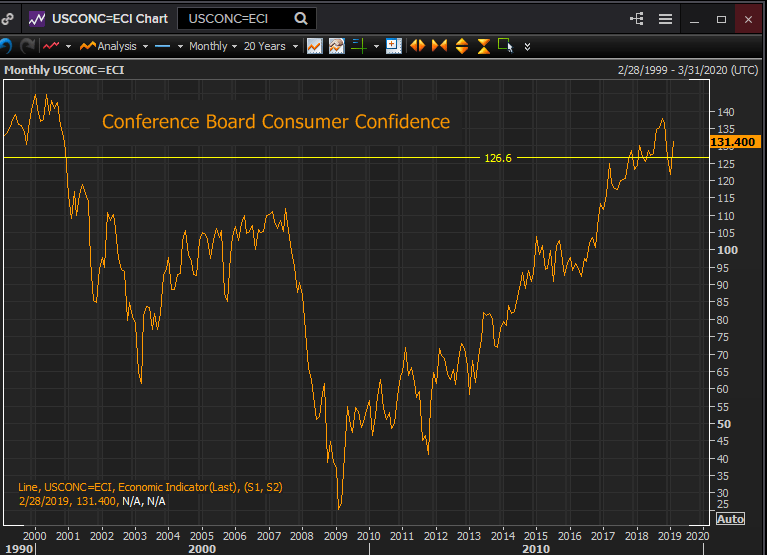
The Conference Board’s consumer sentiment index was at an 18 year high in October of 137.9. Though it fell to 136.54 in November and then126.6 in December that still left it above every score for the 17 years prior to February 2018.
Reuters
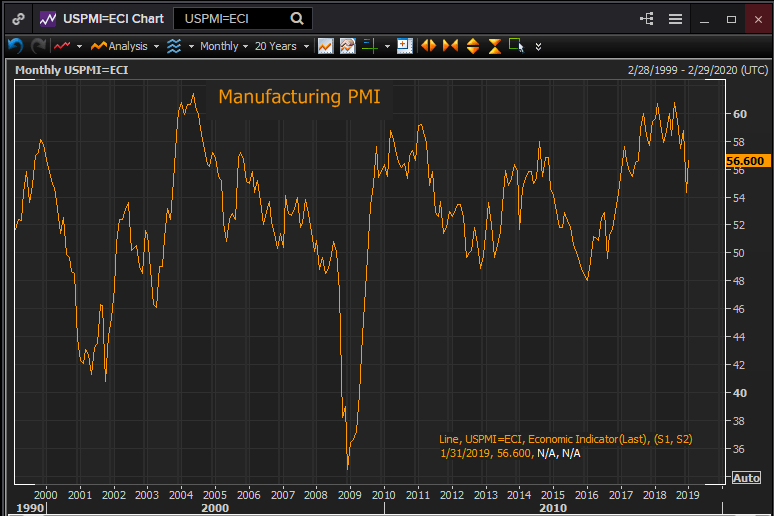
The purchasing manager’s indexes (PMI) from the Institute for Supply Management showed the same pattern. The manufacturing index hit 60.8 in August, then 57.5 in October, 58.8 in November and 54.3 in December, perhaps influenced by the government shutdown at the end of the month. It rebounded to 56.6 in January.
Reuters
The manufacturing sector has had an exceptionally good two years, with the best employment creation in a generation and a strong order book. The fourth quarter average of 56.8 is not normally associated with growth below 2% as in the Atlanta Fed prediction.
The services PMI exhibited similar characteristics. The fourth quarter average of 59.5 followed September’s 13 year high of 60.8 is, like the manufacturing index, well above the 50 division between expansion and contractions. It is not a level associated with sub-2% economic growth.
Conclusion
The fourth quarter GDP number should be considered preliminary until all of the data that feeds into the calculation is complete and fully revised.
Reuters
Author

Joseph Trevisani
FXStreet
Joseph Trevisani began his thirty-year career in the financial markets at Credit Suisse in New York and Singapore where he worked for 12 years as an interbank currency trader and trading desk manager.
















