US Durable Goods Preview: Where the consumer leads
- Durable goods orders expected to recover from February's sharp declines
- Business capital spending to return after three months flat
- Strong retail sales in March hold promise for improvement

The US Census Bureau will release its March report on manufacturers new orders for durable goods at 8:30 am EDT, 12:30 pm GMT on Thursday April 25th.
Forecast
Durable goods orders are expected to rise 0.8% in March having fallen 1.6% in February. Orders excluding the transportation sector are predicted to gain 0.2% after February’s revised 0.1% decline. Orders outside of the defense procurement sector are forecast to rise 0.1% in March following the prior month’s 1.9% drop. Nondefense capital goods orders ex aircraft and parts, a common proxy for business investment spending, are projected to gain 0.1% after February’s 0.1% slide.
Durable Goods and Retail Sales
Durable goods are a subset of the overall retail sales category whose items are intended to last three years or more in use. Covering products as diverse as commercial airplanes and trucks to cellphones, bicycles and cutlery they are often purchased less frequently and give a picture of longer range household consumption and business investment.
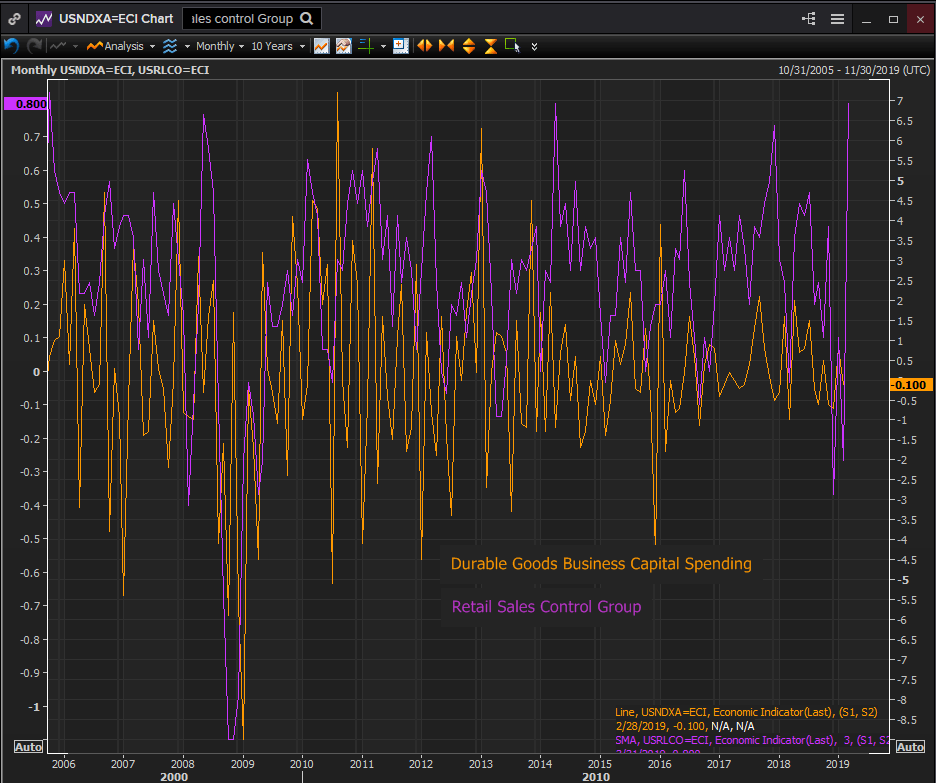
Retail sales have had a volatile four months. The -1.6% result in December far below the 0.2% forecast was ascribed to the reporting difficulties created by the partial closure of the federal government for most of January. Of the next three month the spreads between the consensus estimate and the final number were 0.8% in January (0.8% vs 0.0%), 0.5% in February (-0.2% vs 0.3%) and 0.7% in March (1.6% vs 0.9%).
The sales control group, the consumption category for GDP calculation had a similar period. December’s spread was 2.6% (-2.2% vs 0.4%), January’s 1.1% (1.7% vs 0.6%), February 0.7% (-0.3% vs 0.4%) and March 0.6% (1.0% vs 0.4%).
Durable goods have seen considerably less disparity between the consensus predictions and actual numbers as might be expected for products that have less potential for impulse buying by consumers. In December it was 0.3% (1.2% vs 1.5%), January 0.9% (0.4% vs -0.5%) and February 0.2% (-1.6% vs -1.8%).
The business capital goods proxy category, nondefense capital goods excluding aircraft, was the same. December had a 0.9% spread (-0.7% vs 0.2%0, January 0.7% (0.8% vs 0.1%) and February 0.1% (-0.1% vs 0.0%).
Leaving out December retail sales had an average discrepancy of 0.67% in January, February and March between the final statistic and the consensus market forecast. The control group’s average was 0.8%.
For durable goods the disparity was 0.55% in January and February and for capital goods it was 0.4%.
The consumer volatility of the past four months has settled down to an excellent return performance in March. The unease stemming from the government shutdown and the focus it brought on the unending partisan warfare in Washington has abated and the American consumer seems to have gone back to their lives and ignoring the machinations in the capital.
Conclusion
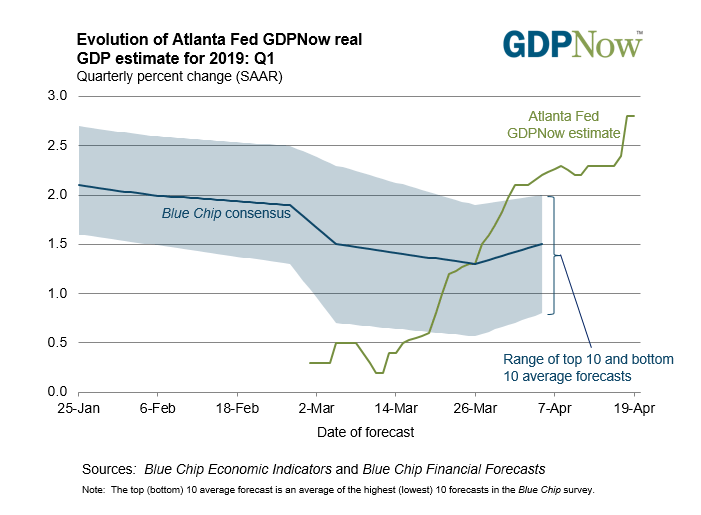
Several factors point to a better than expected durable goods result in March. The economy has performed well in the first quarter. Despite low initial estimates for GDP, beginning in early March at less than 0.5% annualized, the most recent forecast from the Atlanta Fed GDPNow model is 2.8%. Equities have soared to record or near record highs this month based largely on excellent corporate earnings reports. Retail sales in March were much stronger than predicted, 1.6% vs 0.9% in the overall number and 1.0% s 0.4% in the control group.
If consumers are spending on retail items the likelihood is that extends to durable goods. And if the consumer is spending businesses will as well.
Author

Joseph Trevisani
FXStreet
Joseph Trevisani began his thirty-year career in the financial markets at Credit Suisse in New York and Singapore where he worked for 12 years as an interbank currency trader and trading desk manager.
















