US Durable Goods Orders January Preview: As China turns
- Business investment projected to be positive after unexpected drop in December.
- US-China trade deal possibly trumped by virus.
- Economy may have accelerated in first quarter.

The US Census Bureau will issue January’s Manufacturers New Orders for Durable Goods on Thursday February 27th at 13:30 GMT, 8:30 EST.
Forecast
Durable goods orders are expected to drop 1.5% in January after rising 2.4% in December. Ex-transport orders are predicted to rise 0.2% following December’s 0.1% decline. Orders ex-defense will gain 1.3% after the 2.4% loss in December. Non-defense capital goods orders ex-aircraft and parts is forecast to be 0.1% higher after December’s revised 0.8% decrease.
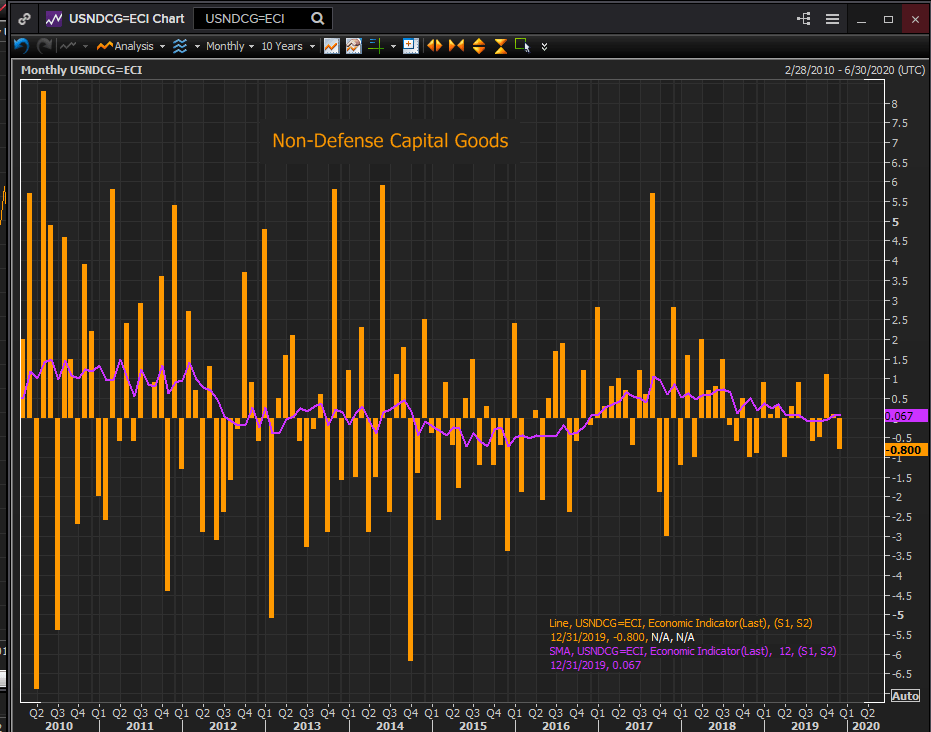
Non-defense capital goods ex-aircraft
Business investment was the missing ingredient in GDP last year as spending declined from 0.358% in the 12-monthy moving average in January to 0.067% at mind-year, became negative for four months, (July -0.058%, August -0.092%, September -0.083%, October -0.033%) before recovering slightly to 0.058% and 0.067% in November and December.
Reuters
The uncertain nature of the US-China trade negotiations for much of last year accounted for the increasing reluctance of executive to commit to long-term spending. Even though market conviction never wavered that a deal would be struck, and the October announcement that an agreement had been reached led to a brief burst in spending that month a general revival was waiting not only for the actual signing , which took place on January 15th but for the economic proof that the deal was working.
Whatever initial gains in Chinese orders to US manufacturers and farmers that took place soon after the treaty have been subsumed in the health crisis on the mainland and the unknown amount of economic damaged caused by the corona virus.
Economic growth in the US
By most measures the US economy warrants the praise frequent praise of its central bankers. The labor market has provided excess work, rising wages, the lowest overall unemployment rate in half a century and record employment for African-Americans and Hispanics. Consumer confidence in the Michigan and Conference Board Surveys is at levels rarely seen in the history of both measures.
Retails sales and personal spending reflect the buoyancy of the job market and as business spending waned last year, the consumer was the chief engine of economic growth.
The US expanded at an average 2.3% in 2019 and the Atlanta Fed’s GDPNow estimate for the first quarter was 2.6% as of February 19th. The second estimate for fourth quarter GDP due at the same time on Thursday as durable goods is expected to be unchanged at 2.1%.
Conclusion and the dollar
The Federal Reserve’s three precautionary rate cuts last year served their purpose and the threatened slowdown in the US never occurred. It may have been that the concern was more theoretical than real, US statistics never faltered, or that the rate reductions provided a shot of economic confidence, the issue will not be settled.
China’s health crisis is a concern of another order. Though we do not know the extent of the slowdown in the Chinese economy, the official manufacturing PMI for February will be reported on Friday the 28th with a fall to 45 from 50 predicted and the private assessment from Caixin on March 1st, we do know that great hopes for a revival in American manufacturing was laid to the completed treaty.
That delivery will have to wait until the more immediate and pressing crisis is successfully managed.
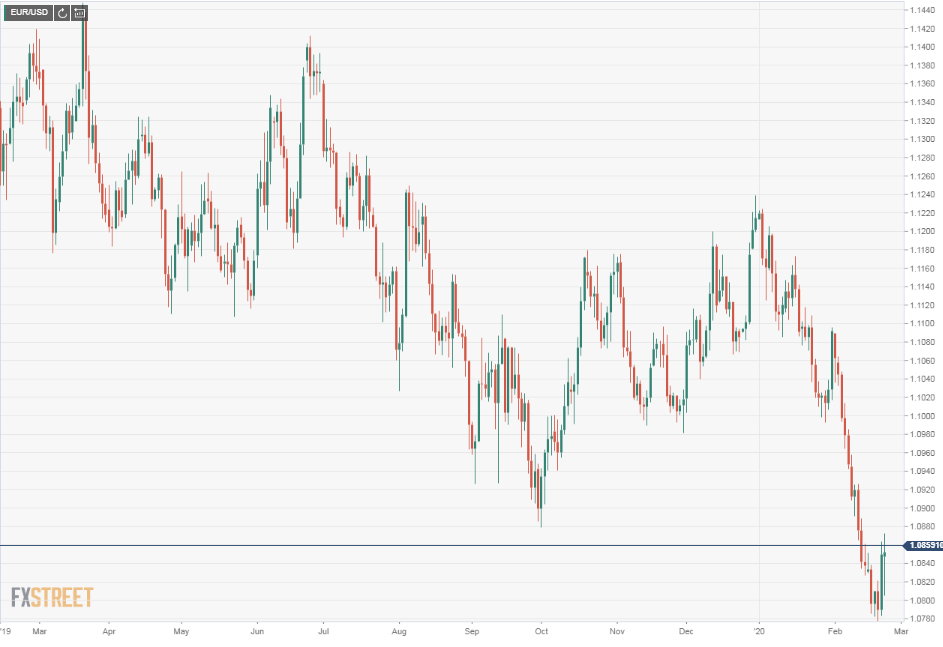
The dollar has seen a steady rise the last two weeks as the investors sought safety outside of Asia, the yen’s traditional role as a safe-haven largely unused because of its proximity and susceptibility to the problem.
One of the Fed’s chief concerns last summer was the trade conflict with China. Whether the current problems will elicit a similar response from the central bank cannot be known until the Chinese impact is clear. But what it certain is that any fillip for the US economy and its factories and farmers will have to wait for China to solve her own crisis first.
Author

Joseph Trevisani
FXStreet
Joseph Trevisani began his thirty-year career in the financial markets at Credit Suisse in New York and Singapore where he worked for 12 years as an interbank currency trader and trading desk manager.
















