US Dollar Weekly Forecast: US labour market will be at centre of debate
- The US Dollar Index falls to more than three-year lows this week.
- The post-ceasefire optimism weighs heavily on the Greenback.
- The Fed’s next rate cut is expected at the September 17 meeting.


This week, the US Dollar (USD) faced heightened selling pressure, briefly falling to the 97.00 contention zone for the first time since March 2022 as reported by the US Dollar Index (DXY).
The monthly chart illustrates a significant (down) trend, showing the index is about to end its fifth consecutive month highlighted in red, indicating a decline exceeding 12% from the year-to-date peaks north of the 110.00 barrier recorded in mid-January.
Recently, geopolitics took over the global market's sentiment following the Trump-brokered ceasefire between Israel and Iran, which has so far halted more than ten days of air attacks between those countries, and the late intervention of the US.
The news sparked a meaningful retracement in the Greenback across the board, sponsoring at the same time the move to fresh highs in most of its rival currencies, while US yields maintained a steady decline to multi-week lows.
Focus now shifts to trade deadline
President Donald Trump declared the US-China agreement "done" following the recent discussions in London. This announcement came after a series of debates between officials from Washington and Beijing, who successfully established a framework aimed at renewing their trade ceasefire. He stated that Beijing has pledged to provide magnets and rare earth materials as part of the agreement.
Furthermore, the White House has confirmed that the newly reached agreement permits the United States to implement a 55% tax on goods imported from China. The proposal details a 10% "reciprocal" tax, alongside a 20% tax aimed at fentanyl trafficking and a 25% tax imposed on current trade barriers. China has announced its intention to implement a 10% tax on imports originating from the United States.
Across the Atlantic, European Commission (EC) President Ursula von der Leyen highlighted the complexity of trade negotiations with the United States. She reiterated her aim to reach a final agreement by the July 9 deadline in light of President Trump's comments labelling the EU as "unfair".
During a press briefing at the G7 summit in Canada, she informed reporters that discussions continue to be complex, yet progress is being made, a development she deemed positive. She stated that she was making significant efforts to build momentum, suggesting that the negotiations were in a complex state and the outcome remained to be seen.
Let’s recall that a failure to reach a deal between the US and the EU will result in a 50% tariff duty on all imports from the EU.
In examining the wider economic landscape, it is crucial to note that even lower tariffs may result in negative long-term consequences for the economy.
Despite the potential for initial price increases to lessen, persistent trade restrictions are expected to keep costs high in various sectors, limit consumer spending, and hinder overall economic growth. The Federal Reserve (Fed) may be forced to reconsider its current 'wait-and-see' strategy if those threats materialise.
Amid persistent disputes, evidence suggests that the White House is leaning toward a preference for a weaker currency. What measures can we expect from the Trump administration to tackle the record-high trade deficit in a timely manner? A strategy aimed at the 'repatriation' of industries is in progress; however, attaining a positive outcome will necessitate considerable time and substantial financial investment.
Between the Fed’s independence and rate cuts
The Federal Open Market Committee (FOMC) maintained its policy rate during the June 17-18 meeting, aligning with expectations. However, the real focus shifted to the new guidance provided: the statement, the press conference, and particularly the updated dot plot drew significant attention.
The communications, when considered collectively, appeared somewhat less aggressive than what markets had anticipated, as officials continued to indicate a potential easing of approximately 50 basis points by the end of the year. The Committee is navigating a landscape marked by a subdued growth forecast and an elevated Unemployment Rate, juxtaposed with a marginally stronger inflation outlook.
Fed Chair Jerome Powell's subsequent press conference failed to clarify expectations regarding two potential interest rate cuts. He adopted a notably patient tone and emphasised that the Fed expects tariff-related price pressure to emerge in the coming months.
During his semiannual testimony earlier this week, Powell cautioned Congress that increased import tariffs could lead to higher inflation this summer — a critical period for assessing the suitability of rate cuts. Powell warned that President Trump's tariffs might result in rising goods inflation, emphasising the Fed's necessity to navigate a precarious balance amid ongoing trade tensions and broader geopolitical uncertainties.
The persistent decline in US inflation, despite the Consumer Price Index (CPI) and the Producer Price Index (PPI) meeting a minor stumbling block after the headline Personal Consumption Expenditures (PCE) matched consensus in May and rose above estimates when tracked by the core print, combined with a cooling domestic labour market, appears to support the view that lower interest rates are on the way, even in light of Powell's cautious approach.
Is Powell’s prudent bias losing followers?
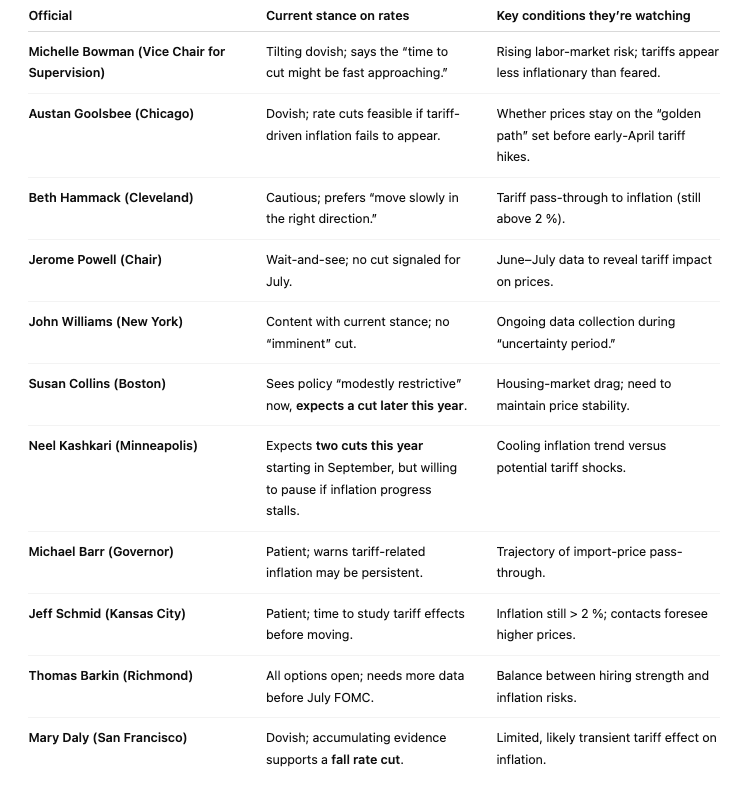
Overall picture
- Dovish bloc (Bowman, Goolsbee, Collins, Kashkari, Daly) sees cooling inflation and limited tariff pass-through as grounds for rate cuts starting in the fall, some advocating as many as two moves.
- Cautious/neutral bloc (Hammack, Powell, Williams, Barr, Schmid, Barkin) stresses data dependence: they want proof that tariffs either will not lift inflation or that any boost is transitory before easing.
- Consensus: A July cut is unlikely; September or later remains the earliest realistic window, contingent on whether summer inflation prints confirm or refute tariff-driven price pressure.
What’s in store for the US Dollar?
Next week, investors will focus primarily on the US labour market, with the releases of JOLTS Job Openings, the ADP report, the usual weekly Initial Jobless Claims, and the crucial Nonfarm Payrolls. In addition, the ISM will be in the spotlight with its key gauges from the Manufacturing and Services sectors.
What about techs?
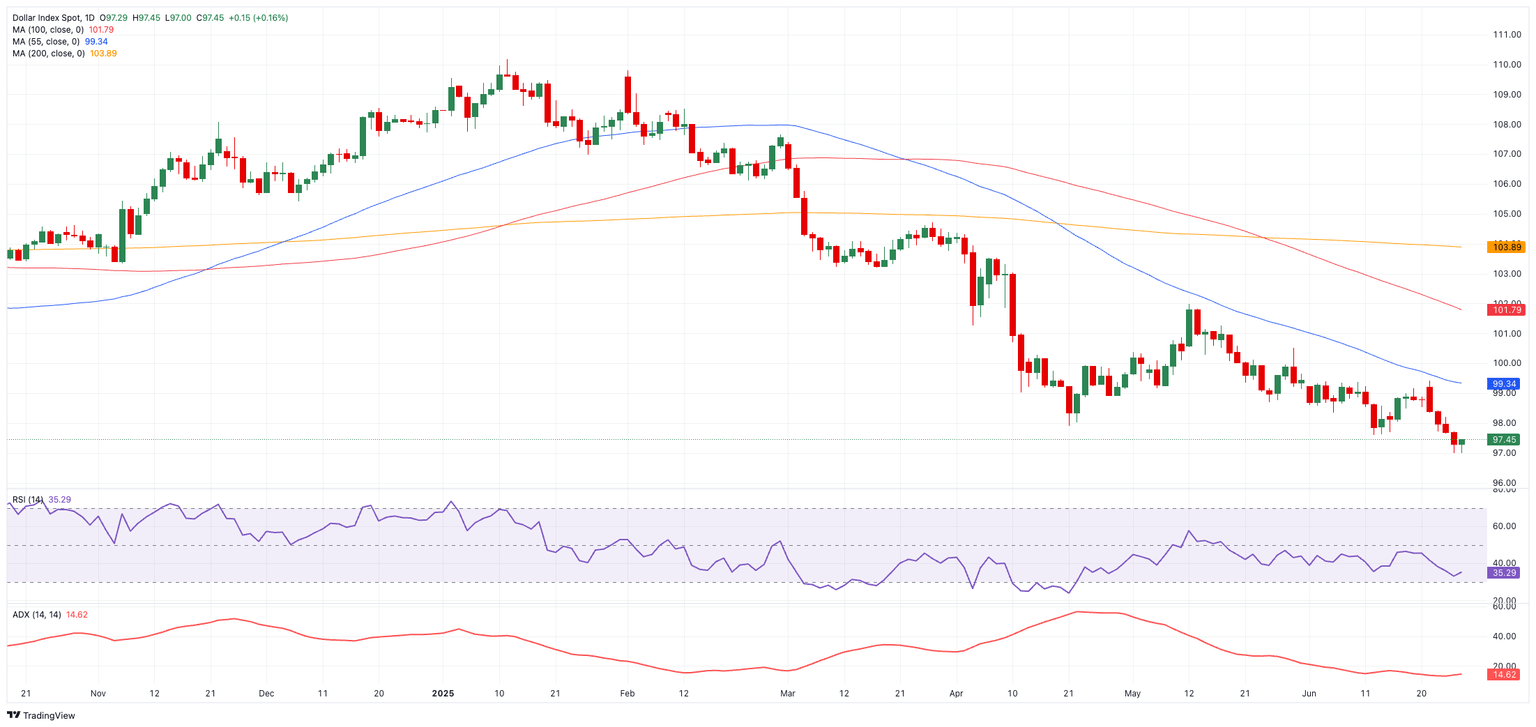
The selling bias on the US Dollar Index (DXY) appears to have carte blanche.
That said, once the multi-year trough at 97.00 (June 27) is cleared, the index could set sail to the February 2022 floor at 95.13 (February 4), which is just above the 2022 base of 94.62 (January 14).
On the upside, initial resistance emerges at the June ceiling of 99.42 (June 23), an area underpinned by the provisional 55-day SMA. North from here sits the weekly peak of 100.54 (May 29), which precedes the May high of 101.97 (May 12), in turn underpinned by the interim 100-day SMA.
Of note: the index remains poised to extend its downward path as long as it navigates below the 200-day and 200-week Simple Moving Averages (SMAs), currently at 103.81 and 102.97, respectively.
In addition, momentum indicators remain tilted toward a bearish bias: The Relative Strength Index (RSI) has deflated to the 32 area and flirts with the overbought zone, while the Average Directional Index (ADX) around 15 shows a lacklustre trend strength.
Nonfarm Payrolls FAQs
Nonfarm Payrolls (NFP) are part of the US Bureau of Labor Statistics monthly jobs report. The Nonfarm Payrolls component specifically measures the change in the number of people employed in the US during the previous month, excluding the farming industry.
The Nonfarm Payrolls figure can influence the decisions of the Federal Reserve by providing a measure of how successfully the Fed is meeting its mandate of fostering full employment and 2% inflation. A relatively high NFP figure means more people are in employment, earning more money and therefore probably spending more. A relatively low Nonfarm Payrolls’ result, on the either hand, could mean people are struggling to find work. The Fed will typically raise interest rates to combat high inflation triggered by low unemployment, and lower them to stimulate a stagnant labor market.
Nonfarm Payrolls generally have a positive correlation with the US Dollar. This means when payrolls’ figures come out higher-than-expected the USD tends to rally and vice versa when they are lower. NFPs influence the US Dollar by virtue of their impact on inflation, monetary policy expectations and interest rates. A higher NFP usually means the Federal Reserve will be more tight in its monetary policy, supporting the USD.
Nonfarm Payrolls are generally negatively-correlated with the price of Gold. This means a higher-than-expected payrolls’ figure will have a depressing effect on the Gold price and vice versa. Higher NFP generally has a positive effect on the value of the USD, and like most major commodities Gold is priced in US Dollars. If the USD gains in value, therefore, it requires less Dollars to buy an ounce of Gold. Also, higher interest rates (typically helped higher NFPs) also lessen the attractiveness of Gold as an investment compared to staying in cash, where the money will at least earn interest.
Nonfarm Payrolls is only one component within a bigger jobs report and it can be overshadowed by the other components. At times, when NFP come out higher-than-forecast, but the Average Weekly Earnings is lower than expected, the market has ignored the potentially inflationary effect of the headline result and interpreted the fall in earnings as deflationary. The Participation Rate and the Average Weekly Hours components can also influence the market reaction, but only in seldom events like the “Great Resignation” or the Global Financial Crisis.
Premium
You have reached your limit of 3 free articles for this month.
Start your subscription and get access to all our original articles.
Author
Pablo Piovano
FXStreet
Born and bred in Argentina, Pablo has been carrying on with his passion for FX markets and trading since his first college years.

















