US Consumer Confidence Preview: Expectations turn critical after Fed’s announcement
- CB Consumer Confidence is expected to have eased in September to 105.5 from 106.1.
- Market players show concerns after central banks pledged for “higher for longer.”
- US Dollar trading at its highest since February 2022 and en route to extending gains.

The United States (US) CB Consumer Confidence is expected to have extended its decline in September after trimming June and July gains in August. The index, which reflects prevailing business conditions and aims to predict what will happen in the upcoming months, is foreseen at 105.5 in September.
Back in August, the Present Situation sub-index fell to 144.8 from 153.0 previously, while the Expectations Index declined to 80.2 after printing 88.0 in July. On a positive note, the index held above 80, suggesting the risk of a recession decreased. Nevertheless, the official report noted that “although consumer fears of an impending recession continued to recede, we still anticipate one is likely before year-end.”
The US Federal Reserve (Fed) announced its decision on monetary policy last week. Chair Jerome Powell was a bit more optimistic about the economic future. He said that a soft landing is no longer a baseline scenario but a “plausible outcome,” adding that it is what policymakers have been trying to achieve for all this time. Finally, he noted that “ultimately, this may be decided by factors that are outside our control at the end of the day, but I do think it's possible.”
Still, Fed officials seem more confident inflation will keep easing without a sharp rise in unemployment levels and without a steep recession. Growth has been upwardly revised for 2024 to 1.4%, from 1.1% foreseen in June, while the unemployment rate is now seen topping 4.1%, down from the 4.5% for 2024 expected in the previous meeting.
Investors will be looking for clues about consumer confidence levels and pay attention to the Expectations Index as if the latter remains above 80, a worse-than-anticipated headline reading will have a lesser impact on financial markets. Furthermore, the US will release the August Personal Consumption Expenditures (PCE) Price Index next Friday, the Fed’s favorite inflation reading, and speculative interest will likely await the figures for a steeper directional compromise.
USD possible scenarios
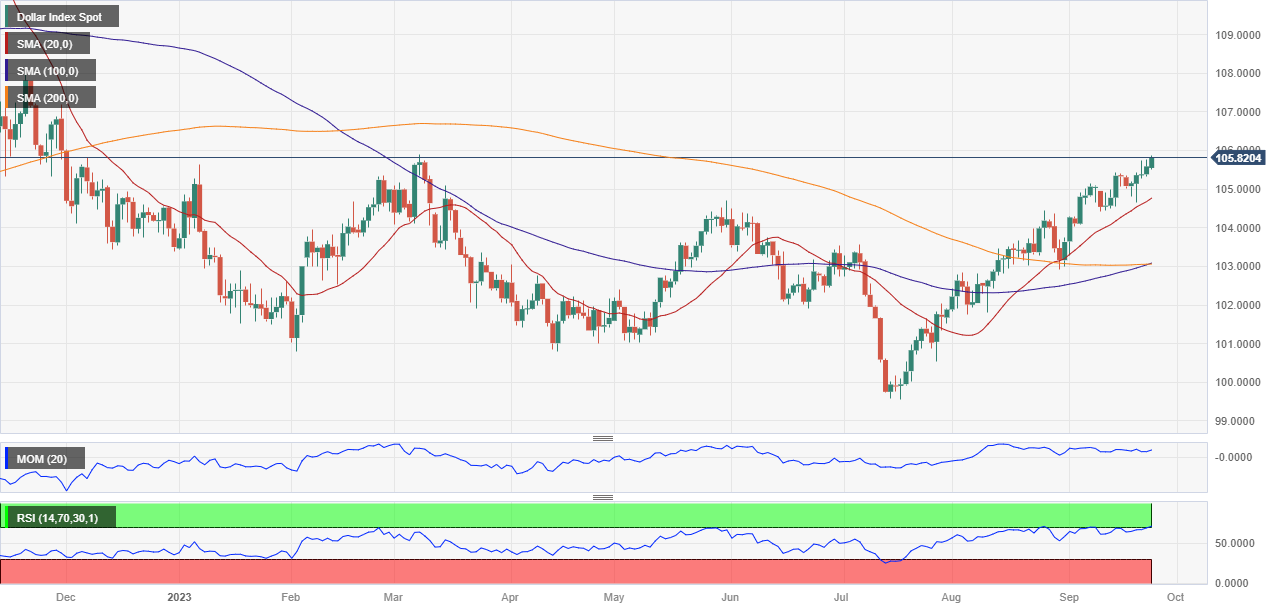
The US Dollar trades near fresh multi-month highs against most of its major rivals, reflecting the cautious mood alongside the US economic resilience. The US Dollar Index (DXY) trades in the 105.70 region, levels not seen since February 2022. The DXY has been rallying pretty straight ever since posting a multi-year low of 99.56 in mid-July.
From a technical point of view, the chances skew to the upside. The daily chart shows that a bullish 20 Simple Moving Average (SMA) leads the way north, providing dynamic support since mid-August and currently advancing well above the longer ones, which also offer bullish slopes.
Technical indicators, in the meantime, rotated north within positive levels, with the Relative Strength Index (RSI) indicator approaching overbought readings but without any sign of bullish exhaustion.
Author

Valeria Bednarik
FXStreet
Valeria Bednarik was born and lives in Buenos Aires, Argentina. Her passion for math and numbers pushed her into studying economics in her younger years.