|

US ADP September Preview: Payrolls rise, correlation and interest falls

  • Private payrolls expected to rise 648,000 in September.
  • August at 428,000 less than half the 950,000 forecast.
  • Correlation with Non-farm Payrolls has declined sharply post-COVID-19.
  • Market impact has declined with disconnect from NFP.

Private payrolls from Automatic Data Processing are forecast to rise by 648,000 in September after adding 428,000 in August.

Correlation declines

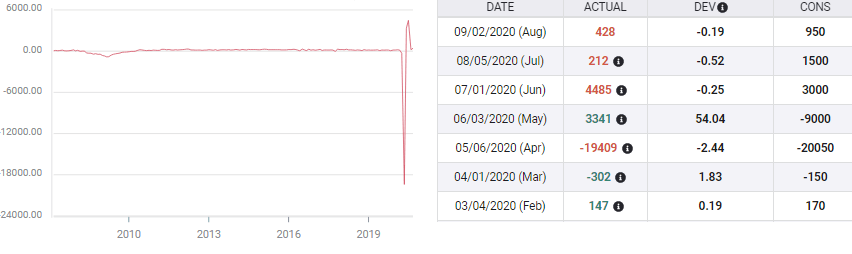
The correlation of the ADP employment change figures with Non-farm Payrolls, which is its chief market value, has fallen sharply in the five months since the recovery began in May.

ADP payrolls
FXStreet

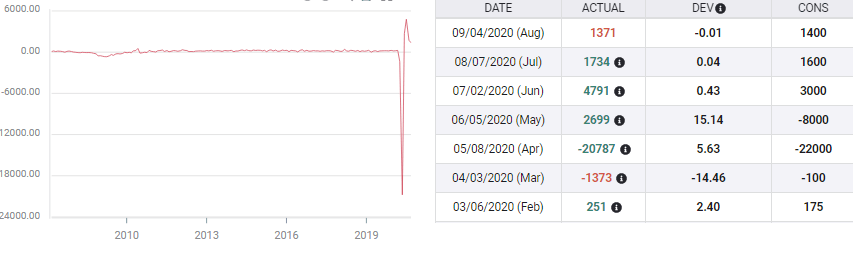
Forecasts for both ADP and NFP missed the labor market turn in May.  Following the huge job losses in April predictions were for those to continue, ADP was expected to shed 9 million more workers and NFP 8 million.   In fact NFP gained 2.699 million employees that month while the initial ADP number showed a loss of 2.76 million positions.   It did not help ADP accuracy that the revision to the May number added 6.101 million bringing it to 3.341 million.

Similar discrepancies occurred in June, ADP initial result 2.369 million, NFP 4.971 million, ADP revision 4.485 million, and July ADP first release 167,000, NFP 1.734 million, ADP second release 212,000.

In August ADP was 428,000 and NFP was 1.371 million. The revision for August’s ADP will be issued with the September statistic.

Conclusion

The September estimates of 648,000 for ADP and 850,000 for NFP may represent a return of the historical relationship between these two US employment numbers. But even if these number end in agreement for September it will require more than one month or several until the markets trust ADP on Wednesday to front for NFP on Friday.

NFP 
FXStreet

Author

Joseph Trevisani

Joseph Trevisani began his thirty-year career in the financial markets at Credit Suisse in New York and Singapore where he worked for 12 years as an interbank currency trader and trading desk manager.


More from Joseph Trevisani
Share:

Editor's Picks

GBP/USD flirts with weekly highs in the Fed's aftermath

GBP/USD reversed early losses following the Federal Reserve decision to keep rates on hold and neared the 1.3360 level before shedding some ground. Focus shifts to Governor Kevin Warsh's speech, while the Bank of England will announce its monetary policy decision on Thursday.

EUR/USD extends rally pass 1.1450 on Fed's Warsh

EUR/USD trades at fresh weekly highs above 1.1450, following the Federal Reserve monetary policy decision to keep interest rates on hold. The statement showed policymakers remain confident in economic progress while blaming inflation on energy prices. The divided vote among officials put in doubt a September hike, leading to sharp US Dollar losses.

Gold faces rejection at $4,100 amid emergence of USD dip-buying

Gold retreats after facing rejection at $4,100 in the Asian session on Thursday as the US Dollar attracts some dip-buyers following the previous day's post-FOMC slide to a one-week low. Escalating US-Iran tensions support oil prices, fueling inflation fears and reviving the Greenback's haven demand at the expense of the bullion.

WTI falls below $83.00 despite hostilities in the Middle East

West Texas Intermediate, the US crude oil benchmark, is trading around $82.80 during the early Asian trading hours on Thursday. WTI falls amid some profit-taking despite escalating conflicts in the Middle East. Traders book some profits following the US Federal Reserve interest rate decision.

Fed review: Reversing course (?)
At face value, the FOMC's 9-3 split decision hold was exactly in line with the expectations we laid out in our Fed preview - a divided hold, 22 July. We also named the three dissenters - Hammack, Logan and Kashkari - as the most likely hawks to support rapid tightening.
US Dollar mid-year outlook: Exceptional currency, exceptional risks?
The US Dollar enters the second half of 2026 in a markedly different position from a year ago. The King currency has recovered, reflecting persistent US inflation, changing expectations for Fed policy, geopolitical tensions and renewed demand for defensive assets.