|

UK bond market sell off rattles market and knocks the pound

The pound is the worst performing currency in the G10 FX space on Wednesday, as the rout in the Gilt market continues. UK Gilts are surging at the US open, and 10-year UK sovereign yields are at their highest level since 2008. They are higher by 11 bps today. This compares with a 1bp increase in Treasury yields and a 6bp increase in French government bond yields.

The UK is looking like an outlier and is in the sights of the bond vigilantes. It feels like the UK is in a tricky spot, and with UK CPI set to be released next week, the focus on the UK bond market could continue for some time.

But is the sell off fair?

The UK currently has a lower budget deficit than the US and France at 4.7% of GDP, vs. 6.24% deficit for the US, and a 5.5% deficit for France. However, the deficit is set to rise this year and the government is set to issue more debt in 2025 vs, 2025. With growth expected to moderate, this will weigh on the deficit. Thus, other countries have their fiscal issues, but the UK is potentially on the cusp of another fiscal crisis, without either 1, intervention from the BOE or 2, government action to either raise Tax or cut spending. Neither of these are attractive options when the economy is stagnating.

Pound could be under pressure as long as bond yields continue to rise

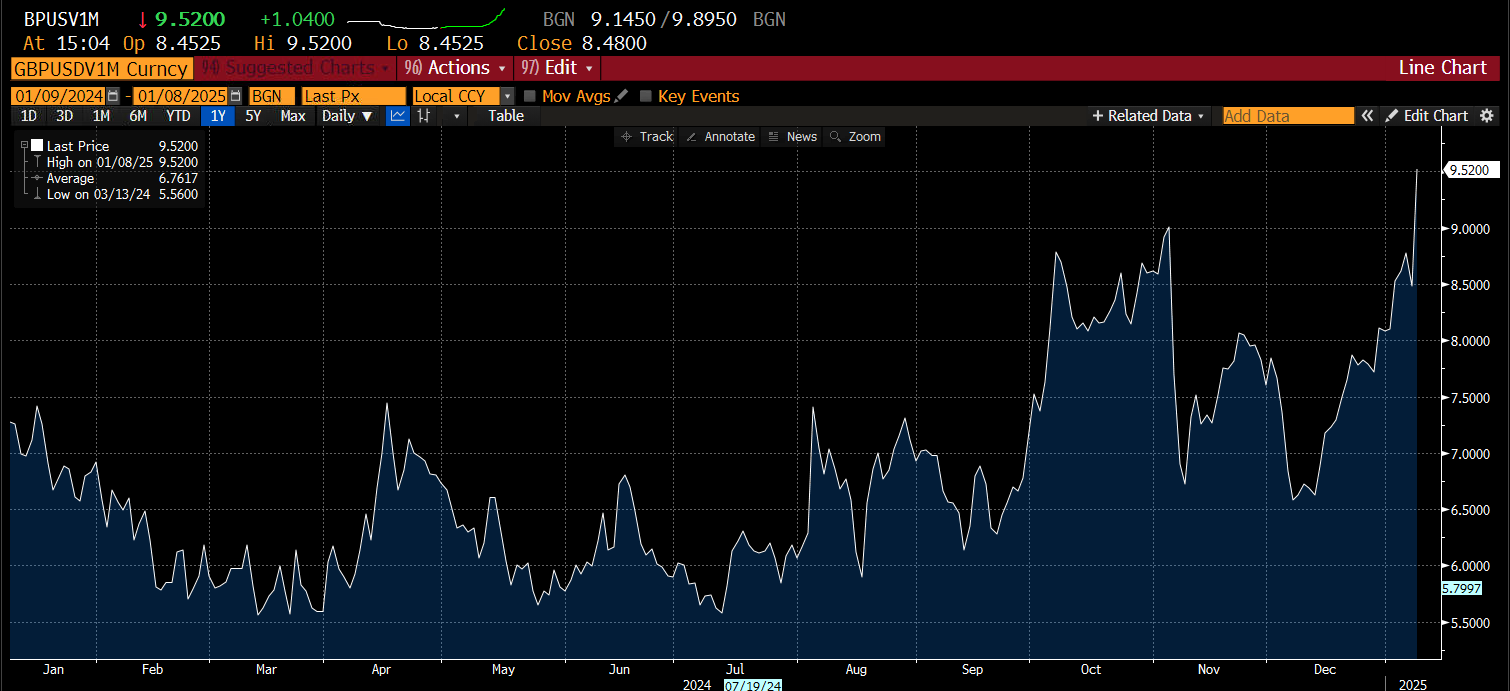
Fiscal issues are weighing on the pound. GBP/USD is the weakest performer in the G10 today. Signs of fiscal de-anchoring occur when yields rise, but a currency falls, thus events on Wednesday do not bode well for the pound in the medium term. GBP/USD volatility has also spiked to its highest level since 2023 at 9.4%, this is still well below the levels reached in 2022, in the aftermath of the Truss Budget. To compare, 1-month EUR/USD volatility is 8.9%. Thus, it could be a bumpy ride for the pound in the coming weeks, and a break below $1.20 in GBP/USD is possible.

GBP/USD one month at the money volatility, 12 month chart
Chart

 Source: XTB and Bloomberg 

Author

Kathleen Brooks

Kathleen has nearly 15 years’ experience working with some of the leading retail trading and investment companies in the City of London.


More from Kathleen Brooks
Share:

Editor's Picks

GBP/USD drops to 1.3200 region as UK PM Starmer resigns

GBP/USD has come under renewed selling pressure in the European session on Monday, falling back to the 1.3200 region. UK PM Keir Starmer announced that he will resign and noted that nominations for new contender will open on July 9.

EUR/USD turns south toward 1.1400 amid concerns over Iran deal progress

EUR/USD turns south toward 1.1400 in the European trading hours on Monday. Concerns about progress for the US-Iran peace deal and expectations of higher US interest rates keep the US Dollar supported against the Euro. ECB President Lagarde is set to speak later on Monday.  

Gold lacks bullish conviction near $4,200 as Fed hike bets and Iran risks underpin USD

Gold maintains its bid tone near the $4,200 mark through the first half of the European session, and seems to have snapped a three-day losing streak, to a more than one-week low set the previous day. Crude Oil prices turn lower after mediators – Qatar and Pakistan – announced a formal 60-day roadmap aimed at securing a final US-Iran peace deal.

Breaking: Iran closes the Strait of Hormuz amid ceasefire deal violation
Iran says it is closing the Strait of Hormuz after accusing the United States (US) and Israel of violating the ceasefire. According to Iran, the decision came over the continued Israeli strikes in Lebanon. The Iranian Revolutionary Guard Corps Navy issued a warning to all vessels: "Do not approach the Strait of Hormuz; otherwise, your security will be jeopardized."
Canada CPI Preview: Inflation expected to tick higher in May, pressuring BoC outlook

The publication of Canada’s May Consumer Price Index figures on Monday will be the focus of attention. Indeed, Statistics Canada data will provide markets with an update on price pressures following its June 10 meeting, where policymakers kept the interest rate steady at 2.25%, matching the broad consensus.

Regime change: Inside Kevin Warsh's first move to make the Fed unreadable on purpose

The rate did not move. That was the least interesting thing about Kevin Warsh's first meeting in charge of the Fed. The FOMC held its benchmark at 3.50%-3.75% for the fourth straight meeting, exactly as priced, and then the new chair used his first press conference to dismantle the machinery the market has leaned on for a decade.