|

Two-year US yields with bearish Elliott Wave pattern

If you’ve been following our free analysis or monthly webinars, then you know we’ve been bearish on the US dollar for quite some time. And based on current price action, that bearish trend may not be over just yet.

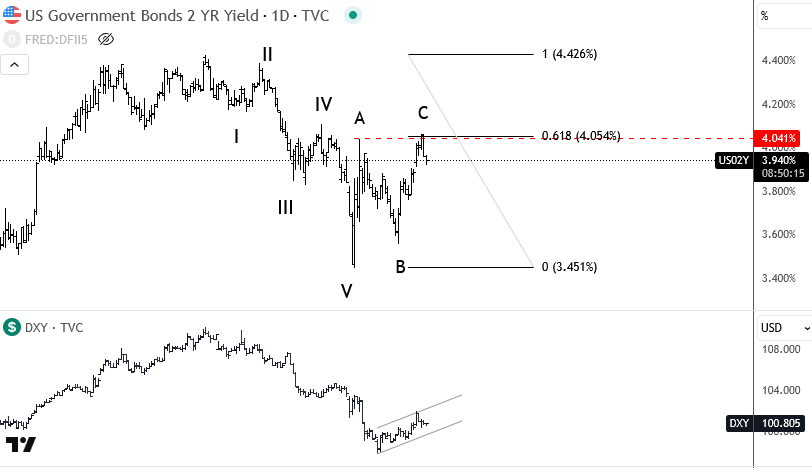
The recent rebound from the April lows looks like just a temporary consolidation before further weakness resumes. One key reason for this view lies in the US bond market—specifically the 2-year yield, which is showing a very clean Elliott Wave pattern. We’ve seen five waves down, followed by an A-B-C corrective rally that already retested the important 61.8% Fibonacci resistance.
yieldsVSdxy

This suggests a possible turn to the downside is near, especially after this week’s softer-than-expected US CPI data, which came in at 2.3% versus 2.4% expected. If inflation continues on this path, the Fed may be more inclined to cut interest rates sooner rather than later.

The completed A-B-C rally on the 2-year yield chart suggests more downside ahead in yields—and when that kicks in, it will most likely send the US dollar out of its current bear flag pattern.


Get Full Access To Our Premium Elliott Wave Analysis For 14 Days. Click here.


Get Full Access To Our Premium Elliott Wave Analysis For 14 Days. Click here.

Author

Gregor Horvat

Gregor Horvat

Wavetraders

Experience Grega is based in Slovenia and has been in the Forex market since 2003.

More from Gregor Horvat
Share:

Editor's Picks

EUR/USD consolidates above 1.1800 as trades await Eurozone CPI and US data

The EUR/USD pair struggles to capitalize on the previous day's modest bounce from the 1.1780-1.1775 area, or over a one-week low, and oscillates in a narrow band during the Asian session on Wednesday. Spot prices currently trade around the 1.1815 zone, nearly unchanged for the day, as traders keenly await the release of the flash Eurozone consumer inflation figures.

GBP/USD consolidates ahead of Bank of England rate decision

The Pound Sterling traded in a narrow range against the US Dollar on Tuesday, edging modestly higher to near 1.3700 as markets adopted a cautious stance ahead of the Bank of England's first policy decision of 2026. GBP/USD opened the session at 1.3665 and touched an intraday high near 1.3707, with the pair consolidating below the multi-year high of 1.3869 posted in late January.

Gold extends recovery toward $5,050 as US-Iran tensions boost haven demand

Gold price builds on the previous recovery toward $5,050 in the Asian session on Wednesday. The precious metal extends the rebound after a historic and volatile sell-off last week. Traders weigh the next round of US economic signals amid a resurgent demand for safe-haven assets and renewed US-Iran geopolitical tensions.

Why is the crypto market crashing?

Bitcoin and the broader crypto market are experiencing a heavy downturn on Tuesday amid negative sentiment following the latest tech earnings. The top crypto briefly declined more than 5% over the past 24 hours, sliding below $73,500 before quickly recovering above $75,000 at the time of publication. Over the past two weeks, Bitcoin has lost more than 23%, eroding about $401 billion in market capitalization.

Gold and silver recovery continues, but equities sink as tech is shunned

The risk recovery is on pause as we move through Tuesday. After signs that a recovery in precious metals could boost overall risk appetite earlier today, a nasty sell off in tech stocks has pushed the Nasdaq and the S&P 500 down by 1.7% and 1.1% respectively.

Ripple slides as low retail, institutional demand weigh

Ripple edges lower, trading marginally below $1.60 at the time of writing on Tuesday as bulls and bears battle for control. The cross-border remittance token rose to $1.66 on Monday, but profit-taking and risk-off sentiment in the broader crypto market led to the ongoing correction.















