Too little, too late: Response to the slowdown impairs trust and confidence in governments

Outlook: We are seeing limit up/limit down halts to futures trading and circuit breakers in equities. The belated, inadequate and lopsided response to the economic slowdown by every major government has seriously impaired trust and confidence in government in general, and not just in the US. The WSJ points out “In fact, the SP 500 has swung 4% or more in either direction for the last seven consecutive sessions, topping the previous record of six days from November 1929.”
If regulators could get their act together, you can bet they are working on a new regime to halt trading in just about every asset class. It’s just a gleam in the eye and we are not seeing any proposals, but it’s the obvious solution to markets gone haywire. The chief form of disruption is hoarding of cash. Everyone who can borrow is borrowing to the limit, and banks know perfectly well that defaults loom everywhere—big companies, small companies, individuals, other governments. It’s obvious that moral hazard was not caged entirely and loose credit standards are going to hit us over the head again.
One important source of anxiety is foreign banks funding all kinds of things in dollars. Remember those Hungarian mortgages back in 2009? A shortage of dollars and a relatively expensive swap line of foreign central banks with the Fed are a real risk to weird and unconsidered corners of the world economy.
Today former Fed chiefs Yellen and Bernanke have an op-ed in the FT—is that a first?—calling on the Powell Fed to reinstate all the old programs from 2008-09, and also to add in corporate bonds to the buying program.
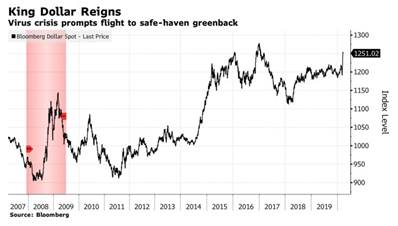
As for the dollar, it’s the safe haven again, despite a less than competent government response to a crisis and often in coherent and dishonest leadership. We admit to being a little surprised that sterling is faring so badly—below 1.2000 overnight for the first time since the Brexit fallout in the summer of 2016. This is fueled in part by a less than capable-seeming response to the pandemic by the Boris team. The new crisis also puts the trade talks with the EU on the back burner and implies that a deal will not get done by June in time for all the countries to approve by year-end. That means a no-deal hard exit and heaven only knows how various issues will get resolved, like the Irish border, not to mention those pesky fishing rights. The UK economy is back to looking very vulnerable to a heavy recession, heavier than in Europe.
The hardest hit are the emerging markets, as we suspected last week. Bloomberg reports “Outflows from emerging markets are already at record levels, reaching $30 billion in 45 days amid the virus outbreak, according to the Institute of International Finance. All major emerging-market currencies tracked by Bloomberg have weakened against the dollar since Jan. 20 -- the onset of Covid-19 concerns in Asia -- with the Russian ruble and Mexican peso dropping almost 20%.” See the chart.
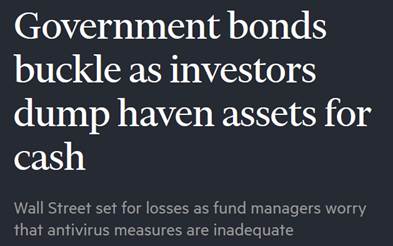
But it’s not just the EMs. See the front page headline from the online FT.
Tidbit: Trump claimed in a press conference on Tuesday he always called it pandemic, forgetting that only two weeks ago he said it was nothing much and would be down to zero in a few days. This so enraged the NYT it has to print a rebuttal, within hours, and on the front page:
Jan. 22, asked on CNBC whether he was concerned about a global pandemic: “No, not at all,’’ Mr. Trump said. “We have it totally under control. It’s one person coming in from China, and we have it under control. It’s going to be just fine.”
Feb. 26, at a White House news conference, about the number of reported cases of the virus: “We’re going down, not up. We’re going very substantially down, not up.”
Feb. 27, at a White House meeting: “It’s going to disappear. One day — it’s like a miracle — it will disappear.”
March 7, seated next to President Jair Bolsonaro of Brazil at Mar-a-Lago, his Palm Beach, Fla., club: “I’m not concerned at all.” (At least three members of the Brazilian delegation and one Trump donor at Mar-a-Lago on March 7 later tested positive for the virus.)
March 16, in the White House briefing room, warning that the outbreak would last until summer and then suddenly disappear: “So it could be right in that period of time where it, I say, wash — it washes through. Other people don’t like that term. But where it washes through.”
US Politics: Joe Biden won the three state primaries last night, as expected, and now has a delegate count that Bernie cannot surmount—exactly what happened with Clinton in 2016. Biden has already moved on to the full presidential race, leaving Bernie behind. It remains to be seen how much he adopts of Bernie’s ideas, which is what it will take for Bernie to drop out and put his shoulder behind Biden. Biden will not have a hard time competing with Trump in looking like a calm and competent leader. Trump is clearly running off the rails. “Where it washes through” is Trumpian incoherence.
This is an excerpt from “The Rockefeller Morning Briefing,” which is far larger (about 10 pages). The Briefing has been published every day for over 25 years and represents experienced analysis and insight. The report offers deep background and is not intended to guide FX trading. Rockefeller produces other reports (in spot and futures) for trading purposes.
To get a two-week trial of the full reports plus traders advice for only $3.95. Click here!
This is an excerpt from “The Rockefeller Morning Briefing,” which is far larger (about 10 pages). The Briefing has been published every day for over 25 years and represents experienced analysis and insight. The report offers deep background and is not intended to guide FX trading. Rockefeller produces other reports (in spot and futures) for trading purposes.
To get a two-week trial of the full reports plus traders advice for only $3.95. Click here!
Author

Barbara Rockefeller
Rockefeller Treasury Services, Inc.
Experience Before founding Rockefeller Treasury, Barbara worked at Citibank and other banks as a risk manager, new product developer (Cititrend), FX trader, advisor and loan officer. Miss Rockefeller is engaged to perform FX-relat

















