Today the news includes revisions to third quarter GDP

Outlook:
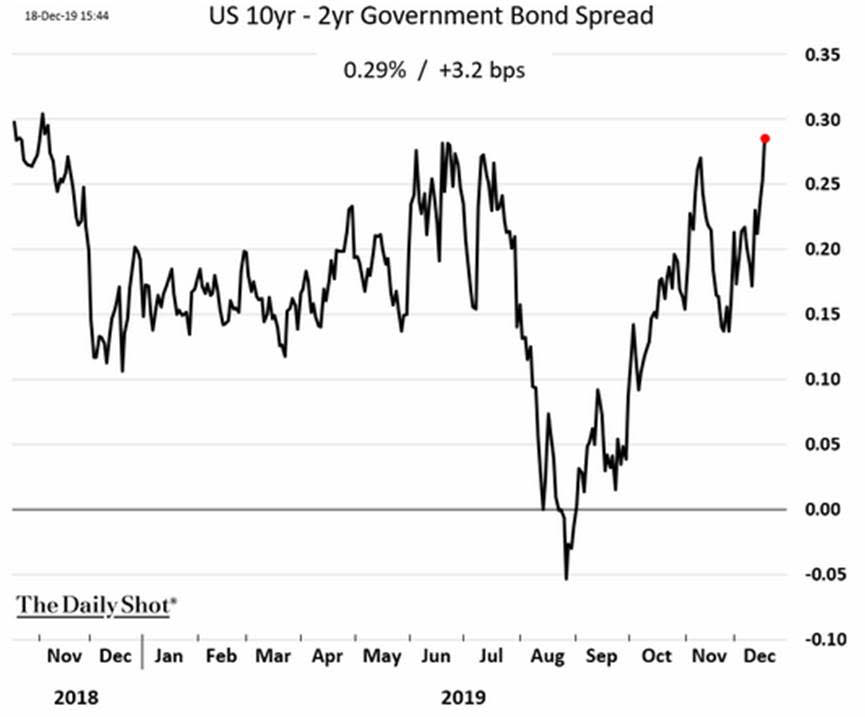
If the dollar is not on a downward slide—and the votes are not all in—the chart below is a partial reason for a recovery. Granted, the yield curve inversion was exaggerated in the first place, so a return to a more normal curve was only to be expected. And growth might be slowing or at least tepid.
But the widening of the differential is a sign of stabilization and steadier expectations. Academics blather about what the yield curve means. A lot of it is BS and some of it is guys showing off their expensive vocabulary, but at bottom, the yield curve reflects the rate of return that savers/investors demand, given the inflation outlook, over a series of holding periods.
If inflation is on the order of 2% and the 10-year is yielding 2%, there is no real return. When the 10-year is yielding less than 2%, the return is negative. There’s no point in saving or investing in Treasuries except as a vault to hold the money. It’s better only in the sense that it’s easier to get your hands on than uncovering the hole in your backyard. Golly, no wonder the stock market is up so much.
Today the news includes revisions to third quarter GDP, but of more importance is the personal income and consumption data, and the PCE deflator. Income is forecast up 0.3% and consumption, by 0.4%. This means savings will have gone down and debt will have gone up. The PCE deflator is expected a tad higher at 1.4% but the core to have slipped down to 1.5% (Bloomberg). As before, we have yet to see the price effect of tariffs on consumer goods. Bottom line—inflation and inflation expectations remain tame.
This may mean that additional gains in the longer-end yields will have to rely on more stabilization rather than inflation expectations. With only one country—Sweden—backing away from negativity, we probably have a long way to go to get any real return worth having. The Fed declares itself happy with no interest rate changes at all in the upcoming year. The UK is probably cutting. Japan is probably going for some additional fiscal stimulus and Lagarde may surprise with the same thing, if a tiny amount, in the eurozone. Next week we will start to get everyone’s year-ahead forecasts. What can they say except “nothing is happening”?
But stay tuned for the next outrageous act from the White House that has the potential to return risk appetite/risk aversion to the top of concerns, and support the safe-haven dollar. It looks like the dollar falling out of favor was a premature idea.
Politics: It is yet to be determined, but it looks like the Senate is going to hold the impeachment trial without evidence and without witnesses, or try to. This makes it a sham, the very word the Republicans are using to describe the House investigation and the passing of the articles of impeachment in the first place.
This may change once the Senators go home for two weeks and listen to their constituents. The latest poll (ABC) shows 85% of Dems support having witnesses and written evidence, and 64% of Republicans do. 64% is well over half, almost two-thirds. Can they ignore popular opinion? In the Nixon case, popular opinion was decisive and drove top Senators to the White House to get his resignation. It’s not clear we have the same character and backbone in this case.
What can the judge do about any of this? We get a partial answer from the WSJ, which says the chief justice is very aware that he must handle things just right in order for the public to perceive the Supreme Court as non-political and as legitimate. The WSJ neglects to mention that after the Bush-Gore presidential decision and the Citizens United decision (companies can donate to candidates like citizens), it has a tough row to hoe.
In the impeachment trial, the Senate gets to decide the extent of the judge’s authority and can override his decisions with a 51% vote. Eeek. Chief Justice Roberts…. “will hold less power over the proceedings than a municipal court judge hearing a pickpocketing case. The trial’s rules will be written by the jury—the Senate—whose Republican leadership has already pronounced the defendant not guilty.” The override capability is like “letting seven of 12 jurors reverse a trial judge on any given motion in an ordinary case.”
One impeachment legal expert says Roberts is likely to “sit up there and be a figurehead, every now and again maybe having to make some rulings on the scope of various arguments. He won’t want to get the institutional integrity of his own branch of government all tangled up with this highly partisan exercise.”
The trial is going to come ahead of the case in which the Court has to decide whether the black letter law giving the House the right to see anyone’s tax returns is valid. That’s scheduled for March. Then in June the Court will hear a DACA case in which the executive (Obama) gave illegal immigrants a reprieve if they were brought to the US as children. These two cases are kind of funny. First is the separation of powers and the concept of checks and balances that permeates the Constitution. Presumably the chief justice would not like to see the executive strip the court like he is stripping Congress. But Obama’s assertion of executive privilege in the DACA situation is the same executive privilege Trump asserts practically every day.
It might be worth noting that the Supreme Court (led by a Nixon appointee) ruled that the president couldn’t use privilege to hide evidence of a crime—the Watergate tapes. Nixon had to turn them over to the special prosecutor and within two weeks, resigned. Another claim of privilege was denied in the Clinton v. Jones case, albeit not part of the impeachment process. And the Trump claim of privilege is the tax records case was already decided at the appellate level as not applicable because the taxes were incurred and paid when Trump was a citizen, not the president.
Still, those who believe in the Constitution are about to get screwed by one of its faults—vagueness on exactly how to manage a fair impeachment. The good news is that the American public is not as dense as some politicians think it is. Already over 70% in a poll say the trial should have witnesses, and the appropriate ones, too. We all watch TV. Most of us have seen “Law and Order” more times than we will admit. We know what a good trial looks like—think Atticus Finch—and what a bad one looks like, too (“Mississippi Burning”). If the trial is sham, the public will punish the guys who ran it that way. The 2020 election is getting more interesting, not for the top spot but for the composition of the Senate. Is it possible we will throw the bums out?
A happy note comes in the form of the top evangelical newspaper, Christianity Today, coming out for impeachment and removal. Trump doesn’t have a religious bone in his body but for various reasons—Irsael, judgeship appointments, especially against abortion—evangelicals have supported him. Now they are retreating. The editorial says “The president of the United States attempted to use his political power to coerce a foreign leader to harass and discredit one of the president’s political opponents. That is not only a violation of the Constitution; more importantly, it is profoundly immoral.”
Earlier, the paper had called for removal of Clinton for “unsavory dealings and immoral acts.” It now sees the same words applicable to Trump. “To indulge in sexual immorality is to make oneself and one’s desires an idol. That Trump has been, his whole adult life, an idolater of this sort, and a singularly unrepentant one, should have been clear to everyone…. Unfortunately, the words that we applied to Mr. Clinton 20 years ago apply almost perfectly to our current president.”
Nobody knows if this about-face will be influential. The newspaper’s circulation is only 130,000.
This is an excerpt from “The Rockefeller Morning Briefing,” which is far larger (about 10 pages). The Briefing has been published every day for over 25 years and represents experienced analysis and insight. The report offers deep background and is not intended to guide FX trading. Rockefeller produces other reports (in spot and futures) for trading purposes.
To get a free trial, please write to [email protected] and you will be added to the mailing list..
This is an excerpt from “The Rockefeller Morning Briefing,” which is far larger (about 10 pages). The Briefing has been published every day for over 25 years and represents experienced analysis and insight. The report offers deep background and is not intended to guide FX trading. Rockefeller produces other reports (in spot and futures) for trading purposes.
To get a two-week trial of the full reports plus traders advice for only $3.95. Click here!
Author

Barbara Rockefeller
Rockefeller Treasury Services, Inc.
Experience Before founding Rockefeller Treasury, Barbara worked at Citibank and other banks as a risk manager, new product developer (Cititrend), FX trader, advisor and loan officer. Miss Rockefeller is engaged to perform FX-relat