Till Debt Do Us Part: How Leveraged Is the Typical Boomer?


The Boomers are more leveraged than previous generations were ahead of retirement. We examine the liabilities side of the balance sheet for this group and explore some of the challenges they may face.
The Borrowing Boomers
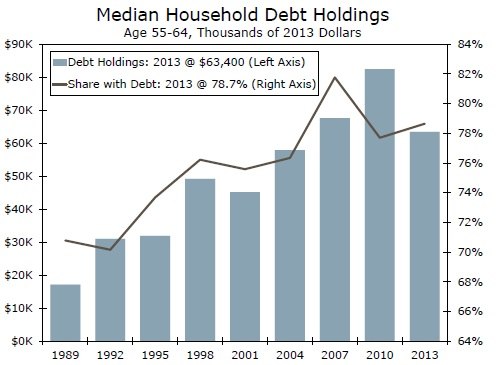
Unsurprisingly, the Baby Boomers have less debt than younger generations who are currently in their prime working years and still climbing the ladder of life. However, the typical Boomer has more debt at this point in their life relative to previous generations. As of 2013, 79 percent of households age 55-64 and 66 percent of those age 65-74 had debt of some kind (top chart). The long-run trend in the top chart signals a rising share of each successive generation approaches the traditional retirement age with debt of some sort. In addition, not only do more Boomers hold debt, the typical value in real dollars has also risen. The Great Recession pushed debt holdings for this age bracket even higher in 2010 than the bubbly 2007 period. Real debt holdings for the typical boomer receded markedly in 2013, although this in part reflects a decline in homeownership.
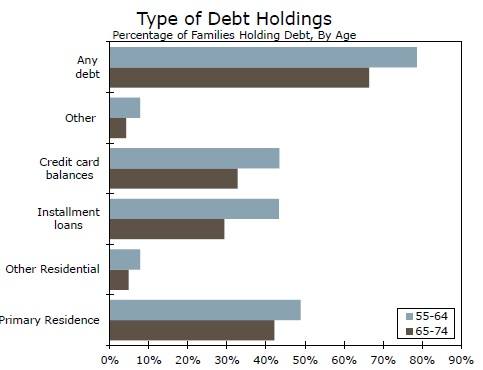
Like the asset side of the balance sheet, housing comprises the bulk of debt for the average Boomer. A bit under half of Boomers hold debt secured by their primary residence (middle chart), with the median value for Boomers age 55-64 amounting to about $100,000. Credit card balances and installment loans (for vehicles for example) are also common, but median balances are a relatively manageable $3,000 and $12,000, respectively. Mean debt holdings are more than double the median, however, suggesting that some Boomers are significantly more leveraged than their peers.
Old School Not So Funny for the Boomers
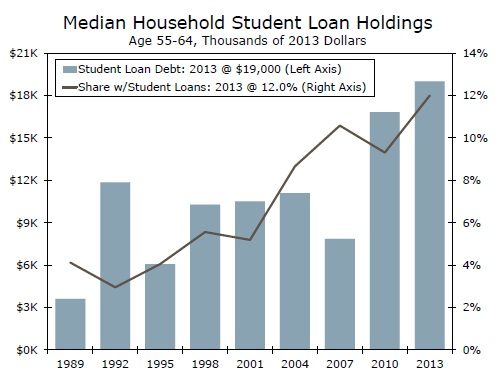
Student loan debt has emerged as a hot button issue for some Boomers. A recent report by the Government Accountability Office (GAO) drew attention to this issue, highlighting the number of people whose Social Security checks are being reduced to pay off delinquent student debt.* The report found that there were 114,000 people age 50 or older in fiscal year 2015 who had their benefits reduced by about $140 a month for unpaid student loans. As the bottom chart illustrates, student loan debt has increased in size and prevalence for older individuals. We caution, however, about overstating the pervasiveness of the problem; according to Survey of Consumer Finances data, only 12 percent of 55-64 year olds have some form of student debt, with older Boomers having an even smaller share. In addition, the 114,000 individuals age 50+ from the GAO study represent less than 0.5 percent of Social Security beneficiaries. This suggests that most Boomers are not grappling with a crushing student loan burden as they enter their golden years. That said, the GAO report found that a sizable share of those who had their Social Security benefits reduced were either pushed below/pushed even further below the poverty line. Further, if the trend of growing educational debt continues, the problem will likely increase in scope over time and create further challenges for Boomers who are already struggling with retirement preparedness.
Author
Wells Fargo Research Team
Wells Fargo