The yen is a problem: Will they or won’t they intervene?

Outlook: The large plate of data yesterday came down to one key figure–retail sales, which is either fairly decent (+0.8% ex-gasoline) or pretty bad (not adjusted for inflation).
The Daily Shot had this very cool chart from Goldman showing why, exactly, it’s housing and pork chops driving inflation and not socks and lawn chairs. It’s not only house prices themselves and rental costs--mortgage rates hit over 6% for the first time since the 2008 crisis, more than double in just one year.
Retail sales (as a measure of personal consumption) was one reason the Atlanta Fed downgraded the Q3 GDP forecast to a mere 0.5% from 1.3% last week and 1.6% a few days before. Capital investment is another reason, offset by a small rise in government spending.
Today we get the Treasury capital flow report (something only three people on the planet can read) and the University of Michigan consumer surveys, watched for inflation expectations. Again we have to complain the survey covers only a few hundred people, which renders it useless, even if the average Joe could forecast inflation in the first place. It’s more a vote of confidence in the Fed.
Going into a weekend is always a bit nerve-wracking when the FX market has been delivering exaggerated moves, like sterling at 1.1350 and again testing the 1985 low. The yen is a problem, too–will they or won’t they intervene? The big central bank meetings next week are the US and the UK. Both are likely to hike by 75 bp and in the US, the next two hikes before year-end could be 50 bp each–but traders are not so sure the BoE will keep up with the Fed now that some of the data spells recession sooner.
Contributing to negative sentiment about sterling is the prospect of railroad workers going to strike on Oct 1-5, the original strike scheduled for Sept 15 having been postponed for the Queen’s funeral. The FT remarks that a strike would disrupt the Tory party conference on the same date, with members arriving at the conference from all over the country and apparently not using cars.
Several analysts note today is the anniversary of the UK’s Black Wednesday, the day in 1992 that the UK removed itself from the European Rate Mechanism, having entered it with unviable ranges against the Deutschemark in the first place. It’s the date that made George Soros even richer, since he had shorted the pound (and been copied by many others). The Bank of England tried intervention and raised rates by astronomical amounts, but to no avail. The phrase “Soros broke the Bank of England” became conventional wisdom, but really the blame lies with the Treasury and the politicians who had set the unrealistic trading bands in the first place.
Several dozen books narrate those events and we read most of them. One thing that sticks in the memory is that Soros travelled around the UK and Europe interviewing finance officials to get a feel for the UK’s commitment to ERM (weak) and whether other ERM members would rise to sterling’s defense (no). Markets can live with artificial and economically bad rate relationships for just so long and then the free market grabs the reins and spurs a runaway. It happens less often nowadays because most currencies are freely traded, but we do have some likely examples still–the yen, the renminbi, and perhaps some EM’s.
There comes a time in the currency markets when enough is enough. We wonder if sterling is not nearing that point. If the BoE does “only” 50 bp next week, then the pound likely has more to fall. If it does the 75 bp expected up until the retail sales release, then that could be a tipping point for the pound to stage a recovery. It’s fairly well oversold. See the monthly chart. Sterling has been falling since Nov 2007 and aside from a minor recovery in 2014, endless depreciation has been its fate. Notice it was falling even before Brexit in 2016. But every time the pound makes a big new low, it rebounds.
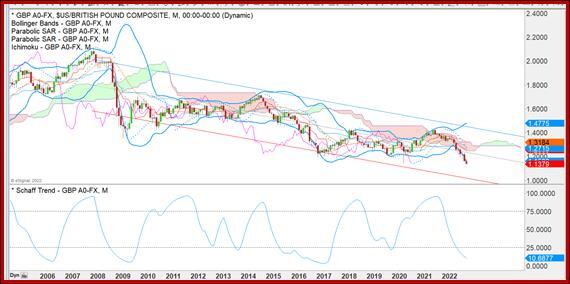
At a guess, now is one of those rare times when Brexit favors sterling, if only because the government can make decisions while the European Commission waffles and kicks cans. The new Truss government has a cold-hearted but clear-headed stance toward the energy crisis, which makes it more effective than the Europeans. Beware going short sterling and going home.
Tidbit: The Chinese currency fell below 7 to the dollar yesterday for the first time since July 2020 and before that, August 2019 when Trump named China a currency manipulator. The WSJ reports that last evening, the offshore yuan was quoted at 7.0072 and the onshore market had 6.99. The yuan has devalued about 9% year-to-date from the combination of an aggressive Fed plus domestic economic woes, especially the collapse of the property sector, aggravated by quarantines and factory shut-downs due to the zero Covid policy.
Tidbit 2: Russia will let you out of prison if you join the army. Ukrainians, in recovering territory about the size of Delaware, speak of Russian soldiers fleeing as fast as they can run and leaving equipment and ammunition behind.
There are a few whispers about Ukraine winning the war. Even The Economist magazine has a story on how the West should help Putin “fail faster” by supplying even more weapons. Weapons are a big part of the Ukrainian success story, along with better intelligence, better leadership, better training, better motivation/incentive and more guts. Here is part of The Economist article:
“Victory for Ukraine is not yet certain, but a path is discernible. Evicting Russia entirely from Ukraine will be hard. It will mean pushing it out of territory where it is far better dug in and organised than in Kharkiv. A general collapse of the Russian forces cannot be ruled out, but is improbable.
“The West should, therefore, reinforce success. Ukraine has shown that it can use Western weapons to regain territory; the West should send better ones, such as longer-range atacms munitions for the himars launchers that have proved so effective, which it previously hesitated to supply.” Add ammunition and training, too, please. Just in time, the US announced a new $600 billion military arms package for Ukraine.
This is an excerpt from “The Rockefeller Morning Briefing,” which is far larger (about 10 pages). The Briefing has been published every day for over 25 years and represents experienced analysis and insight. The report offers deep background and is not intended to guide FX trading. Rockefeller produces other reports (in spot and futures) for trading purposes.
To get a two-week trial of the full reports plus traders advice for only $3.95. Click here!
This is an excerpt from “The Rockefeller Morning Briefing,” which is far larger (about 10 pages). The Briefing has been published every day for over 25 years and represents experienced analysis and insight. The report offers deep background and is not intended to guide FX trading. Rockefeller produces other reports (in spot and futures) for trading purposes.
To get a two-week trial of the full reports plus traders advice for only $3.95. Click here!
Author
Barbara Rockefeller
Rockefeller Treasury Services, Inc.
Experience Before founding Rockefeller Treasury, Barbara worked at Citibank and other banks as a risk manager, new product developer (Cititrend), FX trader, advisor and loan officer. Miss Rockefeller is engaged to perform FX-relat

















