The skinny on Bidenomics

_XtraSmall.jpg)
Paul Krugman recently wrote an Op-ed in the NY Times, “Biden Versus the Bad News Bros,” in which he confronted skepticism by those who would discount the positive information about our economy coming from data collected and published by federal agencies. According to those data, we see declining inflation, persistently low unemployment rates, and incrementally improving economic growth statistics, all suggesting a relatively sanguine economic picture.
I tend to align with Krugman nine times out of 10, if not more so. In this case, however, while I agree that some economic observers have failed to acknowledge how well the economy has been performing, I feel that Krugman’s cheerleading for the President obscures some challenges that lie ahead. It’s not that I disagree with anything he said in that column. It’s just that the run of good fortune that we’ve been experiencing isn’t likely to last forever, and it may just turn at a particularly inconvenient time for Biden and the Democrats.
To digress, among the most common tasks for economists is that of making economic forecasts, but these exercises are highly problematic. We can, of course, offer our expectations; but predicting when a turnaround is expected to occur is especially fraught. Forecasters are confronted with a plethora of data, not all of which is necessarily relevant. Decerning what’s real and deserving of our attention and what’s noise that can be ignored is no easy task. Moreover, our economy is complex. A good many influences work at cross purposes; and it’s difficult to determine which of the countervailing forces will dominate or how soon that effect will be realized. In any case, almost all the data used for making these assessments reflect conditions that had been experienced in the past — i.e., months, or even quarters ago. As the saying goes, “past performance may not be indicative of future performance,” so we shouldn’t assume that the attractive economic conditions that we have recently been experiencing will necessarily continue.
Given these caveats, I tend to pay particular attention to one data series constructed by the Conference Board — the Index of Leading Indicators. This index was designed to signal changes in the pace of forthcoming economic activity. The following chart shows a history of year-over-year changes for this index as well as annual changes in real GDP on a graph that identifies recessionary periods by the shaded areas.
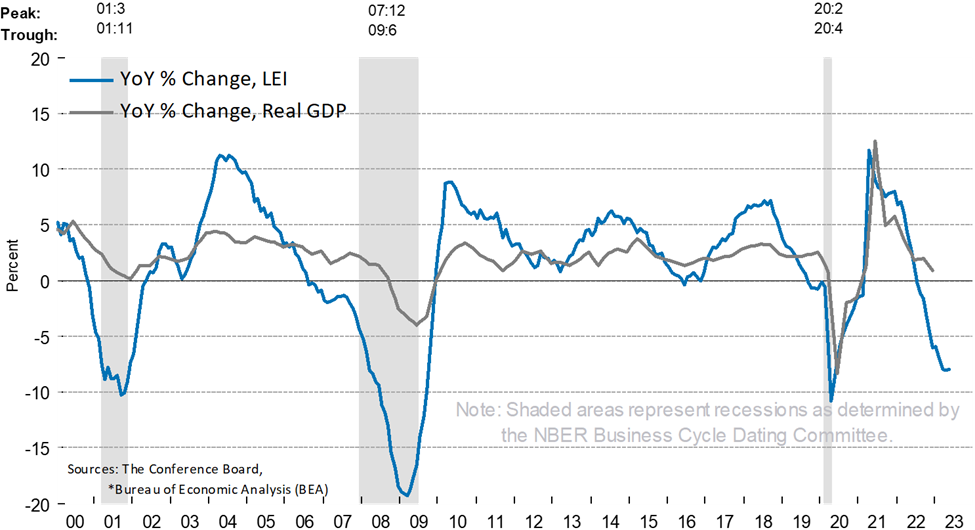
The Index has fallen for the last fourteen months, and the move into negative territory for year-over-year changes clearly signals that a recession is well within the realm of possibilities. The Conference Board itself is somewhat cautious about making a firm prognostication. It’s latest report, published on June 22, 2023, states, “. . . we project that the US economy will contract over the Q3 2023 to Q1 2024 period. The recession likely will be due to continued tightness in monetary policy and lower government spending.”
This prospect of a looming recession has made economic policy much more complicated. With the economy at or near full employment, the Fed has been able to take a hard line on fighting inflation, raising the target for the federal funds interest rate on 10 occasions since March of 2022. Now, however, with the rising risk of a recession developing, the Fed’s decision to hold off on further rate increases for now makes sense, giving them time to see how things develop.
Although the Fed left the door open for further interest rate hikes, I don’t expect this action to happen for as long as the economy seems poised to cool on its own, provided inflation continues to edge lower. On the other hand, if inflation starts to accelerate even slightly, my sense is that concerns about a recession will take a back seat to concerns about inflation — at least to begin with — and we’ll see the Fed resuming its interest rate hikes. My reading of the Fed is that the governors have little appetite for precipitating a recession, but they will do so as a last resort to maintain credibility with the public and assure that inflation is contained.
Krugman is on solid ground championing the economic performance under the Biden administration so far. Whether this record will hold through next year’s election cycle, however, remains to be seen. And whether Biden should be blamed or credited for it, in either case, is another question, altogether.
Author
Ira Kawaller
Derivatives Litigation Services, LLC
Ira Kawaller is the principal and founder of Derivatives Litigation Services.
















