|

The Flash Crash cycle is in progress right now

NDX is at long term channel support, a break below could trigger the Flash Crash cycle wave due in December 2018

I have written extensively about my discovery of the Flash Crash (FC) cycle in past posts 

I first mentioned the Flash Crash cycle back in May 2010, when the Flash Crash happened and I discovered then there was a regular Flash Crash cycle, which is a Gann 360 TD/525 Calender day/75 week crash cycle.

On September 2011 for example, the FC cycle was predicting an October 2011 FC Low

Actual: We saw an 10/4/11 major Low
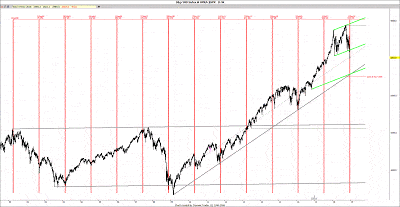
The Flash Crash 525 CD cycle 
04/14/00L - 09/21/01L = 525 CD = 75 weeks = 2.618 X 200 CD = 523.6
04/14/00L - 03/12/03L = 1062 CD = 2.02 X 525 CD = 03/12/03 Major Low
04/14/00L - 08/13/04L = 1582 CD = 3.01 X 525 CD = 08/13/04 Major Low
04/14/00L - 11/21/08L = 3143 CD = 5.99 X 525 CD = 11/21/08 Major Low,
04/14/00L - 05/06/10L = 3674 CD = 7.00 X 525 CD = 05/06/10 flash Crash,
04/14/00L - 10/14/11L = 4200 CD = 7.98 X 525 CD = 10/04/11L, Major Low.
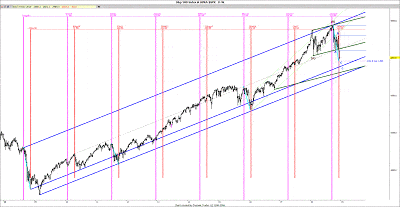
The Flash Crash 75 week cycle 

04/14/00L – 09/21/01L = 01 X 358.00 TD = 01 X 525 CD = 01 X 75.00 weeks
04/14/00L – 03/12/03L = 02 X 363.50 TD = 02 X 531 CD = 02 X 75.86 weeks
04/14/00L – 08/13/04L = 03 X 362.00 TD = 03 X 527 CD = 03 X 73.33 weeks
04/14/00L – 11/21/08L = 06 X 360.67 TD = 06 X 524 CD = 06 X 74.83 weeks
04/14/00L – 05/06/10L = 07 X 361.14 TD = 07 X 525 CD = 07 X 74.98 weeks
04/14/00L – 10/04/11L = 08 X 360.63 TD = 08 X 524 CD = 08 X 74.82 weeks
04/14/00L – 01/20/16L = 11 X 360.36 TD = 11 X 524 CD = 11 X 74.79 weeks


7 out of 9 FC Cycles saw 7%-26% (avg 12-14%) declines and most are in 2-3 wks
03/24/00H - 04/14/00L was a 14% decline in 3 weeks
08/31/01H - 09/21/01L was a 20% decline in 3 weeks
01/31/13H - 03/12/03L was a 16% decline in 8 weeks
06/24/04H - 08/13/04L was a 7% decline in 7 weeks
11/04/08H - 11/21/08L was a 26% decline in 3 weeks
04/26/10H - 05/06/10L was a 12% decline in 3 weeks
09/16/11H - 10/04/11L was a 12% decline in 2 weeks
 

The 360 TD Cycle is about 75 weeks, which has been in the markets ever since the April 14 2000 mini Crash Low and has since pinpointed 8 major crash Lows in the past 17 years, including the 4/14/00 mini crash Low, 9/21/01 crash Low, 3/12/03L, 8/13/04L, 11/2108 crash Low, 5/6/10 Flash Crash, 10/04/11 Low and more recently the 1/20/16 crash Low.
Many of the 360 TD/75 week flash crash cycle Lows were major Panic Lows, like the 4/14/00 Low, 9/21/01 Panic Low and the 11/21/08 Banking crisis Low. A few, like the 3/12/03 Low and 8/13/04 Low were not Panic Lows, but still major Lows.  At times the FC Cycle skips a beat, out of the last 12, 8 (67%) were direct hits and 4 (33%) were misses.

Conclusion: The 360 TD Flash Crash Cycle predicted many crashes and major Lows in the past, including the 4/14/00 crash Low, 9/21/01 crash Low,  3/12/13 Low, 8/13/04 Low, 11/21/08 crash Low, 5/6/10 FC, 10/04/11 crash Low, 1/20/16 Crash Low and now again in December 2018 Lows. Some were misses, but in general, it is a regular cycle to be reckoned with.The Flash crash (FC) cycle, once active sees an average 12-14% decline in a few weeks. As the Flash Crash (FC) Cycle is a 1 1/2 year fixed cycle, it will have a +/- variance of a few weeks, so timing the exact Low will be Key as once the Flash Crash cycle bottoms, we will see a sharp rally afterwards.

Author

Raj Ian G Thijm, MBA

Raj Ian G Thijm, MBA

Raj Time and Cycles

I have been actively involved in the Financial Markets since August 1987. After receiving my B.S.


More from Raj Ian G Thijm, MBA
Share:

Editor's Picks

GBP/USD declines toward 1.3500 as markets turn risk-averse

GBP/USD comes under bearish pressure and declines toward 1.3500 on Tuesday. The UK ILO Unemployment Rate held steady at 4.9% in the three months to June, against a forecast of 4.8%, while Employment Change arrived at 83K in the same period versus 147K previous. Weak UK labor data, combined with the risk-averse market atmosphere amid a re-escalation of tensions in the Middle East weigh on the pair.

EUR/USD retreats below 1.1600 on modest USD recovery

EUR/USD struggles to gain traction and trades below 1.1600 in the second half of the day on Tuesday, even after the data from the Eurozone and Germany highlighted improving economic sentiment in August. The US Dollar (USD) benefits from the risk-averse market atmosphere as tensions in Middle East remain high, making it difficult for the pair to turn north.

Gold sticks to losses below $4,400 as USD recovers further from two-month low

Gold remains depressed below the $4,400 mark through the first half of the European session, snapping a two-day winning streak amid a broadly firmer US Dollar. Inflation risks stemming from higher oil prices back the case for at least one interest rate hike by the US Federal Reserve in 2026.

Pi Network holds steady amid app studio costs surge to push user adoption

Pi Network extends a consolidation range capped below $0.0900 holding above the $0.0839 support level. PI token remains under pressure as the Core Team pushes for real user adoption by raising costs for AI-powered app creation, effective from August 24. Leverage-linked risk exposure eases as Open Interest declines despite an increase in social interest.

Fiscal concerns and doubts on Fed independence send US yields to long-term highs

US Treasury yields keep rising across the curve this week, with the yield for the 30-year Treasury bond reaching its highest level since 2007, during the global financial crisis, at 5.33% so far on Monday. A mix of concerns about the ballooning US fiscal deficit and growing doubts about the Federal Reserve’s Independence are increasing pressure on US Government Bonds.

Why is Crude Oil priced for a reopening the ships haven't made?
Fourteen vessels crossed the Strait of Hormuz on Tuesday. Before the war, the count ran near 120 a day. In the sessions since the waterway was publicly declared open, Brent has drifted back to $87 and West Texas Intermediate (WTI) to $81, both a little lower again on Wednesday, with daily momentum on each unwound from the top of its range in late July to the low twenties now.