The Federal government is spending us into oblivion

The June federal budget deficit was "only" $66 billion. This looks like a big improvement, but it wasn't.
Even more concerning is the fact that interest on the accumulating debt is eating up nearly one-third of federal tax receipts.
The deficit came in lower because $93 billion in June payments were pushed back into May with the last day of the month falling on a Saturday. This resulted in the largest May deficit on record.
Accounting for the calendar effects, the June deficit was in the $158 billion range.
The June deficit pushed the fiscal 2024 budget shortfall to $1.27 trillion with three months remaining.
The deficit was also mitigated somewhat by strong receipts in June. The U.S. government collected $466.26 billion last month, according to the latest monthly Treasury statement. This was an 11.5 percent increase in revenue compared to June 2023.
June's big year-on-year revenue increase wasn't an anomaly. To give you an idea of how well the Treasury is doing, in April, Uncle Sam ran a surplus thanks to tax day. Tax receipts came in at $776.2 billion in April, a 22 percent increase over last year.
This blows apart the notion often bandied about that the deficits are because of tax cuts. The real problem is on the spending side of the ledger.
Even with some June payments pushed back into May, the Biden administration still managed to blow through $532 billion last month.
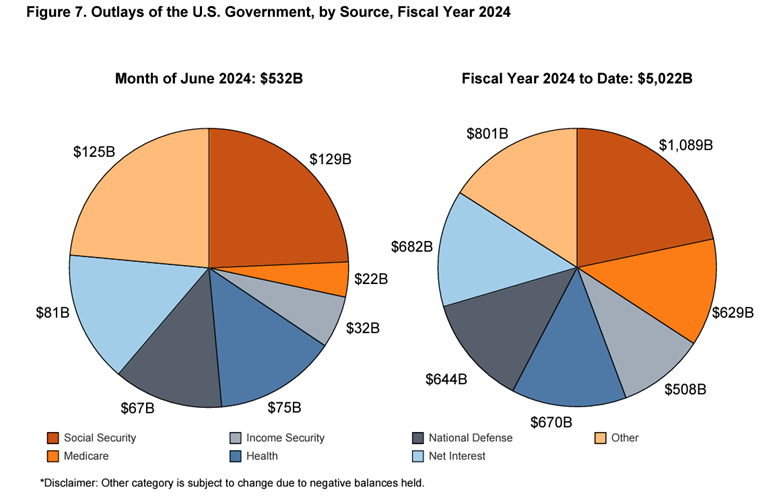
Through eight months of fiscal 2024, the federal government has spent a staggering $5 trillion. That's up 8 percent over the same period last year.
And there is no end to the spending in sight.
Outlays continue to increase despite the [pretend] spending cuts and promises from the Biden administration that it would save “hundreds of billions” with the debt ceiling deal (aka the [misnamed] Fiscal Responsibility Act).
This reveals the ugly truth. No matter what you hear about spending cuts in Washington D.C., the federal government always finds new reasons to spend more and more money. Whether it's a disaster, an emergency, or somebody else's war, the spending train never reaches the station.
This problem isn't specific to Biden or Democrats in general. The Trump administration was running $1 trillion deficits before the pandemic. In other words, Trump was generating Obamaesque deficits despite having what he claimed was the strongest economy in history.
Borrowing and spending is a bipartisan sport.
The problem is the only way to whittle down spending would be to address the biggest outlays - entitlements, national defense, and the interest on the debt. Congress lacks the political will to cut defense or reform Social Security and Medicare. And it can't do anything about the interest on the debt other than lower the debt.
Speaking of the debt, massive monthly budget shortfalls are pushing it higher at a dizzying pace. On December 29, the national debt eclipsed $34 trillion for the first time. When Congress effectively eliminated the debt ceiling on June 5, 2023, the national debt stood at a "mere" $31.46 trillion. As of June 13, the national debt stood at over $34.86 trillion.
The interest problem
The federal government spent $140.2 billion paying interest on the national debt in June. That is just over 30 percent of the month's total tax receipts.
So far in fiscal 2024, it has paid $867.7 billion. That is a 33 percent increase over last year.
So far this year, the federal government has spent more on interest than it has on national defense ($644 billion) or Medicare ($629 billion). The only spending category bigger than interest is Social Security.
And interest expenses will only continue to climb.
Much of the debt currently on the books was financed at very low rates before the Federal Reserve started its hiking cycle. Every month, some of that super-low-yielding paper matures and has to be replaced by bonds yielding much higher rates.
Anybody who says "deficits don't matter" is deluded.
And the only way out of this fiscal death spiral is significant spending cuts and/or major tax hikes.
What's it to you?
A lot of people think deficits and debt don't matter. After all, we've been dealing with them for years, and "nothing bad has happened."
But as economist Daniel Lacalle pointed out in an article published by the Mises Wire, bad things are happening.
The CBO projects spending to soar to $10.3 trillion annually by 2034. Even with an overly optimistic expectation of solid economic growth. That would be 24.9 percent of GDP.
As Lacalle points out the ramifications of this government spending spree:
"The CBO projections prove without a doubt that there is no way in which the United States could balance the budget through revenue measures. There is no set of revenue measures that can collect $2 trillion per year in additional annual receipts. Increases in taxes would inevitably slow down investment and growth and reduce long-term potential receipts. Furthermore, even if the United States government was able to increase revenues, the likelihood of a recession in the next ten years, added to the promises of more “extraordinary” expenses in election years, would make the deficit soar regardless of any revenue improvement. An economy that generates an annual deficit of 6 percent of GDP to achieve a mere 2 percent annual growth is on a dangerous path, even if that kind of growth is sustained. Inevitably, at the first sign of a recession, the government would spend even more."
This may sound like a lot of accounting blah, blah, blah. Why should you care about the borrowing and spending? Isn't that Washington D.C.'s problem?
Lacalle says three things should concern you.
- Higher taxes
- Weaker economic growth
- Declining purchasing power of your salary and savings
"If you hail deficit spending, you are embracing impoverishment. If you defend this kind of deficit spending, you are actively supporting stagnation.”
To receive free commentary and analysis on the gold and silver markets, click here to be added to the Money Metals news service.
Author
Mike Maharrey
Money Metals Exchange
Mike Maharrey is a journalist and market analyst for MoneyMetals.com with over a decade of experience in precious metals. He holds a BS in accounting from the University of Kentucky and a BA in journalism from the University of South Florida.

















