The chains that bind: Profits and the courage to pay up


Summary
Supply issues have persisted because of the inability to catch up with the tremendous pace of demand we are still experiencing. While rising costs have no doubt been a headache for businesses, the real disappointment for profitability is missing sales due to a lack of inventory and labor. In this fourth and final installment in our The Chains that Bindseries, we evaluate how profits could be even stronger if it were not for supply problems. Businesses have pricing power, but to exercise it they have to source the people and materials necessary and have the courage to pay up for it.
Pricing power is supposed to be good for profits, but what if you have nothing to sell?
The pandemic and the measures to contain it may be what caused supply problems to surface, but these issues have persisted and worsened due to the tremendous pace of demand that we are still experiencing. The biggest constraint on spending at present is getting your hands on the products you want. This is most conspicuous in the auto industry, where a lack of semiconductors and other key inputs has delayed production and thereby the delivery of vehicles, but is also evident in everything from consumer electronics to furniture. Businesses have thus drawn down inventories in order to meet sales and lifted prices to compensate for dwindling inventories as well as rising costs. The bottom line for businesses: while increased price pressure has no doubt been a headache, the real disappointment for profitability is missing sales due to a lack of inventory.
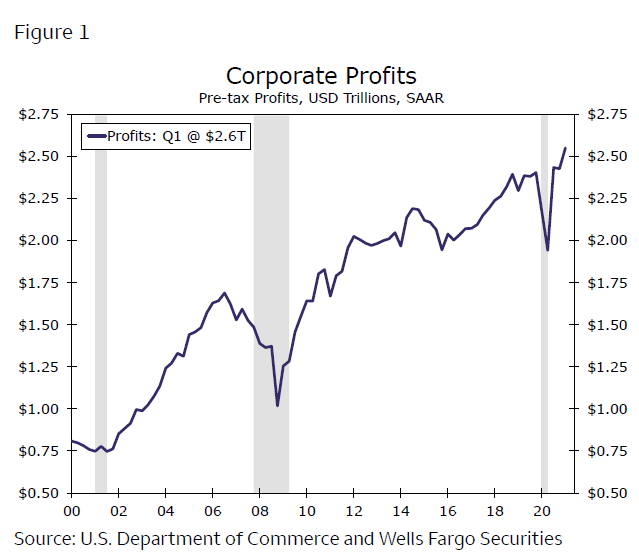
Since the lockdown measures and stay-at-home guidelines were lifted last May, demand has come roaring back. Both business spending on capital goods and consumer spending on goods are at levels not typically seen until years into economic expansion. Profits have bounced back as a result. Economy-wide corporate profits rose to $2.6 trillion in the first quarter, putting the level of profits 6% ahead of its pre-pandemic peak in the fourth quarter of 2019 (Figure 1). But the sharp draw down in inventories, as orders continue to roll in, suggests firms could be selling more if they had the product to move. But at what cost? Input component prices are soaring, which forces businesses to choose whether topay up and hopefully pass those price hikes along, or lose out in the form of sales. This robust demand environment may over firms the justification for procuring inputs even ata higher cost because that is what is needed to meet sales.
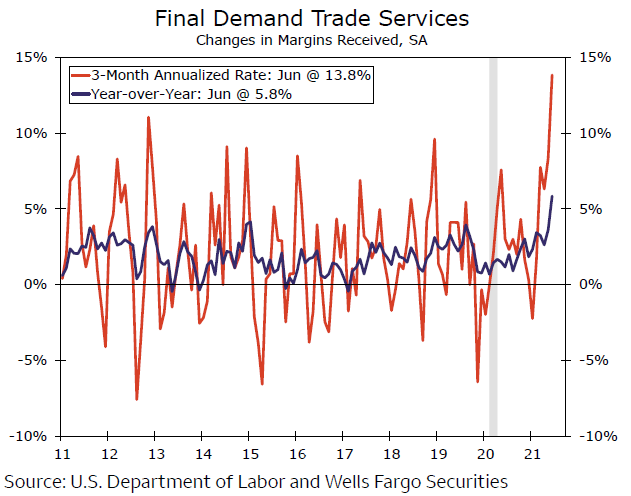
The increased ability to pass along price increases in this environment provides a path toward profitability, even amid ever-increasing costs. Inflation expectations of consumers and businesses suggest attitudes toward price increases have changed, making it easier for firms to lift prices today without losing customers. Prices for final demand trade services, which measures changes in margins received, surged 2.1% in June – the largest gain in data going back to 2010. This measure has been trending higher (Figure 2) and suggests firms may be able to pass on more costs today than they typically could early in a recovery. To the extent that firms have increased pricing power, it offsets some of the hit to revenue from low inventory.
Author
Wells Fargo Research Team
Wells Fargo