The Bank of England growth forecast cut indicates steep deceleration of the UK fourth-quarter GDP
- The UK GDP is expected to decelerate sharply in the final quarter of 2019 reflecting ongoing Brexit uncertainty.
- The quarterly GDP growth is expected to rise by 0.2%, half the growth rate in the third quarter last year.
- The business investment is subdued while with only about half of the UK businesses ready for a no-deal Brexit alternative.
- The Bank of England Governor Mark Carney said the UK has lost 1.5% g GDP relative to the expectation before the June 2016 Brexit referendum.

The UK fourth-quarter GDP is expected to rise 0.2% over the previous quarter, decelerating from 0.6% Q/Q in the previous period, the Office for National Statistics is expected to report on Monday, February 8 at 8:30 GMT.
The first estimate of the fourth-quarter growth will see only the headline GDP growth rate published with the detailed decomposition of key drivers due in the second and the final estimates published later on. The aggregate figure is though expected to confirm the general trend of the economic slowdown heralded by the monthly forward-looking data like the IHS/Markit’s purchasing managers indices that saw the economic activity decelerate at the brink of recession recently.
This has also been reflected in the Bank of England growth forecasts that expect the fort quarter 2018 GDP at 0.3% Q/Q and the first quarter of 2019 GDP at 0.2% Q/Q.
"UK GDP growth appears to have slowed and is expected to remain subdued over much of 2019, reflecting both weakening global growth and the intensification of Brexit uncertainties. The impact of those uncertainties is projected to wane gradually, consistent with the MPC’s assumption of a smooth withdrawal of the UK from the EU," the Bank of England wrote in the February Inflation report.
The major factors behind the current economic slowdown are bundled around the Brexit uncertainty that keeps the UK businesses off major investment decisions before it is actually known what kind of Brexit will materialize. Moreover, the dim outlook for the global economy and the global trade tensions are expected to have a negative impact on the UK export through the trade channel.
Apart from the Bank of England Governor Mark Carney estimation of UK losing about 1.5% of GDP relative to the expectation before June 2016 Brexit referendum, the ongoing trade tension and Brexit uncertainty are expected to weigh on the outlook for the UK GDP that had been lowered to 1.0% for 2020 by the Bank of England.
UK investment postponed since Brexit referendum
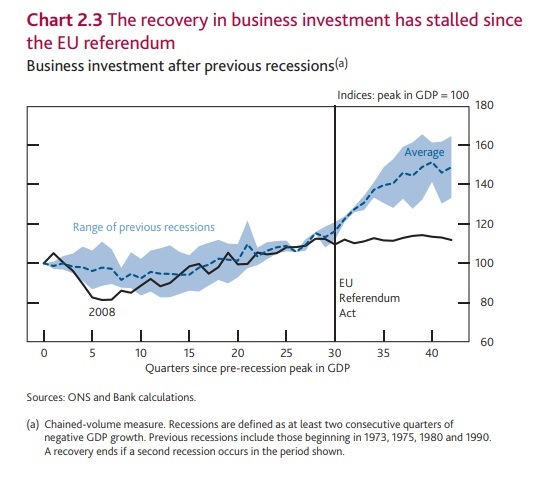
Source: The Bank of England February Inflation report
Author

Mario Blascak, PhD
Independent Analyst
Dr. Mário Blaščák worked in professional finance and banking for 15 years before moving to journalism. While working for Austrian and German banks, he specialized in covering markets and macroeconomics.