|

USD/CAD technical analysis: Communicates a commanding bearish bias
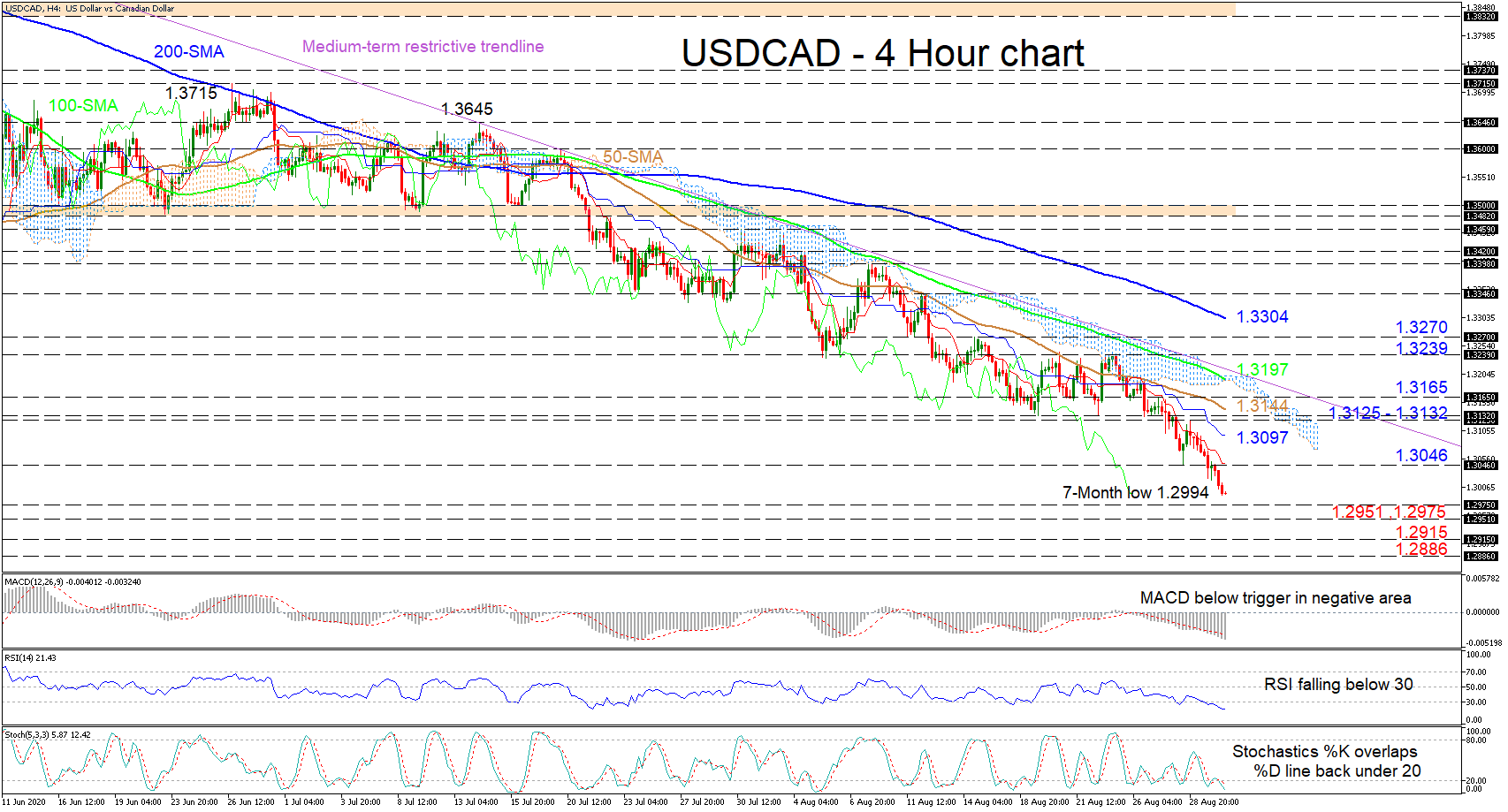
USDCAD seems to be pursuing its proclaimed bearish direction, something also conveyed through the dominant negative bearing within the simple moving averages (SMAs). The short-term oscillators as well as the falling Ichimoku lines deliver a negative demeanour reinforcing this view.

The MACD, some distance in the negative region, is decreasing below its red signal line, while the RSI is slipping further in oversold territory. Moreover, the stochastic oscillator has retreated into the oversold zone, promoting further losses in the pair.

To the downside, sellers may be initially challenged by the 1.2975 barrier of January 8 ahead of the nearby 1.2951 year end low, identified on 31 December 2019. Should the pair weaken further, the 1.2915 obstacle from October 2018 may come into play, prior to the 1.2886 border.

If buyers resurface, early limitations may arise from the 1.3046 inside swing low, coupled with the red Tenkan-sen line. Pushing higher may encounter some friction from the blue Kijun-sen line at 1.3097 ahead of a resistance band from 1.3125 - 1.3132. Nudging above this, the 50-period SMA at 1.3144 and the 1.3165 high may prevent the climb from testing the cloud and 100-day SMA around 1.3197. Should the cloud and neighbouring diagonal line - drawn from 1.4667 - fail to dismiss further advances, the pair may target the 1.3239 tough barrier ahead of the 1.3270 peak.

In brief, USDCAD continues to present a strong short-to-medium-term bearish bias below the descending line and the SMAs.
USDCAD

Author

Anthony Charalambous, CFTe

Anthony Charalambous joined XM in 2019 and specializes in preparing daily technical analysis, using his years of trading experience to provide detailed forecasting for all major asset classes such as forex, indices, commodities and equities.


More from Anthony Charalambous, CFTe
Share:

Editor's Picks

EUR/USD hits two-day highs near 1.1820

EUR/USD picks up pace and reaches two-day tops around 1.1820 at the end of the week. The pair’s move higher comes on the back of renewed weakness in the US Dollar amid growing talk that the Fed could deliver an interest rate cut as early as March. On the docket, the flash US Consumer Sentiment improves to 57.3 in February.

GBP/USD reclaims 1.3600 and above

GBP/USD reverses two straight days of losses, surpassing the key 1.3600 yardstick on Friday. Cable’s rebound comes as the Greenback slips away from two-week highs in response to some profit-taking mood and speculation of Fed rate cuts. In addition, hawkish comments from the BoE’s Pill are also collaborating with the quid’s improvement.

Gold climbs further, focus is back to 45,000

Gold regains upside traction and surpasses the $4,900 mark per troy ounce at the end of the week, shifting its attention to the critical $5,000 region. The move reflects a shift in risk sentiment, driving flows back towards traditional safe haven assets and supporting the yellow metal.

Crypto Today: Bitcoin, Ethereum, XRP rebound amid risk-off, $2.6 billion liquidation wave

Bitcoin edges up above $65,000 at the time of writing on Friday, as dust from the recent macro-triggered sell-off settles. The leading altcoin, Ethereum, hovers above $1,900, but resistance at $2,000 caps the upside. Meanwhile, Ripple has recorded the largest intraday jump among the three assets, up over 10% to $1.35.

Three scenarios for Japanese Yen ahead of snap election

The latest polls point to a dominant win for the ruling bloc at the upcoming Japanese snap election. The larger Sanae Takaichi’s mandate, the more investors fear faster implementation of tax cuts and spending plans. 

XRP rally extends as modest ETF inflows support recovery

Ripple is accelerating its recovery, trading above $1.36 at the time of writing on Friday, as investors adjust their positions following a turbulent week in the broader crypto market. The remittance token is up over 21% from its intraday low of $1.12.














