|

Technical analysis – Gold pushes into fresh record highs

  • Gold surges to fresh all-time high as geopolitical risks intensify.
  • Bulls remain in control but a close above 4,380 is key.

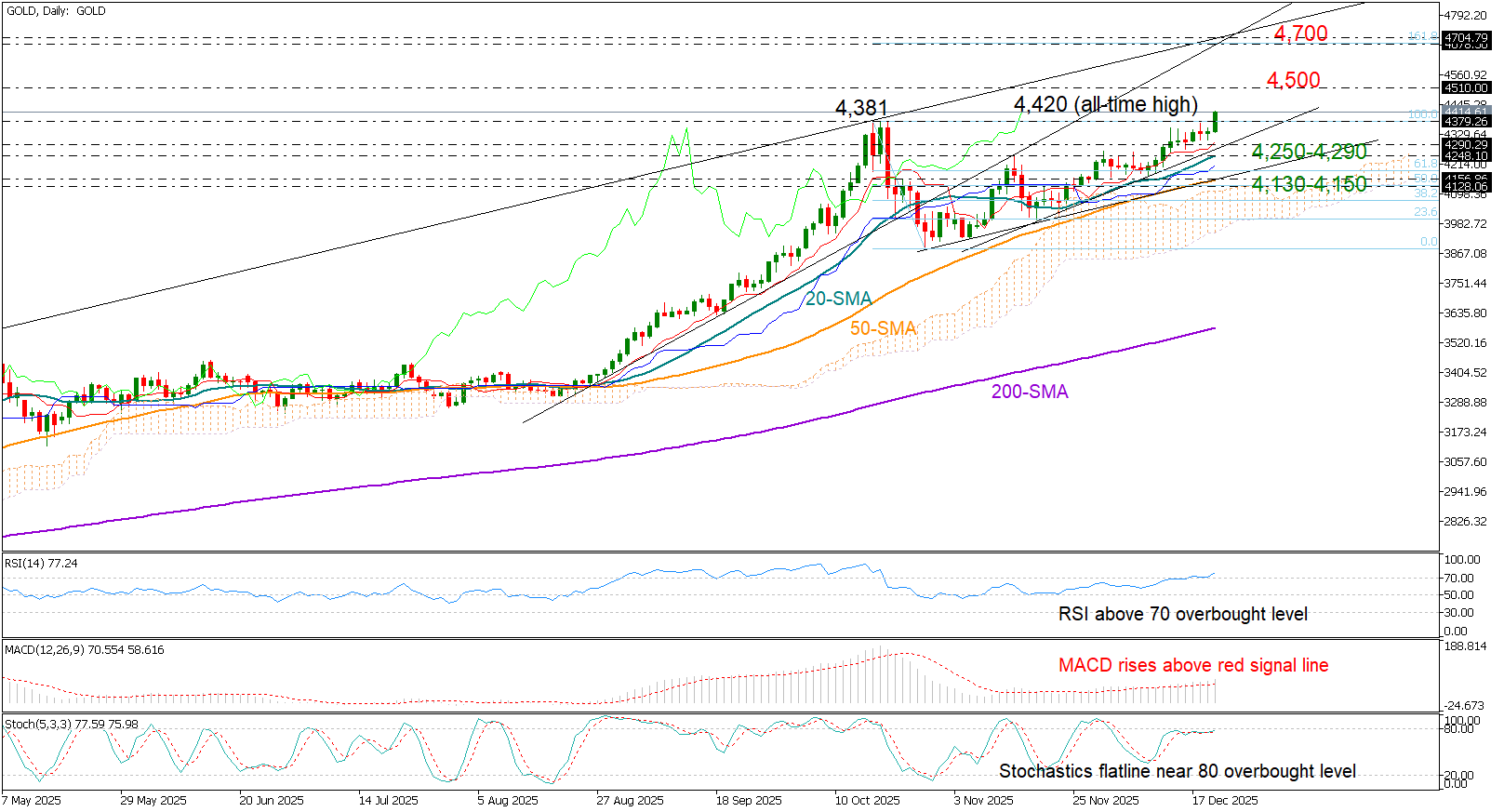
Gold was spotted at a new all-time high of 4,420 early on Monday, extending its two-month-old recovery phase from October’s low of 3,886. A combination of factors - including expectations of Fed rate cuts, headlines surrounding a potential renewed escalation in tensions between Israel and Iran, and another U.S. oil blockade against Venezuela – was sufficient to propel bullion to higher levels.

The bulls must now secure a clear close above the previous peak of 4,381 to stretch towards the 4,500 psychological level and then pick up steam towards the tentative resistance line from April 2025 at 4,700. Note that the 161.8% Fibonacci retracement level of the latest downfall is in the neighborhood too. Beyond that, the door could open for the 4,900 round-level.

From a technical perspective, the deviation from the Ichimoku cloud and the positive slope in the simple moving averages (SMAs) can fuel buying interest in the short-term. The rising MACD is another encouraging sign, though some caution might be warranted as the RSI is strengthening in the overbought territory.

In the event upside pressures fade immediately, support could initially emerge near the 4,250-4,290 zone and the 20-day SMA. Further declines could bring the 50-day SMA and the upper band of the Ichimoku back into play within the 4,130-4,150 region.

Summing up, the precious metal might be poised to enjoy a Santa Claus rally as it enters uncharted territory, with buyers likely awaiting a convincing move above 4,380 to drive the price higher.

Author

Christina Parthenidou

Christina joined Trading Point in May 2017. She holds a master degree in Economics and Business from the Erasmus University Rotterdam with a specialization in International economics.


More from Christina Parthenidou
Share:

Editor's Picks

GBP/USD approaches May highs near 1.3650 on renewed USD selling

GBP/USD approaches the May high, while trading near 1.3650 in the European session on Thursday. The US Dollar slips again even as markets assess whether the US Treasury buyback will be a game-changer. Attention now remains on US data and Middle East headlines for further trading impetus.

EUR/USD hits fresh three-month highs above 1.1700

EUR/USD is at its highest level in three months, above 1.1700, in European trading on Thursday. The pair regains traction as the US Dollar resumes its downside, led by the US Treasury's bond buyback plan.. US Jobless Claims data are next in focus amid lingering Iran risks.

Gold stays in red below $4,500 despite resurgent USD supply

Gold sticks to modest intraday losses and remains below the $4,500 mark in the European session on Thursday. Despite geopolitical uncertainties, the US Dollar loses ground again, resuming the previous day’s slump to a three-month low.

Bitcoin extends gains above $71,000 as liquidity conditions improve

Bitcoin extends its gains, inching toward $72,000 on Thursday, as crypto markets continue to cheer the US Treasury’s decision to double its debt buyback operations. The move has sharply improved market sentiment and liquidity conditions, helped trigger a short squeeze, and overall provided a positive catalyst for the broader crypto market.

The bond coup
Yesterday was marked by a coup from the US Treasury, which suddenly announced that it will ‘at least double’ the maximum size of its buyback operations for longer-term debt, hoping to ease pressure on long-term yields and borrowing costs. Phoah! The markets reacted heavily to the news. The US 10-year yield fell sharply, while the 30-year yield dropped from its highest levels since 2007.
$20 billion offered, $2 billion taken: Why Treasury doubled its buyback cap

The US Treasury moved off its own calendar on Wednesday, and that is the part worth sitting with. At 12:32 GMT, the department said it would at least double the size of liquidity support buyback operations in the 10-year to 20-year and 20-year to 30-year sectors, lifting the maximum from $2 billion per operation to at least $4 billion, effective September 9 and running to November 4.