Swiss Franc vs. Japanese Yen: A shift in carry trade funding?

Yield differentials are supporting the recovery, but a genuine trend reversal has yet to be confirmed. Since the beginning of October 2026, the outlook for USD/CHF has been cautiously optimistic. Conviction remains moderate, with a time horizon of several weeks to months.
The macroeconomic environment is increasingly supportive of a recovery in the currency pair. The widening yield differential between US and Swiss government bonds, together with the recent gains in USD/CHF, suggests that expectations regarding future monetary policy are once again providing support for the US dollar.
At the same time, developments in Japanese and Swiss government bond yields raise a fundamental question: Could the Swiss franc gradually replace the Japanese yen as the preferred funding currency for international carry trades?
Historically, the Swiss franc has benefited from its reputation as a safe haven, supported by Switzerland's stability, low inflation and conservative monetary policy.
However, exceptionally low interest rates could increasingly encourage investors to use the currency for borrowing rather than holding it as an investment.
Such a shift could generate sustained selling pressure on the franc, particularly if global market conditions remain stable and other currencies offer significantly higher yields.
Nevertheless, the available data neither demonstrate a permanent loss of the franc's safe-haven status nor confirm a broad market shift towards Swiss franc funding.
The outlook therefore remains conditionally bullish with moderate conviction.
US and Switzerland: The yield advantage strengthens the Dollar
The data show the yield differential between two-year US and Swiss government bonds at approximately 4.642 percentage points, while USD/CHF trades around 0.82848.
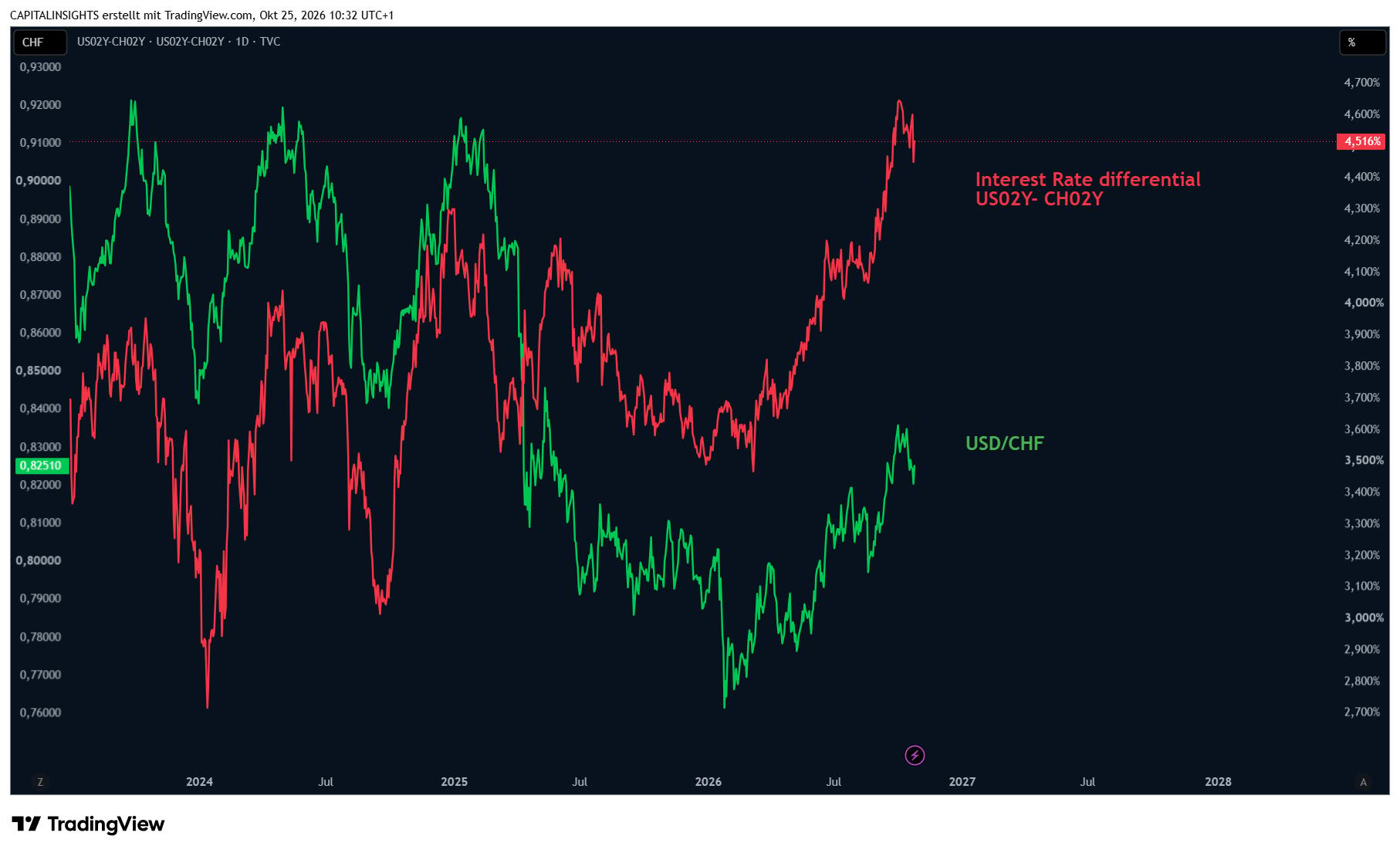
At the right-hand edge of the charts, the yield differential increases significantly. At the same time, USD/CHF has recovered from its year-to-date low of approximately 0.76.
This parallel development is consistent with a market environment in which interest-rate differentials support the dollar.
Two-year government bond yields are particularly important in this context because they reflect market expectations regarding the future monetary policies of central banks.
A widening yield differential suggests that investors expect US interest rates to remain higher than Swiss interest rates for longer, making US investments relatively more attractive.
However, caution is necessary when interpreting these developments.
The absolute size of the yield advantage is not necessarily the best indicator of future exchange-rate movements.
Currency markets are forward-looking, meaning that a known interest-rate differential is usually already reflected in the current exchange rate.
Only a further shift in favour of the dollar, or a yield advantage that persists longer than expected, would provide additional momentum for USD/CHF appreciation.
Furthermore, the differential alone does not reveal whether the recent increase is primarily attributable to rising US yields, falling Swiss yields or a combination of both.
Although the interest-rate environment supports the currency pair, sustained appreciation requires further confirmation through actual monetary policy developments and price action.
Historical divergences limit the explanatory power
Despite the constructive recent developments, a historical perspective introduces an important limitation to a purely yield-based strategy.
Since 2023, the United States has consistently maintained a substantial yield advantage over Switzerland.
Nevertheless, USD/CHF depreciated over extended periods during this time.
This demonstrates that higher interest rates do not automatically lead to a stronger currency.
Exchange rates are influenced by numerous factors simultaneously, including risk premia, hedging demand, economic growth and global capital flows.
The historical data do not establish which of these forces dominated during the individual periods.
More importantly, a substantial yield advantage can coexist with depreciation of the higher-yielding currency.
Although the recent simultaneous recovery in the yield differential and exchange rate is constructive, it does not yet demonstrate a permanently stronger relationship between the two.
The visual distance between the lines in the chart also has no economic significance, as both variables are displayed on different scales.
The decisive question is therefore not whether USD/CHF has already fully caught up with the existing yield advantage, but whether future price action continues to confirm developments in the yield differential.
If USD/CHF were to decline again despite further widening of the yield differential, this would represent a clear warning signal that other market forces are exerting greater influence.
Japan and Switzerland: A potential shift in funding
A second important consideration emerges from the comparison between Japanese and Swiss government bond yields.
The data show the Swiss two-year yield at approximately 0.185%, while the Japanese yield stands at around 1.908%.
Assuming that the Japanese figure also represents two-year government bonds, the Japanese yield advantage amounts to approximately 1.723 percentage points.
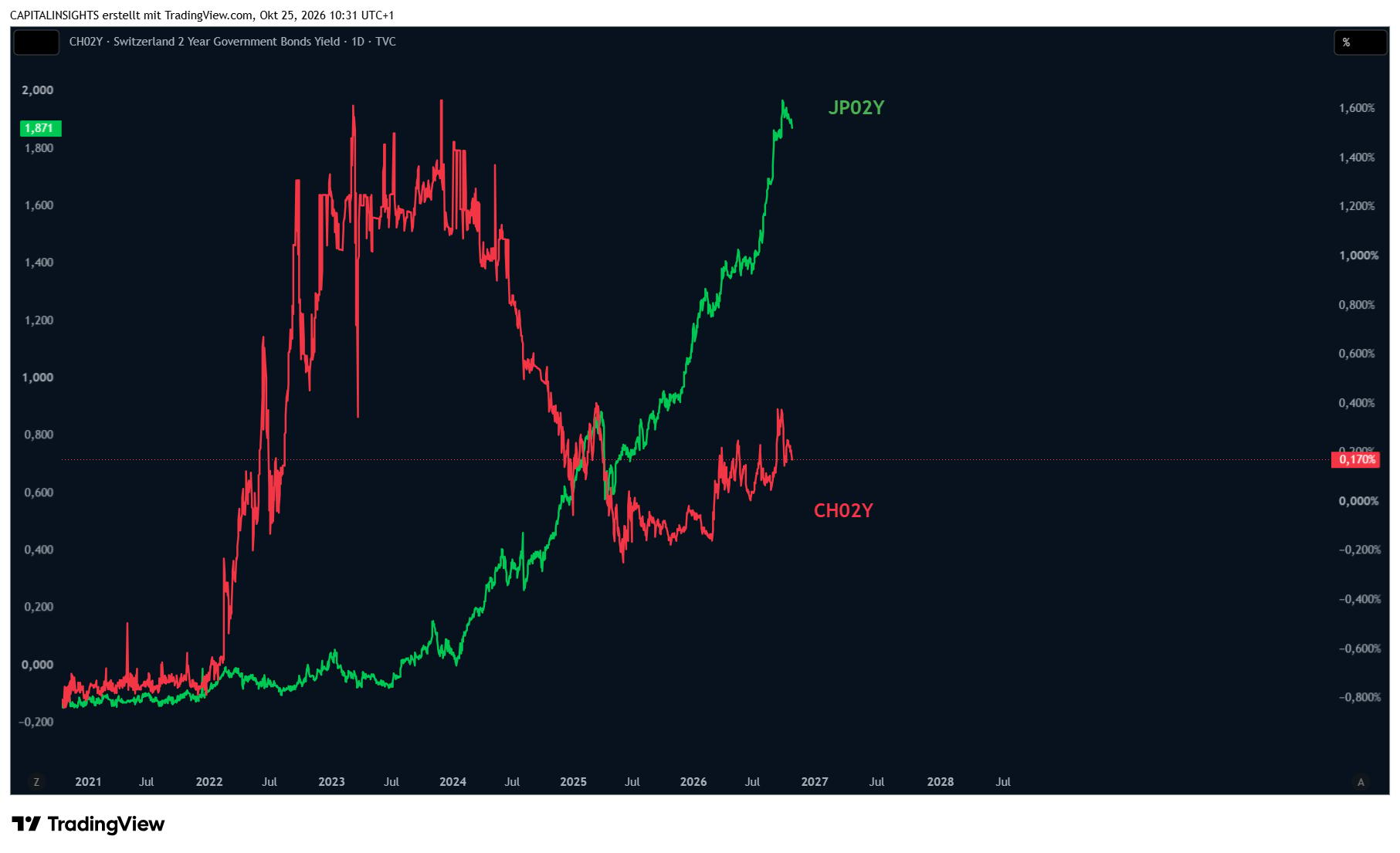
However, the greater significance lies in the differences between the two monetary-policy environments.
For decades, the Japanese yen has served as a traditional funding currency because of Japan's exceptionally low interest rates.
Investors borrowed yen at low financing costs and invested the proceeds in higher-yielding markets.
However, as Japanese interest rates rise, yen-denominated borrowing could become less attractive.
By contrast, Switzerland remains in an environment characterised by very low yields.
This supports the hypothesis that Swiss franc-funded strategies could become increasingly attractive as investors reassess their financing costs.
The underlying economic mechanism is straightforward.
Investors seeking exposure to higher-yielding assets borrow Swiss francs, exchange them for foreign currencies and invest the proceeds abroad.
If these investments are denominated in US dollars, this involves selling Swiss francs and purchasing US dollars.
If this practice becomes sufficiently widespread, it could exert upward pressure on USD/CHF.
However, the significance of this factor should not be overstated.
Government bond yields are not equivalent to actual borrowing costs, which depend on money-market rates and maturities.
Furthermore, when currency risk is hedged, a substantial portion of the interest-rate advantage is often offset.
Swiss National Bank: Low interest rates, but no guaranteed depreciation
The Swiss National Bank has maintained its policy rate at 0% and emphasised its willingness to intervene in the foreign-exchange market if necessary to ensure appropriate monetary conditions.
Although this supports the expectation of a persistently low interest-rate environment in Switzerland, it does not mean that the SNB has committed to permanently depreciating the franc or defending a particular USD/CHF exchange rate.
The SNB should therefore be regarded as an important factor within the monetary-policy environment.
The bullish USD/CHF thesis cannot rely on guaranteed protection through central bank intervention.
A funding currency and a safe haven are not mutually exclusive
The claim that the Swiss franc has lost its role as a safe haven cannot be substantiated by the available data.
Greater use as a funding currency can weigh on the franc while such positions are being established.
However, when these trades are unwound, the mechanism reverses.
Investors sell their assets and must repurchase Swiss francs to repay their CHF-denominated liabilities.
Extensive use of the franc in carry trades can therefore contribute to rapid appreciation during periods of financial stress.
Research published by the SNB also identifies the unwinding of carry trades as a potential explanation for sudden appreciation in safe-haven currencies.
This creates an important risk scenario for USD/CHF.
A stable market environment encourages the establishment of CHF-funded positions, while a sudden increase in market risk can trigger rapid repurchases of Swiss francs.
Since the US dollar also frequently attracts demand during periods of financial stress, the direction of USD/CHF ultimately depends on the relative demand for both currencies.
Valuation and market structure
The hypothesis that the Swiss franc is overvalued based on purchasing-power parity cannot be verified without the underlying valuation model and corresponding data.
It is therefore not incorporated into the outlook as a confirmed foundation.
Even demonstrated overvaluation would not provide a reliable timetable for depreciation, as such imbalances can persist for years.
From a technical perspective, a significant recovery is visible following an extended period of depreciation.
This recovery is relevant, but it does not yet provide sufficient evidence of a complete long-term trend reversal.
Only a continuation characterised by higher lows and higher highs would strengthen the bullish assessment.
Furthermore, potential technical formations in EUR/CHF cannot be directly transferred to USD/CHF.
Scenarios and Conditions for Reassessment
Base case
Conditions: The US–Swiss yield differential remains elevated or widens further, while the recent recovery structure in the chart remains intact.
Implication for USD/CHF: The conditionally bullish outlook remains valid.
Stronger bullish scenario
Conditions: Further widening of the yield differential is accompanied by new highs in USD/CHF, without significant buying pressure on the Swiss franc.
Implication for USD/CHF: Greater confidence in a sustainable upward movement.
Consolidation
Conditions: The yield advantage persists but fails to provide new momentum, while price action only partially confirms the interest-rate differential.
Implication for USD/CHF: A sideways phase or moderate pullbacks within the broader recovery.
Bearish scenario
Conditions: The yield differential narrows significantly, the recovery structure breaks down or substantial Swiss franc repurchases emerge.
Implication for USD/CHF: The bullish assessment must be reduced or abandoned entirely.
Research conclusion
The combination of a recently widening US–Swiss yield differential and a simultaneous recovery in USD/CHF justifies a conditionally bullish outlook with moderate conviction.
The comparison between Japan and Switzerland complements the hypothesis that CHF funding is becoming relatively more attractive, but it does not confirm an actual reallocation of institutional capital.
The most important confirmation signal would be continued simultaneous strength in the yield differential and the exchange rate.
Conversely, the clearest warning signal would be renewed, sustained depreciation in USD/CHF despite an otherwise supportive yield environment.
The assessment therefore remains dependent on clearly defined conditions.
The bond market provides the foundation, but actual price action must still demonstrate whether this develops into a sustainable trend reversal.
Author

Serhad Colak
Capital Insights
Serhad Colak is the founder of Capital Insights. His work focuses on macroeconomic research, monetary policy and cross-asset analysis, with particular attention to inflation, labor-market developments and interest-rate expectations.