Stocks jump as crude oil and gold prices retreat

Global stocks jumped on Tuesday after Russia sent mixed signals about its strategy on Ukraine. The country’s defense minister announced that it will pull some of its troops from the Ukrainian border. It also noted that large-scale military training in its territory would continue. The announcement came at a time when Western countries are attempting to solve the crisis in a diplomatic way. Yesterday, Putin held a meeting with Olaf Scholz and insisted that he does not want war with Europe. The Dow Jones, S&P 500, and Nasdaq 100 indices rose by more than 2% on Tuesday.
The price of crude oil declined sharply as investors reacted to the happenings in Ukraine. Brent, the global benchmark, declined by more than 3% to $93 while West Texas Intermediate (WTI) declined by almost 4% to $91.8. The main reason why oil prices dropped is that analysts were expecting Russia’s supply to be cut off by sanctions if it invaded Ukraine. As a result, the world would be short by about 5 million barrels of oil per day. That deficit would be difficult to fill by other OPEC and non-OPEC members. Later today, the Energy Information Agency (EIA) will publish the latest inventory data.
The US dollar declined slightly as investors embraced a risk-on sentiment. The currency declined even after the US published the relatively strong producer price index (PPI) data. The numbers revealed that the country’s PPI increased from 0.4% in December to 1.0% in January. On a year-on-year basis, the PPI declined slightly from 9.8% to 9.7%. Later today, the US will publish the latest retail sales numbers. Other key economic numbers to watch will be the latest Canadian and UK consumer inflation data. The Eurozone will publish the latest industrial production data.
EUR/USD
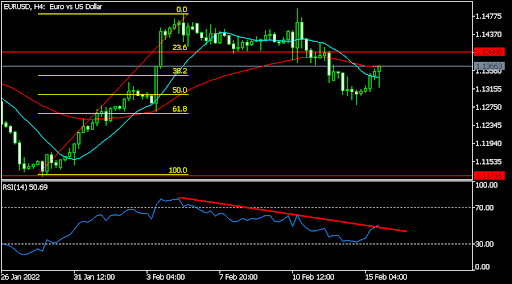
The EURUSD pair rose to a high of 1.1365 as Ukrainian risks eased. On the four-hour chart, the pair managed to move above the 38.2% Fibonacci retracement level. It also moved slightly above the 14-day and 25-day moving averages while the RSI crossed the descending trendline shown in red. It has also formed a small inverted head and shoulders pattern. Therefore, there is a possibility that the pair will keep rising as bulls target the next key resistance at 1.1400.
EUR/CHF
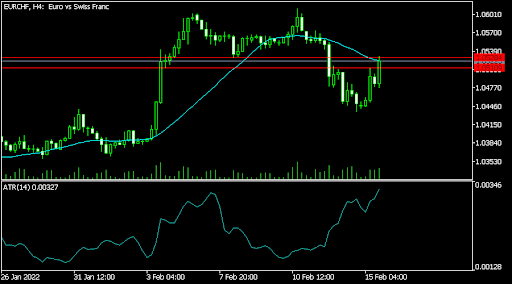
The EURCHF pair rose to a high of 1.0522, which was the highest level since February 11. On the four-hour chart, the pair moved above the key resistance at 1.0510, which was the highest level in January. It also moved above the 25-day moving average while the Average True Range (ATR) has been in a strong bullish trend. The pair has also retested the chin of the double-top pattern. Therefore, since a break and retest pattern is usually bearish, there is a possibility that it will resume the bearish trend.
XAU/USD
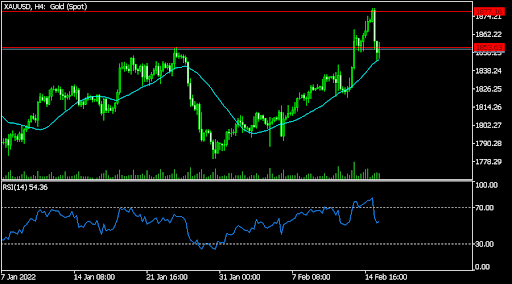
The XAUUSD pair erased some of the gains it made this week as demand for safe havens declined. The pair rose to a high of 1,875, which was an important resistance level since it was the highest level on November 16. It also managed to move below the key support level at 1,853, which was the highest point on January 27. Therefore, the pair will likely keep falling today.
Author

OctaFx Analyst Team
OctaFX
OctaFX is a market-leading forex broker, providing personalised forex brokerage services to customers in over 100 countries worldwide.