S&P 500 – Double Diagonal!


The S&P 500 has been making hard work of maintaining its uptrend since the last significant correction occurred into last August’s low of 2415.75 (futures). Since then, a five wave impulse pattern has pushed markets up by +7.3% per cent, impressive, but the momentum is now waning.
The impulse pattern began by unfolding into a series of 1-2’s, a step-like sequence of advances and declines of similar amplitude which are simply the fractal subdivisions of the up-coming 3rd wave. After three 1-2 sequences, ‘price-expansion’ occurred from the late-September low of 2485.00 which acts as the 3rd-of-3rd-of-3rd wave sequence within the pattern. The reason why the S&P is now making hard work of maintaining the same velocity is because, since early-October, it is engaged in a corresponding series of 4-5’s which are approaching upside completion that ends the entire impulse from August’s low.
Elliott Wave Pattern - The Double Diagonal
If we zoom-in to the final stage of the 4-5-4-5 sequences, we can see something a little unusual – see fig #1. The last two impulse advances as 5th waves can be seen taking the form of an ending/contracting diagonal pattern. The first of the diagonals acts as the fifth wave within the larger 3rd within August’s impulse advance. Note that extending wave 1 to 2580.75 projects the peak of wave 5 in close proximity to the final high of 2594.50.
This was followed by a three wave correction to 2555.50, ending the larger 4th wave within August’s impulse advance.
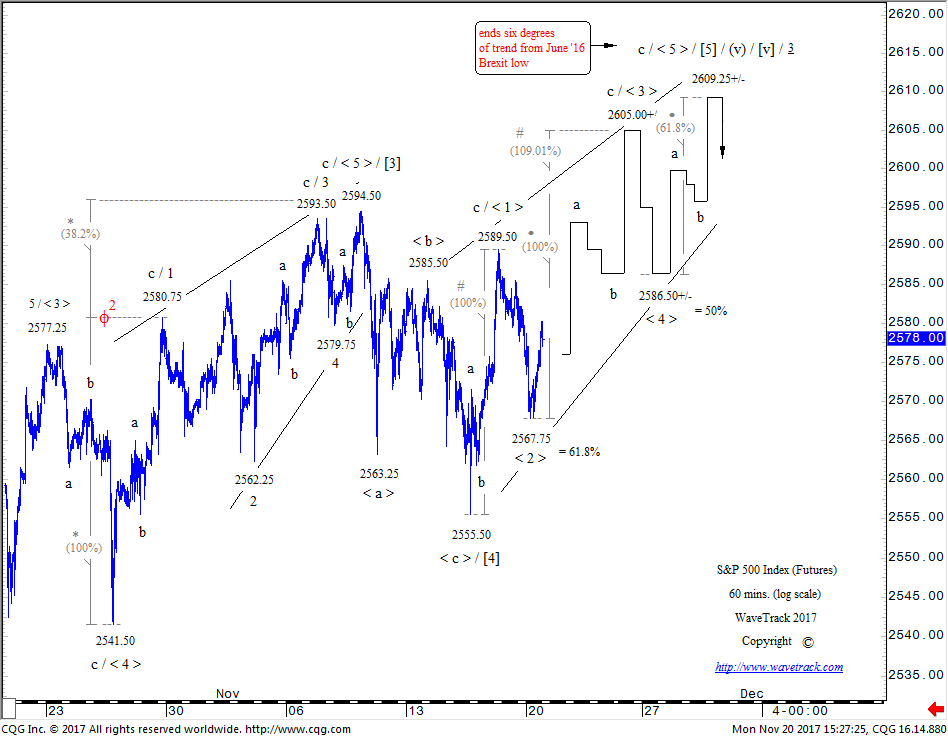
The following advance has also the initial hallmarks of unfolding into a diagonal too. The push higher from 2555.50 to 2589.50 has definitively unfolded into a three wave sequence, not a five. Had it been a five, this would have resulted in the advance proceeding as an ‘expanding-impulse’, but as a three wave sequence, this fits the profile of an ending/diagonal, because the impulse sequences, i.e. 1-3-5 are expected to subdivide into zig zags (or multiples, doubles/triples).
The 2589.50 high is labelled as ending the first wave, wave < 1 > within the ending/diagonal, wave < 2 > has since pulled lower to 2567.75. But wave < 3 > is now engaged to the upside – this must also subdivide into a zig zag (as illustrated) or perhaps a double/triple sequence.
Fibonacci Ratios
Wave < 3 > is commonly slightly larger than wave < 1 >, so we’ve used a subliminal fib. 109.01% ratio that measures its high towards 2605.00+/-. Wave < 4 > then pulls back towards the fib. 50% retracement area at 2586.50+/- which is enough to cause the necessary ‘overlap’ of wave < 1 >. And finally, wave < 5 > to upside targets towards 2609.25+/- where this unfolds by a fib. 61.8% ratio of wave < 3 >.
Observing back-to-back diagonals is something interesting to watch – this doesn’t happen often, and predicting a second is somewhat speculative but definitely worth exploring.
Subscribe and get the latest forecasts on Stocks, FX & Commodities – NOW!
Author
Peter Goodburn
WaveTrack International GmbH
WTI HISTORY

















