Silver-bearing ore is scarcer than Copper itself

Copper smelters in China ended September effectively paying miners over $230 a tonne for ore, not because copper is short but because silver-bearing ore is, and that favours silver holders.
A treatment charge is normally the fee a smelter earns for turning a miner's ore into metal. When that fee falls below zero, smelters are competing so hard for ore that they give it up and pay on top. The ore in question, called concentrate, is the form of copper output that carries silver. For silver holders, this is mildly good news over the next twelve months. The mines that supply more than a quarter of the world's mined silver are producing less of the ore that carries it. The limit is size. On our estimate, the silver at stake comes to roughly a quarter of this year's forecast deficit, and that estimate shrank with July's data.
Silver's price has been under pressure from rising interest rates. It traded at $61.14 an ounce on October 6, on USAGOLD's daily report. Gold stood at $4,156.30. Silver is about half its January high. The Federal Reserve raised rates on September 16 for the first time since 2023. The 10-year Treasury yield is now near its highest level since 2002. September's jobs report showed only 29,000 new jobs, which did not stop long-term yields from climbing. At Golden Meadow®, we treat that as pressure on the price over the next few months, separate from the longer-term case built on a shortfall in supply. Copper mining sits on the supply side of that case.
What a negative fee says about ore
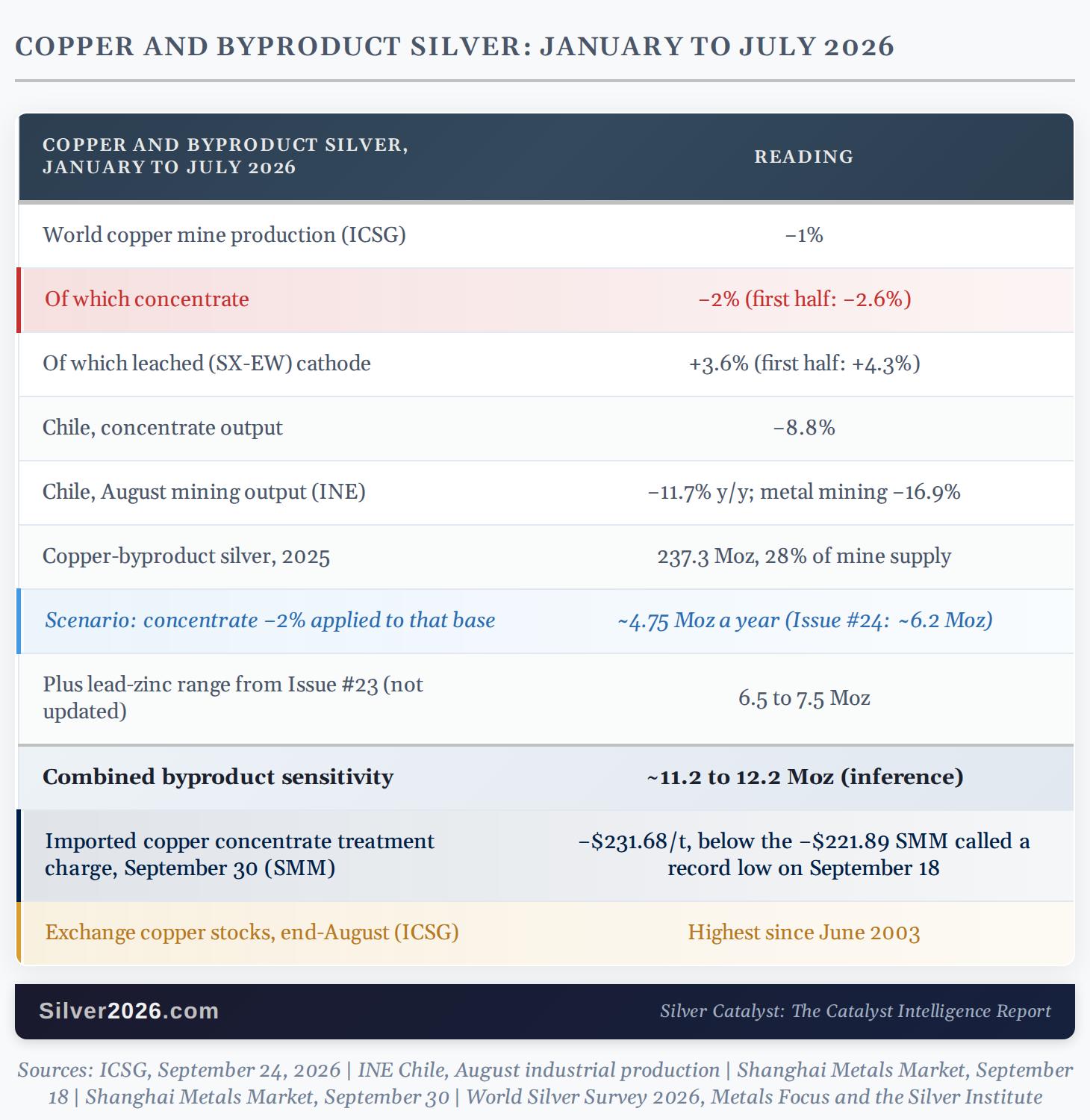
Most of the world's mined copper leaves the mine as concentrate. Smelters, many of them in China, turn it into metal. In a normal market the smelter charges the miner a fee for that work. On the index kept by Shanghai Metals Market, or SMM, that fee has fallen below zero, so the smelter effectively pays the miner.
The index hit what SMM called a record low on September 18. By September 30 it had fallen further, to minus $231.68 a tonne, on SMM's latest weekly review.
A negative fee is what a shortage of concentrate looks like. Smelters are bidding against each other for the ore that is available.
The ore that carries Silver
Copper comes out of mines in two forms. Concentrate is crushed ore that a smelter processes, recovering the silver alongside the copper. Leached cathode is copper dissolved out of rock with acid and plated directly, and it carries no silver.
In Issue #24, I discussed how copper producers leaned on leaching, which adds copper but no silver. The International Copper Study Group's latest figures, through July, show the same split. World copper mine output fell 1%. Concentrate, the silver-bearing part, fell 2%, while leached cathode rose 3.6%.
Chile, the largest copper producer, is part of the reason. Its mining output fell 11.7% in August from a year earlier. The national statistics agency pointed to lower ore grades at major operations and the after-effects of July's storms.
Labour disputes add to the risk
Two large Chilean mines face labour trouble this month. Escondida, the world's largest copper mine, fully suspended operations after a worker died during maintenance. It began restarting on September 24, SMM reported in the same review. Its supervisors' union has since rejected BHP's contract offer and voted for strike action, which under Chilean law means a period of government-led mediation first.
At Antofagasta's Centinela mine, 98.73% of union members voted to strike. A legal strike is possible from October 13 if no deal is reached, on the union's own estimate. A stoppage at either mine would likely reduce concentrate output.
Sources: ICSG, September 24, 2026 | INE Chile, August industrial production | Shanghai Metals Market, September 18 | Shanghai Metals Market, September 30 | World Silver Survey 2026, Metals Focus and the Silver Institute
How much Silver is at stake
Copper mines produced 237.3 million ounces of silver in 2025, on figures from Metals Focus and the Silver Institute. That was 28% of the world's mined silver. Applying the 2% fall in concentrate to that base gives roughly 4.75 million ounces a year.
Lead and zinc mines are the biggest source of silver, on the survey's figures. Adding the range we estimated for them in Issue #23, which has not been updated, gives roughly 11 to 12 million ounces. That is how much less silver there would be if silver output moved in step with copper, lead and zinc output. Every one of those figures is an inference, not a measured silver number or a forecast of ounces lost. The survey's own figure for 2026 arrives next year.
The other side deserves the same weight. Refined copper itself is plentiful. Stocks on the major metal exchanges were at their highest since June 2003 at the end of August. The shortage is in the ore that smelters need, not in the finished metal.
What this means to Silver investors
Most silver is mined as a byproduct of other metals, and copper mines supply more than a quarter of all mined silver. When smelters pay miners for ore, the ore that carries silver is scarce. That supports the case, set out in Silver Rising, that mine supply of silver cannot rise quickly, whatever the price does. Over the next twelve months, it is a mild positive for silver.
It is mild because of size. Our estimate of the silver at stake, roughly 11 to 12 million ounces, is an inference from tonnage, not a measured loss. It also went down rather than up when the July data arrived. Strikes at Escondida or Centinela would push it the other way.
Metals Focus and the Silver Institute forecast a 46.3 million ounce shortfall in the silver market this year, which would make it the sixth consecutive year in deficit. Copper's ore shortage does not create that gap on its own. It makes it harder for the mines to close it.
Want free follow-ups to the above article and details not available to 99%+ investors? Sign up to our free newsletter today!
Author

Przemyslaw Radomski, CFA
Gold Price Forecast
Przemyslaw Radomski, CFA (PR) is a precious metals investor and analyst who takes advantage of the emotionality on the markets, and invites you to do the same. His company, Sunshine Profits, publishes analytical software that any