The market is pricing a BoJ pause. Here's why Ueda's 'keep raising rates' could force a sharp Yen repricing
Traders betting on the Bank of Japan's (BoJ) rate through overnight-rate futures give a hike on October 30 about a one-in-four chance, so the market is pricing a pause. BoJ Governor Kazuo Ueda told a meeting of securities firms on Tuesday that the BoJ will keep raising rates, and that promise could force a Yen repricing if the report the BoJ publishes after its October 29-30 meeting signals a faster pace.
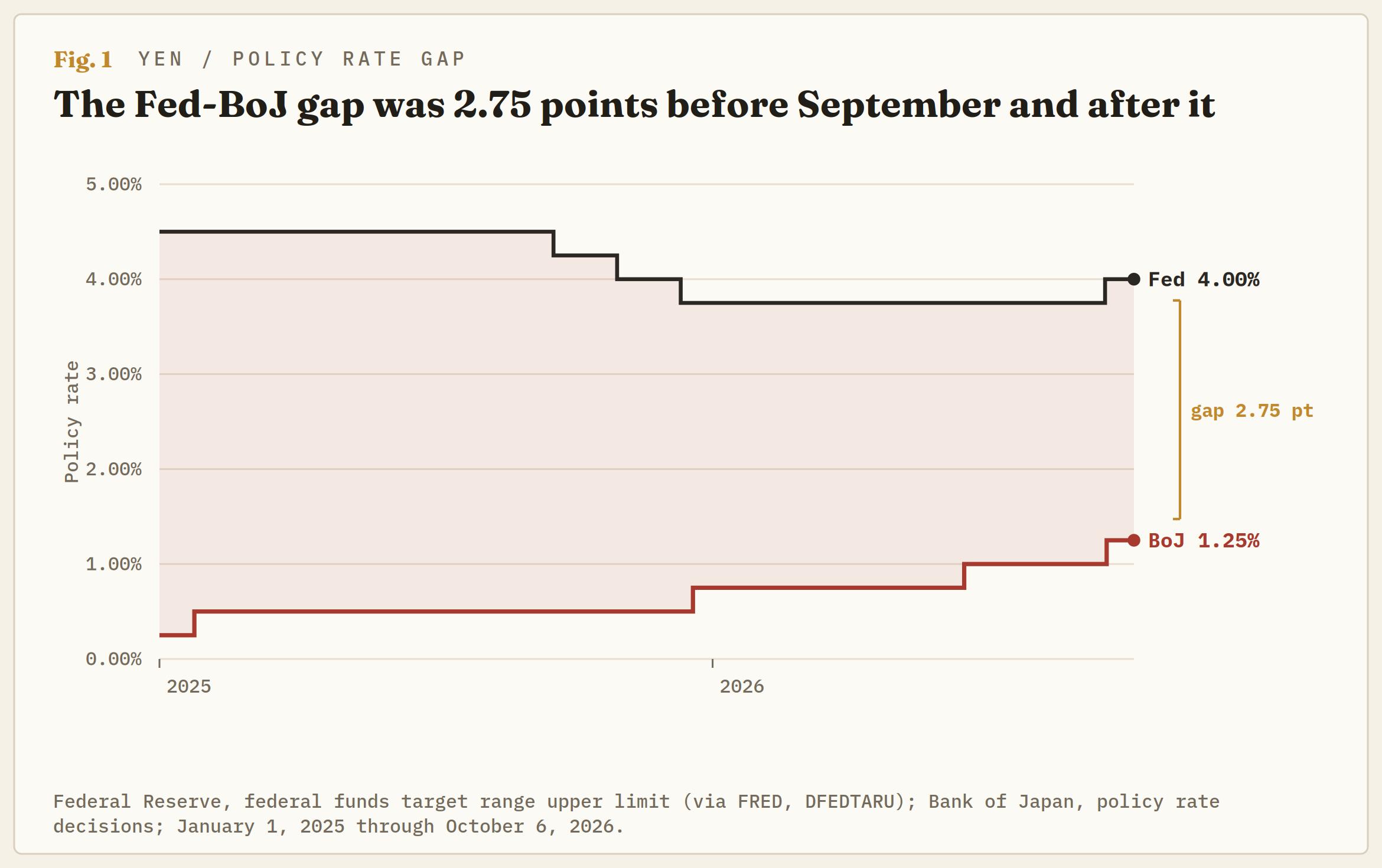
Pace is what both 2026 hikes lacked. The US Federal Reserve (Fed) raised its rate by a quarter-point on September 16, and the BoJ did the same on September 18, so the gap between them was 2.75 percentage points before both hikes and 2.75 points after them. The Yen weakened after the September hike, as it did after the June hike, because a single hike barely touches that gap.
The BoJ raised rates twice, and the Yen got weaker both times
The BoJ raised its rate to 1% on June 16 with USD/JPY near 160.00. By late July the pair was just below 164.00, and Japan's Ministry of Finance (MOF) started buying Yen with its reserves on July 30, joined by the US the next day. The Yen's weakest level in nearly four decades came five weeks after Japan's highest interest rate in 31 years.
The BoJ raised again to 1.25% on September 18, by seven votes to two, with BoJ board members Asada and Sato voting to wait. The pair was near 157.00 that day and reached 159.00 within a week, because the decision carried no clear signal of a faster pace.
A quarter-point every three months barely dents a 2.75-point gap
The Yen's value against the Dollar moves with the difference between what Dollar deposits and Yen deposits pay. The Fed's rate range tops out at 4.00%, 2.75 points above the BoJ's 1.25%, so the trade that borrows Yen cheaply to buy higher-yielding Dollar assets still earns most of what it earned before either hike. At one quarter-point every three months, the BoJ closes that gap in a little under three years, and only if the Fed never hikes again.
The BoJ meets eight times a year, so hikes at back-to-back meetings instead of every three months would add about a percentage point to Japan's rate over a year, a change big enough to reach the Yen.
Tokyo inflation went through 2% with a gasoline subsidy holding it down
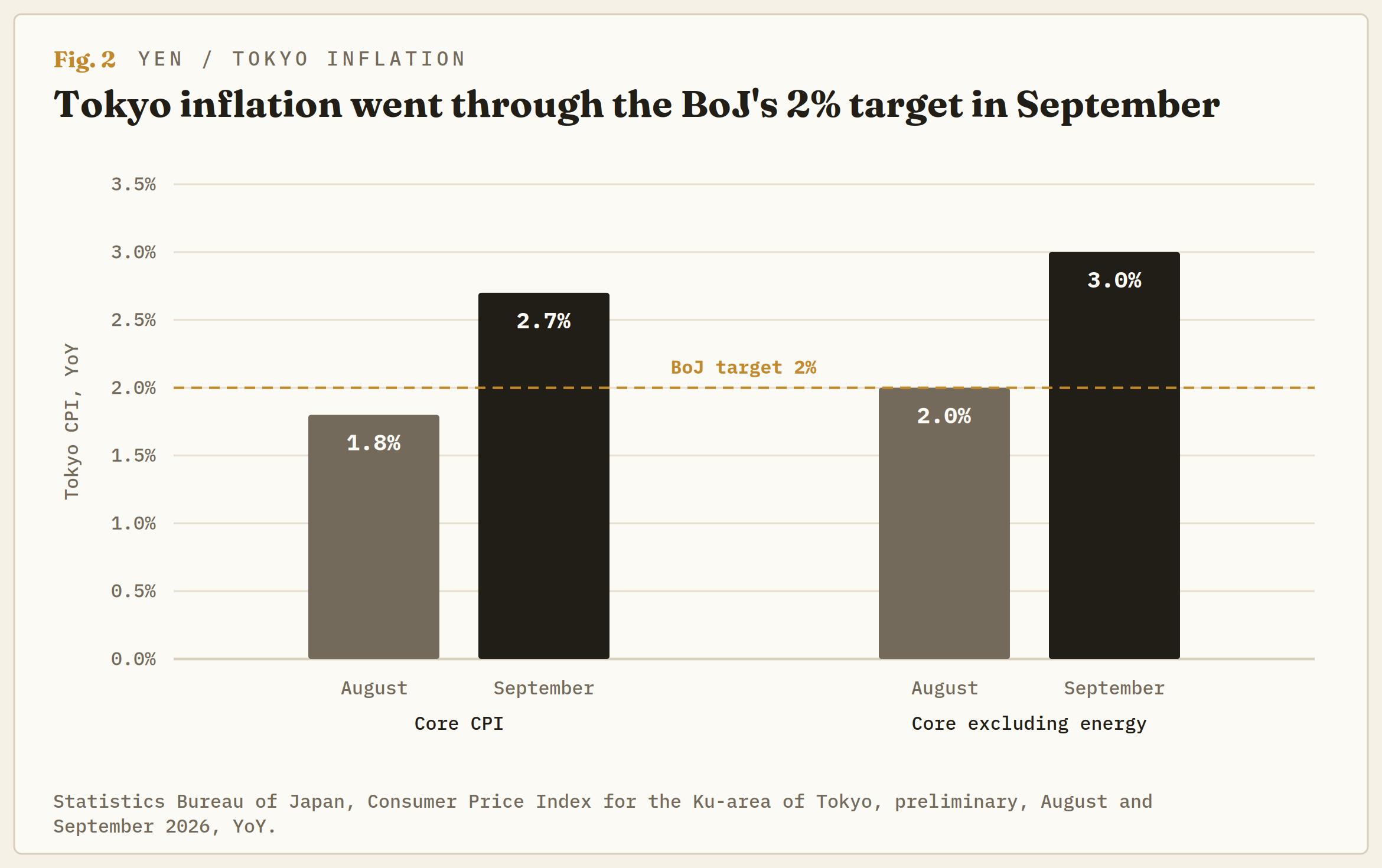
Tokyo's core Consumer Price Index (CPI), which strips out fresh food, rose 2.7% YoY in September, up from 1.8% in August and above a 2.4% forecast. It was the first reading above the BoJ's 2% target in nine months, in a month when the government raised its subsidy on regular gasoline. The measure that also strips out energy, which the BoJ treats as the better guide to underlying inflation, rose 3%, the highest in 13 months.
Governor Ueda said in the same speech that keeping underlying inflation anchored around 2% has become more important, and named three risks that could push it higher: the war involving Iran, demand tied to artificial intelligence, and the weak Yen. A weak Yen raises the price of everything Japan imports, starting with Oil, which puts the currency on the BoJ's own list of reasons to raise rates. Being on that list hasn't yet made the Yen stronger than it was on the day of the September hike.
The October 30 report matters more than the October 30 decision
People familiar with the BoJ's thinking told Reuters the report may say underlying inflation, price growth stripped of one-off swings, has roughly reached 2%. The BoJ's July report put that point somewhere between October 2026 and March 2028, so it may now close an 18-month window in its first month.
The same sources say many at the BoJ would rather wait in October. Futures give an October hike a 26% chance, most of one hike by December, and the rate at 2.02% by September 2027.
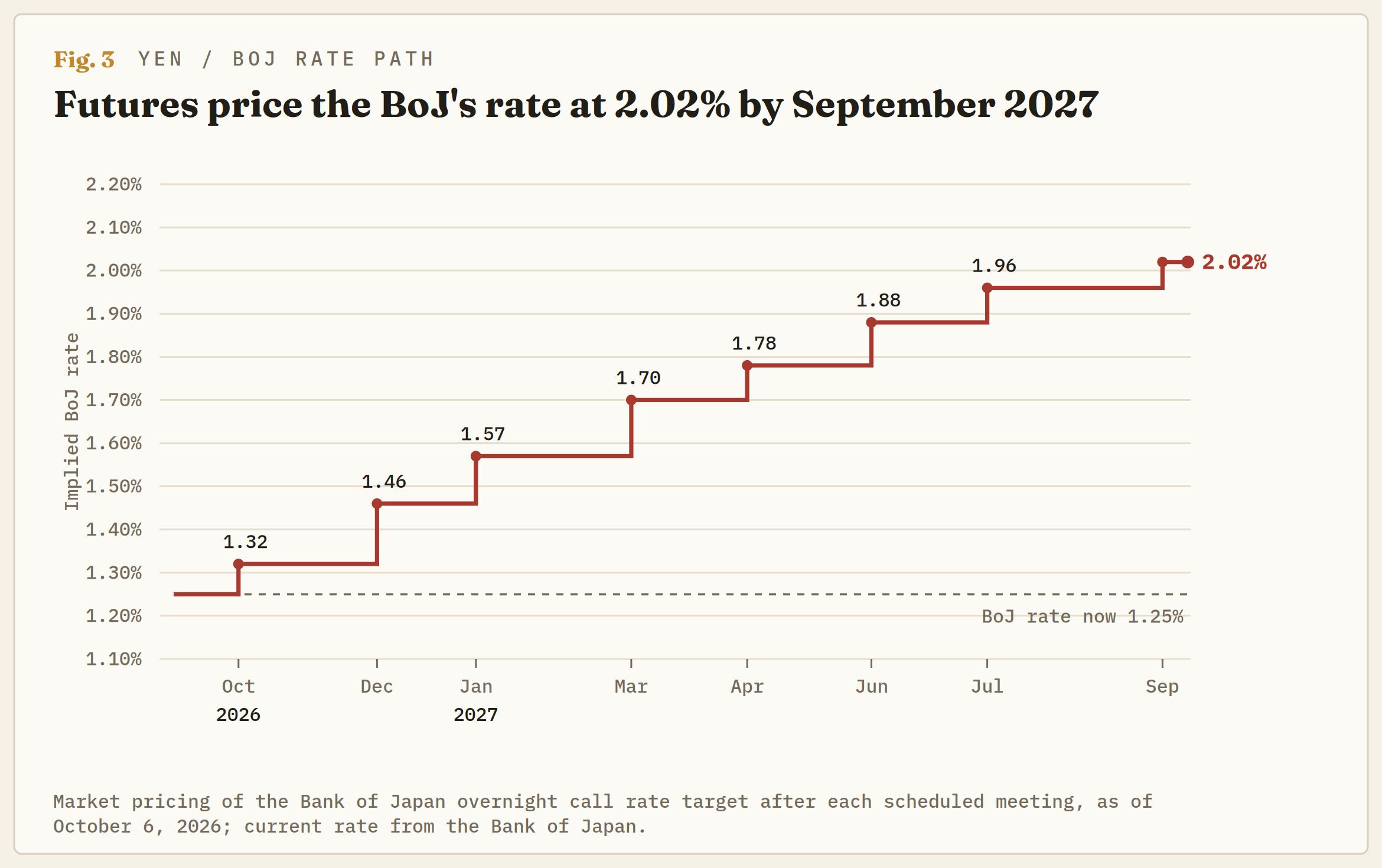
That path is slightly lower than on September 29, after a week in which Governor Ueda, BoJ Deputy Governor Uchida and three BoJ insiders all pointed to higher inflation.
Once underlying inflation is at 2%, the BoJ's stated job becomes stopping it from overshooting, which is the case for hiking faster. Tying 2% to pace would add hikes in January and March, raising what Yen deposits are expected to pay over the next year.
The Fed meets two days before the BoJ
The Fed raised its range to 3.75%-4.00% on September 16 and meets again on October 27-28. After US payrolls rose by 29K in September, CME FedWatch, which turns futures prices into the odds of a Fed move, put an October hike at about one in five. Futures give the BoJ a slightly better chance of an October hike than the Fed, and the BoJ is the one whose insiders call October a high bar.
If the Fed holds on October 28, the gap goes into the BoJ's report unchanged, and any signal on pace narrows it from Japan's side alone. A Fed hike would widen it by a quarter-point two days before the report, which is what happened in September. US CPI for September, due on October 14, can still move those odds.
The Yen has given back most of its September gain
USD/JPY fell from just above 160.00 in early September to just under 153.00 within a week, and has since retraced about 70% of that fall. The daily Stochastic Relative Strength Index (Stoch RSI), a gauge of how stretched a move is, has been above 80 since the start of October and is turning lower, so the rise had already stalled before Governor Ueda's speech. The pair hasn't made a higher high since July.
For two weeks the pair has traded between 156.50 and 159.00, on top of its 50-day and 200-day exponential moving averages (EMAs), averages that weight recent days more heavily, which have converged near 158.00. A daily close below 157.00 takes the pair under the range floor and both averages.
The report either names a faster pace or September repeats
If the report ties 2% to a faster pace, December moves to a full hike and January comes into play. A daily close below 157.00 would then point to 155.00 and the September low just under 153.00. A report that leaves the pace alone, or two more dissents, means September repeats, with the pair back at 159.00 and then 160.00, where it was when the BoJ hiked in June.
A Fed hike on October 28 overrides both branches by widening the gap before the report is out. This reading fails if the report delivers 2% and a faster pace and the Yen still weakens, because then only the Fed's side of the gap moves the Yen. The lean favours the Yen below 157.00 into October 30, and is off above 159.00. The BoJ has raised rates twice to get here, and the most useful thing it can do next for the Yen is publish a sentence about pace.
Author

Joshua Gibson
FXStreet
Joshua joins the FXStreet team as an Economics and Finance double major from Vancouver Island University with twelve years' experience as an independent trader focusing on technical analysis.