Japanese Yen nears 158.00: Two analysts agree it's bullish, and disagree on how far the breakout goes

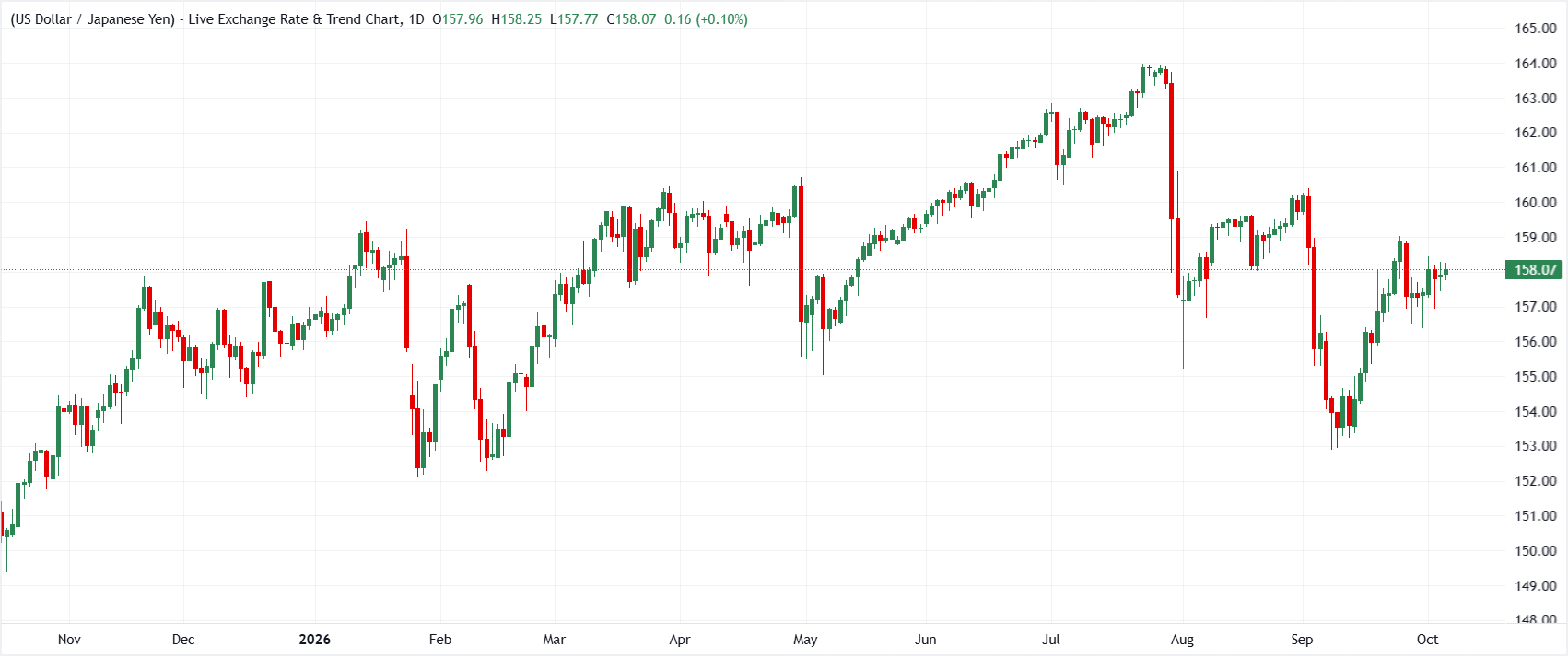
The Japanese Yen (JPY) is drifting near 158.00 against the US Dollar (USD) ahead of a busy week of Japanese data and a still-unclear Bank of Japan (BoJ) timetable. The two most recent FXStreet analyses agree on the direction — both are bullish on USD/JPY — but they disagree on the target and the mechanism: one reads a narrowing triangle with an immediate objective at 158.77, while the other sees a triple retest of a major institutional supply cluster setting up a high-velocity breakout toward 160.00.
RoboForex Analysis Department: "USD/JPY maintains a short-term upward structure"
RoboForex's technical read is the more measured of the two, framed around a tightening range rather than an imminent breakout. "USD/JPY edged higher to 157.90 on Tuesday, with the yen remaining within a narrow range," its analysts wrote, noting the pair is trading within a triangle with "gradually rising lows." Their base case: "The main scenario envisages a further rise towards resistance at 158.77," with "159.36 as the next medium-term upside target" should that level break. On the fundamentals, they flag the tension between Prime Minister Sanae Takaichi's stimulative fiscal plans and the BoJ: the September meeting summary "reflected growing concern that inflation could remain above the 2% target for longer," which "keeps the prospect of another rate hike before year-end alive, although the timing of the next move ahead of the October and December meetings remains unclear." A move below 157.54 would weaken the bullish scenario and expose 156.50. — Read the full report
Andrey Shvedov: "A triple retest of the 7th-order supply cluster"
Shvedov's read is more aggressive, anchored in order-flow microstructure rather than conventional chart patterns. "On the 4-hour timeframe, USD/JPY is currently executing its third consecutive test of the major institutional supply ceiling at the 158.12–158.80 zone," he wrote, arguing that "the sequential retests have progressively absorbed the dormant limit sell orders within the barrier," producing "a classic ascending compression structure." His conclusion: "institutional liquidity providers are systematically consuming the sell-side inventory, preparing the market for a high-velocity breakout cascade." Shvedov frames a buy-the-dip setup with a limit at 157.45 and a target ladder up to 159.85 — and an "immediate H4 candle close firmly above 158.85" validating "instant market momentum continuation toward 160.20." — Read the full report
The takeaway
Both analysts are bullish on the Japanese Yen's near-term direction against the US Dollar, but their conviction and targets differ: RoboForex sees a narrowing triangle with 158.77 as the immediate target and 159.36 only on a confirmed break, while Shvedov reads a triple retest of a heavy 7th-order supply cluster as the setup for a breakout cascade that carries USD/JPY toward 160.00. Watch the 158.77–158.85 zone — a daily close above it reconciles both views and opens 159.36–160.00, while a break below 157.54 would invalidate the bullish bias and expose 156.50.
(This article was created with the help of an Artificial Intelligence tool and reviewed by an editor. Know more.)
Author

FXStreet Insights Team
FXStreet
The FXStreet Insights Team is a group of journalists that handpicks selected market observations published by renowned experts. The content includes notes by commercial as well as additional insights by internal and external analysts.