The Euro regained some moxie after both French and German yields retreated a bit

Euro
The euro regained some moxie after both French and German yields retreated a bit. We see resistance at 1.1305 but the downmove is abnormally long and some off-the-wall factor can come along and drive a real correction higher.
See the 240-min insert. The 50% retracement lies at 1.1407.
Outlook
The Nasdaq hits a new high while the 10-year is at historic highs, too, after climbing in a sharp trajectory. These two things are not supposed to happen at the same time.
Another one: Brent oil prices fell on new Saudi efforts against the Houthis but winter looms and we are still not getting the oil and refined products that will be needed. Short-term vs. long term.
The high PCE reading combined with lousy payrolls drove the rate hike expectations down to 21.6% from 50.9% a week ago. We have five Feds speaking today. We get CPI next week (Wednesday) Oct 14 and it can’t be pretty. This is a clear conflict.
The bond gang wants rate hikes and a Fed chief and TreasSec with more credibility. Today’s yields are dissatisfaction with both outcomes. Where does it end? Nobody knows.
The bond gang is not impressed with statistical jiggery-pokery—the elephant in the room. The core PCE 3-mo annualized stands at 2.05% as of August. It had been 2.3% in July. The Fed notices. Warsh notices. Of course the core excludes food and energy, the very things the public is mad about. But a hold is not too wild an idea if you ignore prices paid and everything else.
Then there is the lopsided high growth, where everything higher is tech-related. The scary part—AI is competing with the US government for long-dated capital, and its’ not trimming. See the chart from Bloomberg.
Finally, the US indebtedness. Yes, you can “grow out” of debt. But is AI going to deliver that? The jury is still out. If AI is akin to railroads and the internet, there will be bodies along the way, as well as recessionary pockets. Us debt is $40.62 trillion. We say the US has been getting away with bad debt for decades. Can it keep doing it? The bond gang says “fix it.” Here is Google’s AI key stats:
- Share per U.S. citizen is $121,242.
- Share per taxpayer is $290,114.
- Debt-to-GDP ratio stands at 127%.
- Daily interest costs exceed $3.8 billion.
Forecast
For the 87th time, we have to say that global investors have almost no choice other than the US Treasury market. Size, variety, liquidity, etc. That means the dollar may correct against the panicky, but it will be back. So will gold come back if the indebtedness situation becomes a crisis.
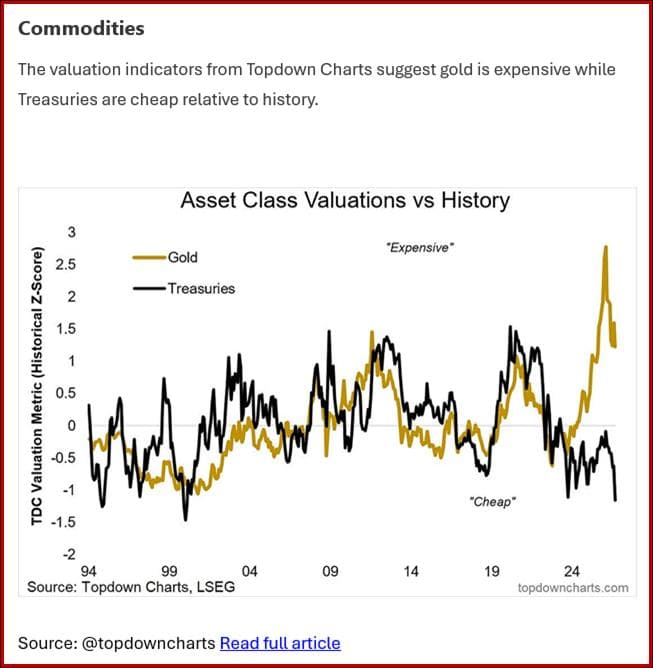
Does history bear this out? No. The Daily Shot has this chart. Historically, gold is too expensive and bonds are “cheap.” We ignore history at our peril.
This is an excerpt from “The Rockefeller Morning Briefing,” which is far larger (about 10 pages). The Briefing has been published every day for over 25 years and represents experienced analysis and insight. The report offers deep background and is not intended to guide FX trading. Rockefeller produces other reports (in spot and futures) for trading purposes.
To get a two-week trial of the full reports plus traders advice for only $3.95. Click here!
Author

Barbara Rockefeller
Rockefeller Treasury Services, Inc.
Experience Before founding Rockefeller Treasury, Barbara worked at Citibank and other banks as a risk manager, new product developer (Cititrend), FX trader, advisor and loan officer. Miss Rockefeller is engaged to perform FX-relat