France's government could fall over the budget. Here's what that would actually mean for the Euro

The Euro (EUR) is trading at its lowest level since May 2025, nearly 7% below its January peak, and France's government could fall over its 2027 budget before the end of November. A French government falling hasn't moved the Euro much by itself, so the risk to price is narrower: France losing its place under the emergency safety net the European Central Bank (ECB) keeps for government bonds.
That safety net, the Transmission Protection Instrument (TPI), lets the ECB buy a country's bonds when its borrowing costs jump for reasons that aren't its own fault. France keeps access only while the European Union (EU) hasn't ruled that it's failing to fix its deficit, and a government that can't pass a budget is the quickest route to that ruling. The ECB has never used the TPI, and its first test could be a country already under the EU's deficit rules.
French governments have fallen twice without hurting the Euro
Michel Barnier's government lost a censure vote, the vote that brings down a French government when a majority backs it, on December 4, 2024. France lost its first government to a censure vote since 1962 and the Euro rose 0.4% the next day. François Bayrou's government lost a confidence vote on September 8, 2025, and in the five trading days after each fall EUR/USD never moved more than half a percent.
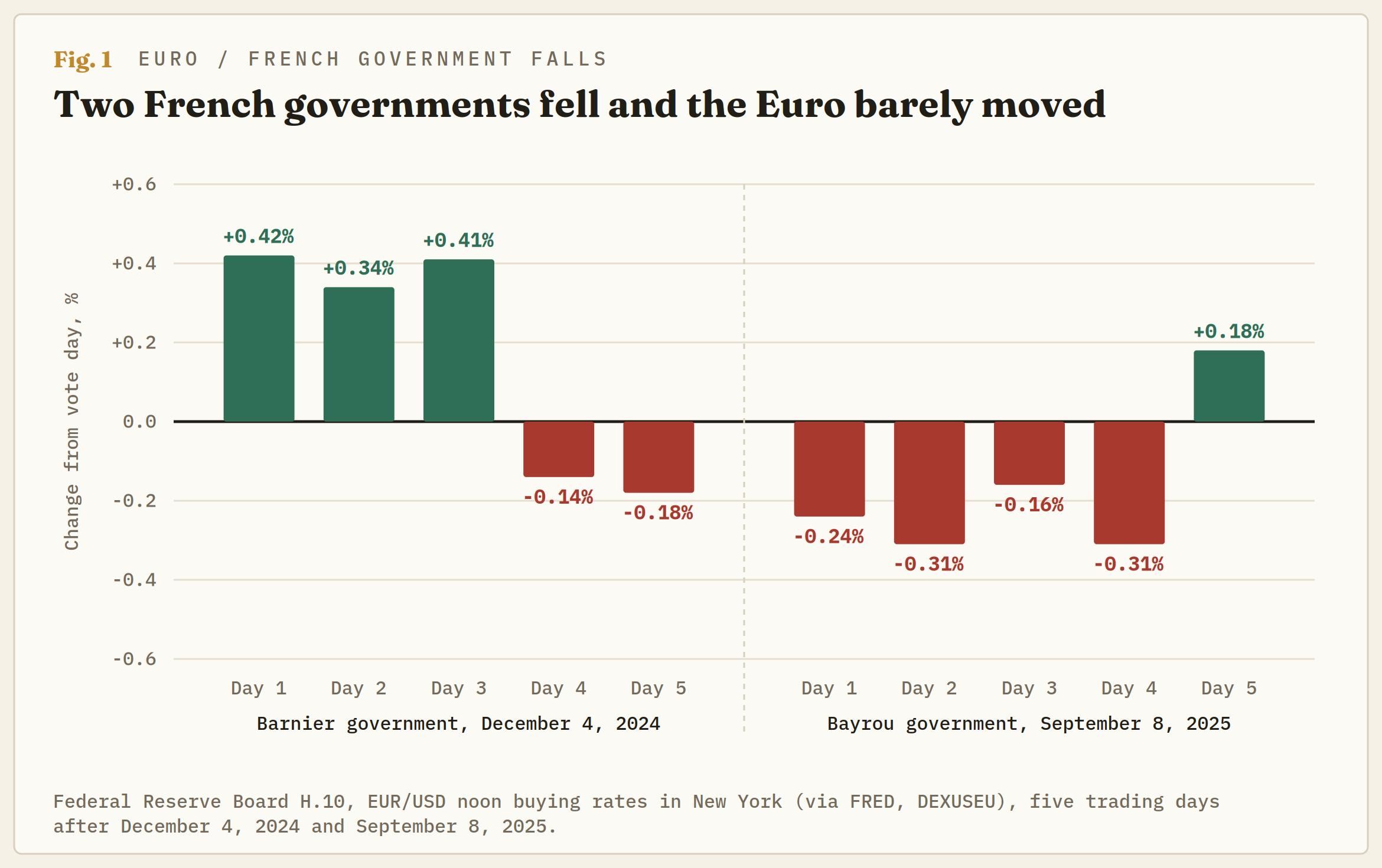
The cost of a French collapse lands on French bonds first, because investors ask more to lend to France than to Germany. The Euro falls with it only if that selling spreads to other countries or changes what traders expect from ECB rates, and in 2024 and 2025 it did neither.
This time the selling spread beyond France
The gap between French and German 10-year borrowing costs is about 1.5 percentage points, its widest since the Euro debt crisis, after its largest one-week increase in 17 years. When Prime Minister Sebastien Lecornu first resigned in October 2025, it was about 0.85 of a point. He's still prime minister, and the gap is nearly twice as wide.
Italian, Belgian and Greek bonds fell with French bonds after the 2027 budget was published last week. The Euro also fell against the Yen and the Swiss Franc, so the weakness isn't only on the Dollar side. Spain added a second vote on Monday, when Prime Minister Pedro Sánchez called a general election for November 29, and the Euro reached its 17-month low the same day.
France's access to the safety net rests on half a sentence
The ECB built the TPI in July 2022 so it could raise rates without one country's borrowing costs breaking away. To qualify, a country must not be under the excessive deficit procedure, the EU's formal process for deficits above its 3% limit, or must not have been found to be failing to take effective action under it. France has been under the procedure since July 2024, so its access depends on the second half of that test.
A finding that a country is failing to act is rare and politically decided, which has kept France eligible so far. The 2027 budget aims to cut the deficit from 5.4% to 5% of Gross Domestic Product (GDP), and a government that falls without passing even that would give the EU its strongest case yet.
The ECB also buys only where a jump in borrowing costs isn't explained by the country's own finances, and a 5% deficit is an explanation it could cite. Finance Minister Lescure said on October 6 that it's too early to talk about the TPI. It's possible the ECB would buy French bonds anyway, but Banque de France Governor Moulin, who sits on the ECB's rate-setting council, has warned against betting on it.
A week of French stress removed a third of the hikes priced in September
The ECB's deposit rate, what it pays banks to leave cash with it overnight, is 2.50%. Futures, which are bets on where that rate will be after each meeting, put about a 30% chance on an October 29 hike and nearly one full hike by December 17. They price the rate at 3.20% by September 2027, against near 3.40% on September 29 and near 2.80% in late August.
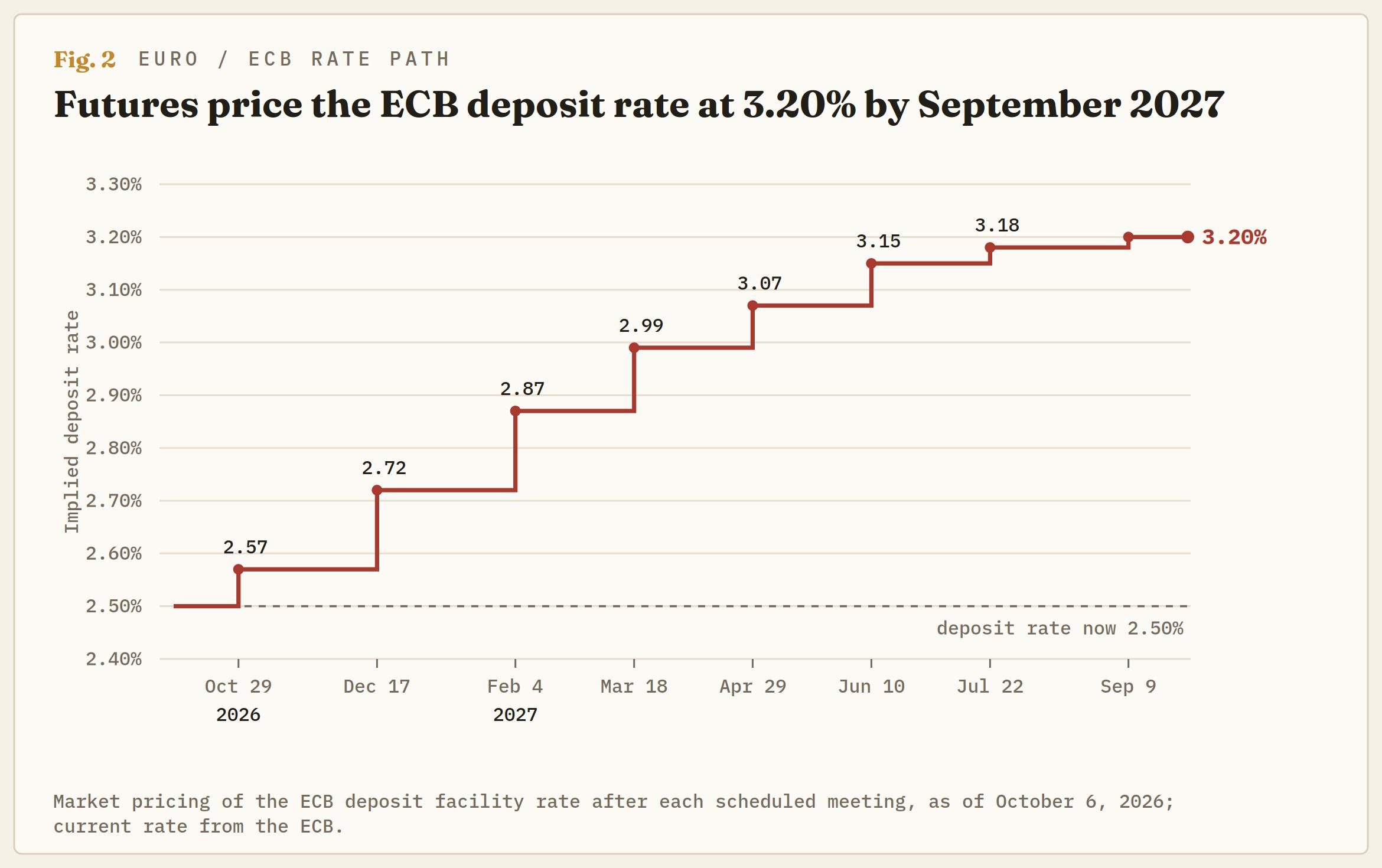
Higher French borrowing costs raise what French borrowers pay without the ECB acting, so traders expect it to do less. Fewer ECB hikes mean a smaller reward for holding Euros instead of Dollars, which is the line from a Paris budget vote to EUR/USD. The ECB hasn't met since its September hike, and its path in futures is already a quarter-point lower.
The budget sped up a slide that started in early September
EUR/USD has fallen for four straight weeks from its early-September high, about 4% top to bottom, breaking the June and July lows on the way. The daily Stochastic Relative Strength Index (Stoch RSI), a momentum gauge, has been below 20, the reading that marks a stretched fall, since mid-September, so the October 1 budget sped up a slide that was already under way. Every high since September 10 has been lower than the one before it.
The October 6 bounce has retraced about a fifth of the slide. French bonds were already rising before National Rally leader Marine Le Pen announced her own budget, and National Rally President Jordan Bardella has said the party will decide on censure based on the budget's merits. The party that decides whether the government survives has now written its own budget. 1.1350, the old floor, is the line, and a daily close back above it says the break was a false one.
Two budget votes and an EU verdict set the next move
The National Assembly votes on the revenue half of the budget on October 20 and on the whole budget on November 17, the ECB meets on October 29, and Spain votes on November 29. The left has promised to back censure, so the National Rally's 122 deputies hold the outcome. The Assembly stops sitting on February 28, 2027, for the presidential election, leaving little time for another.
A budget that passes, or a government that survives censure, keeps the safety-net question theoretical and leaves the gap with Germany room to narrow. With momentum this stretched, that branch points to 1.1350. If censure passes, the EU's verdict on whether France is failing to act becomes the live question just when French bonds would need the safety net. That branch widens the gap past its euro-crisis high, lifts Italian borrowing costs too, takes more hikes out of the ECB's path and puts 1.1000 in play.
Every date in this fork is on a calendar except the EU's verdict, and that's the one the safety net depends on. The lean is to sell the Euro only once the French gap moves past its October high, not on a censure headline alone. The case is wrong if the Euro makes new lows on a censure vote while the gap with Germany holds steady, because then a French government falling is a Euro event on its own.
Author

Joshua Gibson
FXStreet
Joshua joins the FXStreet team as an Economics and Finance double major from Vancouver Island University with twelve years' experience as an independent trader focusing on technical analysis.