Eurozone inflation just hit 3.8%, its highest in three years. This chart shows why the ECB can’t simply hike its way out

The European Central Bank (ECB) would normally have a relatively straightforward answer to inflation running almost twice its target: raise interest rates. But these are not normal circumstances. This time, the bond market is already doing part of the tightening for it, leaving the ECB facing an increasingly difficult dilemma.
Eurozone Harmonized Index of Consumer Prices (HICP) inflation accelerated to 3.8% YoY in September from 3.2% in August, beating expectations of 3.6% and reaching its highest level in three years. Core inflation also edged higher to 2.5% from 2.4%.
The numbers strengthen the argument that the ECB's inflation fight is not over. Yet, at almost exactly the same time, another form of monetary tightening is taking place without the central bank having to do anything. Government bond yields are soaring.
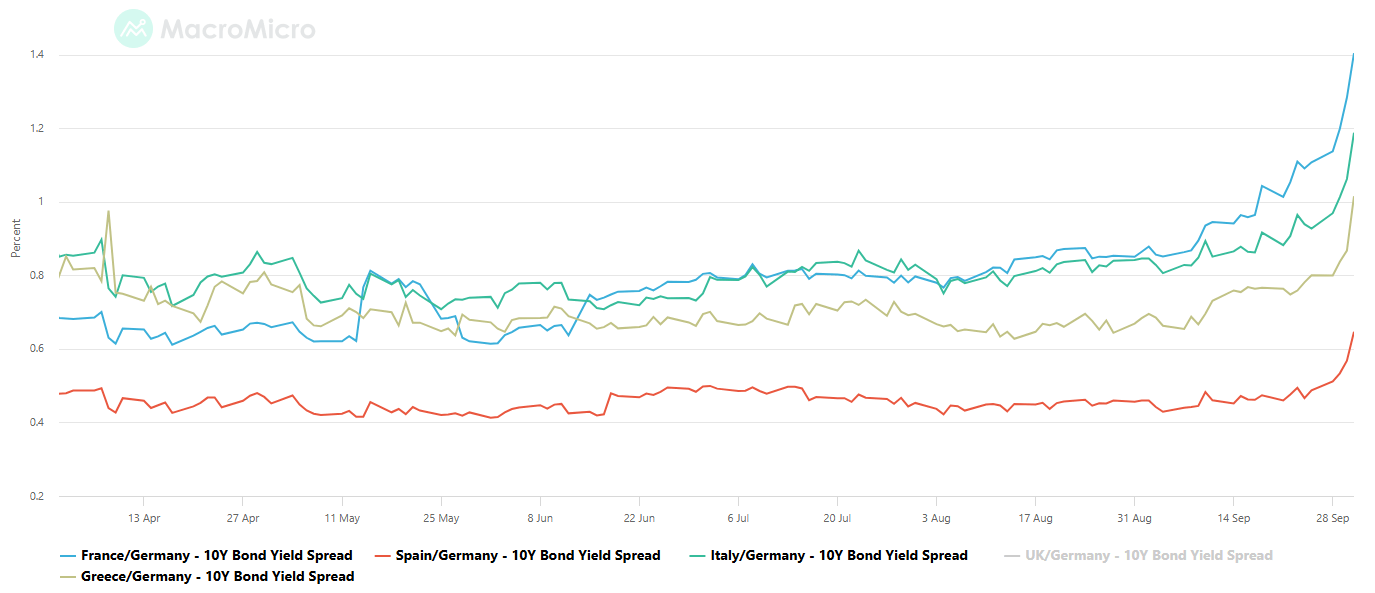
Germany's 10-year borrowing costs recently reached their highest level in 17 years, while France's 10-year yield approached 5%, its highest since 2002. The spread between French and German government bonds has meanwhile widened sharply amid concerns over France's fiscal outlook, with similar widening also observed in Italian and Spanish sovereign spreads.
Higher market rates feed through into borrowing costs for governments, companies and households, potentially slowing investment and economic activity. The ECB therefore faces an unusual question: if bond markets are already tightening financial conditions, how much further does the central bank itself need to go?
The bond market may be doing part of the ECB's job
The answer matters because the ECB has already raised interest rates twice this year, bringing the Deposit Facility rate to 2.50%. BBH argues that above-target inflation and firmer growth still give the ECB room to tighten further. The swaps curve, according to the bank, implies almost 75 basis points of additional tightening over the coming twelve months. TD Securities also expects another 25-basis-point increase in December, which would take the deposit rate to 2.75%.
But the rapid increase in long-term borrowing costs is beginning to challenge that straightforward hawkish narrative.
Deutsche Bank analysts argue that tighter financial conditions are creating “growing doubt whether central banks like the ECB could hike rates as aggressively as thought.” Standard Chartered reaches a similar conclusion. The bank notes that core inflation has only risen modestly since the beginning of the year and argues that higher yields create downside risks for both economic growth and inflation. As a result, the bank sees limited odds of an October rate increase and expects policymakers to prefer waiting for fresh macroeconomic projections in December.
The mechanism is relatively simple. Central banks raise policy rates partly to make credit more expensive, weaken demand and eventually reduce inflation. But when longer-term bond yields rise sharply on their own, mortgages, corporate financing and government borrowing can become more expensive even without another ECB rate increase. Aviva Investors Senior Portfolio Manager Steve Ryder described the bond sell-off as a potential “circuit breaker for rate expectations.”
That is increasingly becoming the central question facing policymakers. Inflation says tighten. Bond markets are already tightening for them.
Higher yields could actually help bring inflation down
Several ECB policymakers are explicitly acknowledging this dynamic. Governor of the Bank of Finland and member of the ECB Governing Council Olli Rehn said higher energy prices are bringing the Eurozone closer to the ECB's adverse inflation scenario. But he also pointed to the opposite force coming from financial markets. “The rise in long-term interest rates will slow growth and reduce the pass-through of the energy shock to other prices and wages,” said Rehn.
ECB Executive Board member Isabel Schnabel has made a similar argument. She said the economy could respond more strongly than expected to the recent surge in global yields, which “would dampen price pressures.”
ECB Chief Economist Philip Lane reinforced this view, arguing that the rise in long-term interest rates will slow economic growth and reduce the pass-through of the energy shock by more than previously projected. Crucially, Lane said that the “demand destruction” caused by higher energy costs could limit the adjustment required from ECB interest rates.
Nordea economists noted that September's acceleration was mainly driven by energy and food, while broader price pressures remained relatively moderate. The bank therefore does not expect an October rate hike, although it retains forecasts for increases in December and March.
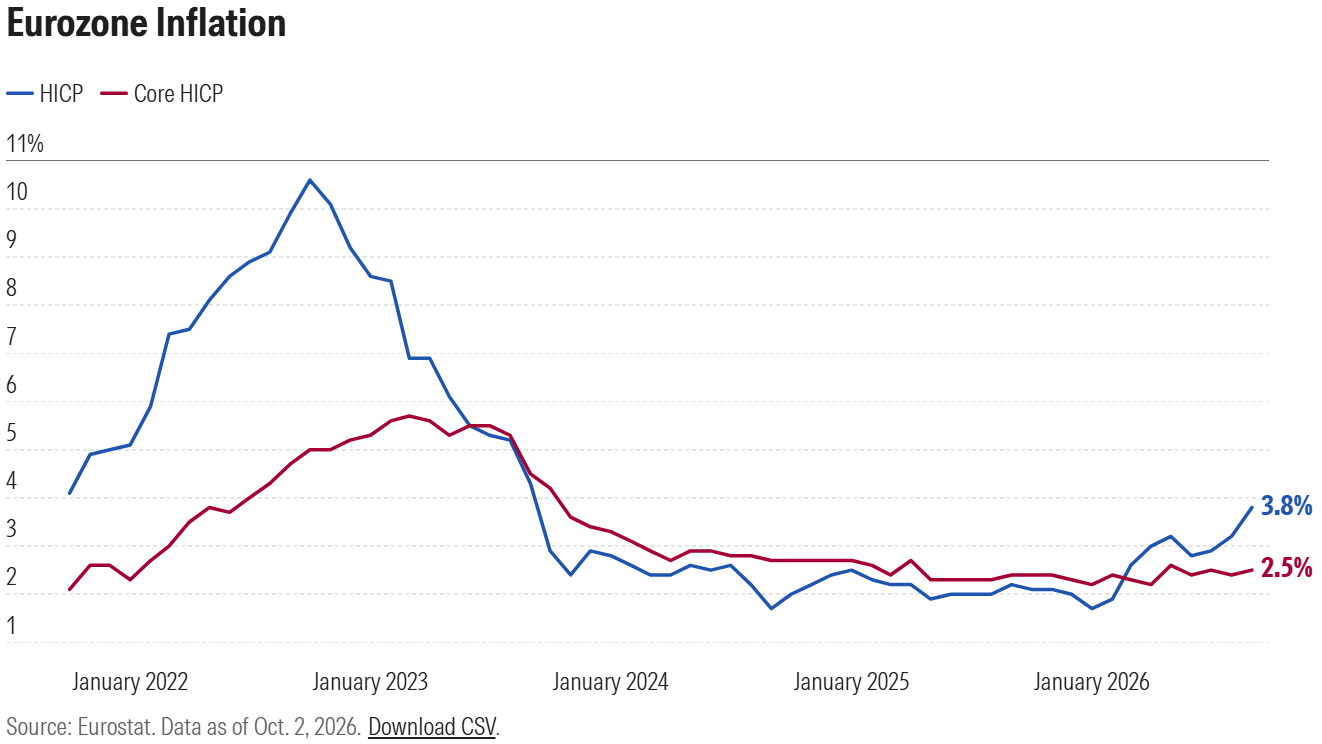
ECB President Christine Lagarde has also emphasized the absence, so far, of clear evidence that the latest inflation shock is becoming embedded. “We see higher inflation ahead but no signs yet that it is becoming embedded,” the ECB President said, arguing that a “measured response” remains appropriate. Phillip Lane, nevertheless, warned that the “second wave” of the energy supply shock creates direct upside risks to inflation while simultaneously posing downside risks to economic growth.
This leaves policymakers waiting for one crucial development: whether the energy shock remains concentrated in headline inflation or begins feeding more aggressively into wages, services and other prices. If second-round effects appear, the argument for higher rates becomes considerably stronger. If they do not, surging bond yields could increasingly substitute for additional ECB tightening.
France makes the ECB's dilemma much more complicated
The problem is that not all European yields are rising for the same reason. Part of the bond sell-off is global. US, UK, German and Japanese borrowing costs have all risen sharply amid concerns about inflation, energy prices, fiscal deficits and the outlook for central-bank policy.
France adds another layer. French 10-year government bond yields recently approached 5%, while the premium investors demand to hold French debt rather than German Bunds has surged to levels not seen since the Eurozone sovereign debt crisis.
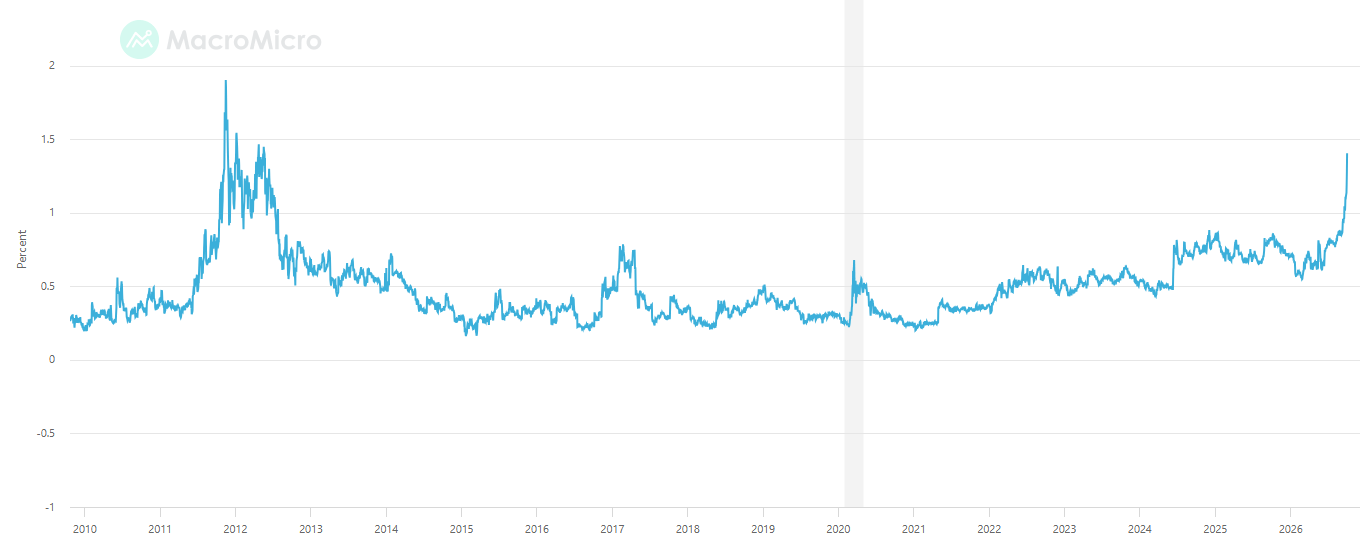
That spread matters for the ECB because monetary policy is supposed to transmit throughout the currency union. If borrowing costs rise broadly across the Eurozone because markets expect higher ECB rates, monetary tightening is functioning largely as intended. If borrowing costs in one group of countries begin rising much faster because investors question their fiscal position, the ECB starts facing fragmentation. And tighter policy could make that divergence worse.
MUFG argues that the widening in Eurozone spreads has already begun changing the monetary-policy debate. The bank notes that market pricing for ECB rate increases through mid-2027 has fallen by around 30 basis points from its recent peak as the bond sell-off intensified. ING Global Head of Markets Chris Turner argues that the French debt sell-off has “broken the narrative of ever-higher short-term market interest rates.” According to Turner, the move raises the question of whether central banks risk entering policy-error territory by continuing to tighten while financial conditions are already deteriorating.
That creates a difficult feedback loop. Higher inflation pushes the ECB toward higher rates. Expectations for higher rates contribute to higher bond yields. Higher yields tighten financial conditions and increase pressure on indebted sovereigns. That pressure then reduces the ECB's room to raise rates.
The ECB could eventually face an even bigger contradiction
If sovereign stress continues to increase, the debate could move beyond whether the ECB should raise rates. It could turn toward whether the ECB needs to support the bond market. The central bank created the Transmission Protection Instrument (TPI) in 2022 to counter unwarranted, disorderly market dynamics that threaten the transmission of monetary policy across the Eurozone. The instrument potentially allows the ECB to purchase sovereign bonds from countries facing unjustified market pressure.
But deploying it today would create an obvious communication challenge. The ECB is raising interest rates because inflation is too high. Purchasing government bonds to suppress borrowing costs would simultaneously ease financial conditions in parts of the economy.
Bloomberg describes this possibility as a potential “nightmare scenario” for the central bank. The issue is particularly sensitive in France because the rise in the country's risk premium is at least partly linked to its fiscal position.
“The spread widening is warranted given the fiscal stance and political uncertainty,” says Danske Bank Chief Strategist Piet Christiansen. Adding: “That's also what complicates the market view on the ECB. If it hampers monetary-policy transmission, it's a job for the ECB. If not, let's let the market price the drivers without intervening.”
That distinction could determine whether the TPI can realistically be deployed. The ECB designed the instrument to address unjustified fragmentation, not to shield governments from higher borrowing costs caused by their own fiscal fundamentals.
Bundesbank President and ECB Governing Council member Joachim Nagel has pushed back against expectations that specific spread levels could automatically trigger intervention. “My job in the Governing Council is to fulfill my mandate. It has nothing to do with maybe certain spread levels or things like that. It's price stability,” noted Nagel.
Three imperfect choices for the ECB
The ECB therefore appears to be moving toward a situation in which every available option carries a cost. It can continue raising rates aggressively to prevent the energy shock from spreading into underlying inflation. That could protect its inflation-fighting credibility, but also push borrowing costs higher, weaken growth and potentially amplify fragmentation across sovereign bond markets.
It can slow the pace of tightening and allow higher long-term yields to do more of the work. That could reduce pressure on indebted Eurozone economies, but risks leaving policy too loose if energy inflation begins feeding into wages and services.
Or, in a more extreme scenario, it could intervene to contain disorderly sovereign-market stress while maintaining higher policy rates. That would leave the ECB effectively tightening with one hand while easing with the other.
MUFG considers the TPI a last resort and argues that policymakers would probably first try to talk down rate-hike expectations. Other possible steps could include changes to quantitative tightening or greater flexibility in how maturing securities are handled. Any move in that direction could have significant consequences for the Euro (EUR).
Why the ECB's dilemma matters for the Euro
Ordinarily, higher inflation and expectations of additional ECB rate increases should support the Euro by increasing the expected return on Euro-denominated assets. That relationship becomes less straightforward when the reason for high yields shifts from expectations of stronger monetary tightening toward sovereign and financial stress.
ING argues that if the bond sell-off forces the ECB to deliver substantially less tightening than markets previously expected, EUR/USD could remain under pressure. MUFG similarly expects a stronger effort from ECB officials to push back against aggressive rate-hike expectations if the fixed-income sell-off resumes, a development the bank says would initially exert further downward pressure on the Euro.
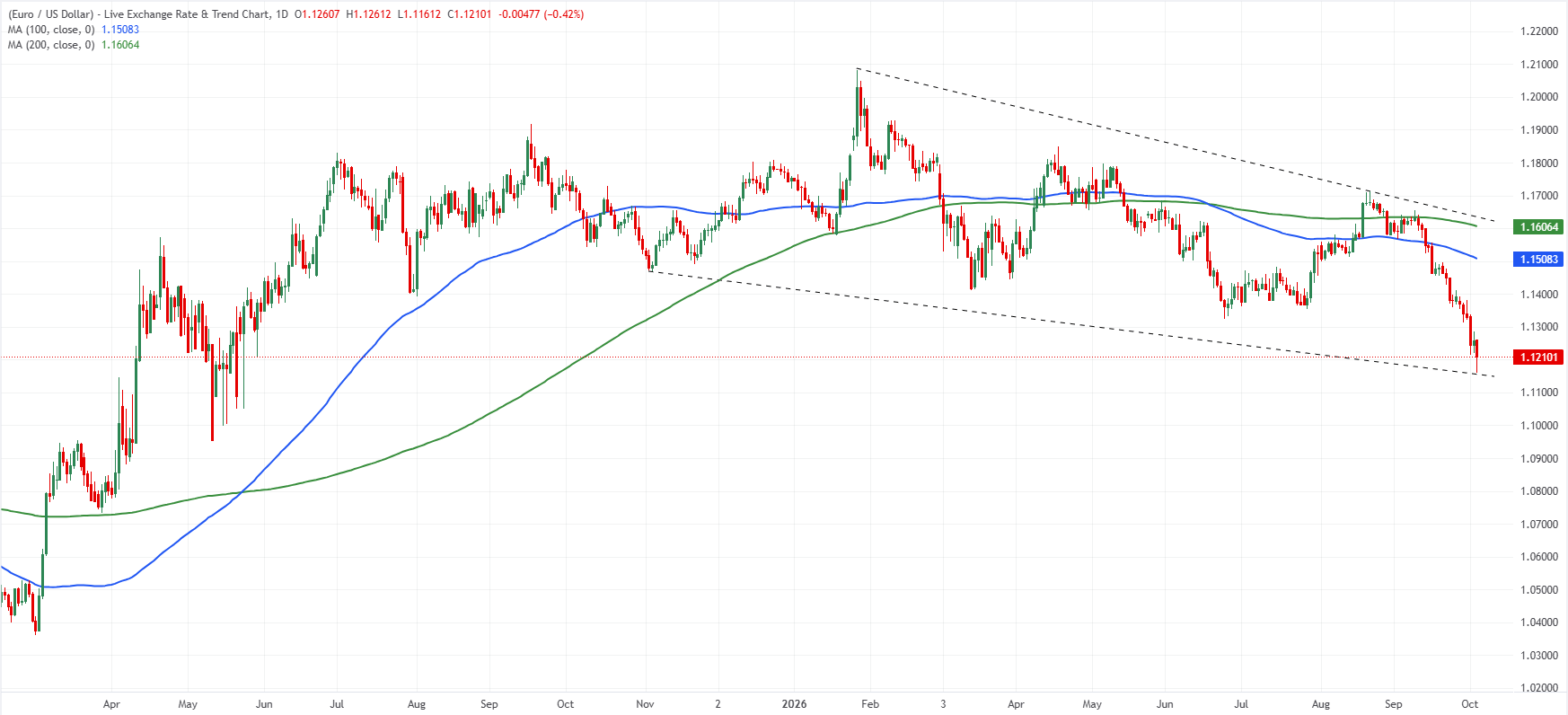
That helps explain the paradox now confronting currency traders. Rising European yields can be positive for the Euro when they reflect expectations for higher ECB rates. They can become negative when they reflect concerns about debt sustainability, fragmentation or an eventual need for ECB intervention. The dividing line between those two regimes may now be becoming increasingly important.
The next ECB decision is about more than inflation
September's 3.8% YoY inflation reading makes it difficult for the ECB to declare victory. Energy inflation is surging, headline inflation is almost twice the central bank's target and policymakers cannot assume that second-round effects will remain contained indefinitely.
But the bond market is changing the calculation. Long-term yields are already tightening financial conditions. France's sovereign stress is raising concerns about fragmentation. And several ECB officials acknowledge that higher borrowing costs could themselves slow growth and prevent the energy shock from spreading through the economy.
The central bank is therefore no longer deciding simply whether 3.8% inflation warrants another rate increase. It must decide how much tightening the Eurozone economy is already absorbing without its intervention.
If bond yields stabilize and underlying inflation strengthens, the case for additional rate increases could become clearer. If yields continue surging and sovereign spreads widen further, the opposite could happen. The ECB may have to slow its tightening campaign precisely as headline inflation approaches 4%.
For policymakers, that would be the uncomfortable irony of the current bond sell-off. The market may end up tightening enough to stop the ECB from tightening further.
ECB FAQs
The European Central Bank (ECB) in Frankfurt, Germany, is the reserve bank for the Eurozone. The ECB sets interest rates and manages monetary policy for the region. The ECB primary mandate is to maintain price stability, which means keeping inflation at around 2%. Its primary tool for achieving this is by raising or lowering interest rates. Relatively high interest rates will usually result in a stronger Euro and vice versa. The ECB Governing Council makes monetary policy decisions at meetings held eight times a year. Decisions are made by heads of the Eurozone national banks and six permanent members, including the President of the ECB, Christine Lagarde.
In extreme situations, the European Central Bank can enact a policy tool called Quantitative Easing. QE is the process by which the ECB prints Euros and uses them to buy assets – usually government or corporate bonds – from banks and other financial institutions. QE usually results in a weaker Euro. QE is a last resort when simply lowering interest rates is unlikely to achieve the objective of price stability. The ECB used it during the Great Financial Crisis in 2009-11, in 2015 when inflation remained stubbornly low, as well as during the covid pandemic.
Quantitative tightening (QT) is the reverse of QE. It is undertaken after QE when an economic recovery is underway and inflation starts rising. Whilst in QE the European Central Bank (ECB) purchases government and corporate bonds from financial institutions to provide them with liquidity, in QT the ECB stops buying more bonds, and stops reinvesting the principal maturing on the bonds it already holds. It is usually positive (or bullish) for the Euro.
Author

Ghiles Guezout
FXStreet
Ghiles Guezout is a Market Analyst with a strong background in stock market investments, trading, and cryptocurrencies. He combines fundamental and technical analysis skills to identify market opportunities.















