Seasonal adjustment changes could bring a downdraft to payrolls this winter


Summary
Building on our prior work estimating the impact of shifting seasonal adjustment trends on non farm payrolls, we extend our analysis to the fall and winter months. We expect COVID-related shifts in the seasonal adjustment process to weigh on the level of non farm payrolls in the fourth quarter, which could make it more difficult for the Fed to get a clear read on the labor market's recovery, especially as other real factors continue to add to uncertainty.
Reflecting on the summer surge
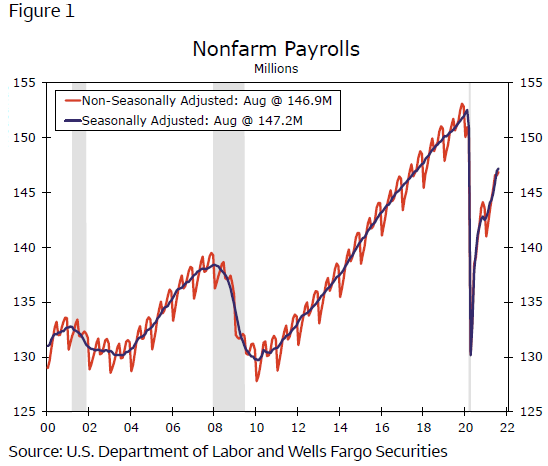
In this report, we build on our prior work to estimate the impact of shifting seasonal adjustment trends on non farm payrolls. While the level of payrolls tends to rise in expansions, it often fluctuates over the course of the year in a predictable pattern (Figure 1). The seasonal adjustment process aims to cutout this consistent variation in order to give a better idea of the underlying trend. Large swings in the economy, similar to what we experienced last year, can plague the seasonal adjustment process by introducing dificult-to-control outliers.
In our previous report, we developed a framework using the average (2015-2019) difference between seasonally adjusted (SA) and non-seasonally adjusted (NSA) payrolls for each month, to highlight the months in which seasonal adjustments play the largest role. From this, we found that four months(April, July, August & September) could be classified as seasonally calm, while the remaining eight months(January, February, March, May, June, October, November & December) were seasonally volatile. Though seasonally volatile months may not always experience seasonal distortions, the opportunity for such distortions is comparatively high. However, incorporating changes from the COVID crisis, unsurprisingly, introduced more volatility, reducing the number of seasonally calm months to two (April & September). July and August's seasonal adjustment factors jumped significantly higher in 2020, causing them to be reclassified as seasonally volatile.
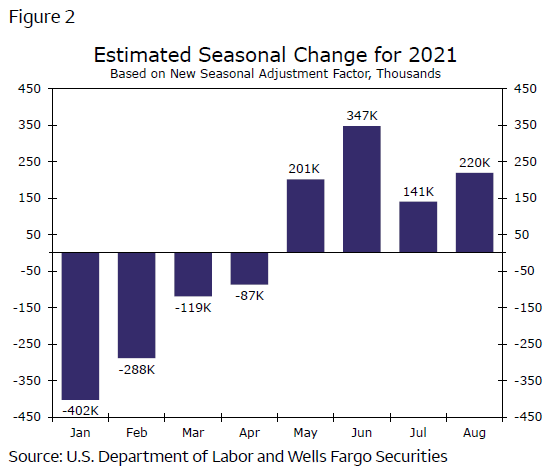
Since our previous piece, we have received this summer's payroll data, and as we suspected, there was a significant boost from the seasonal adjustment process from May to August (Figure 2). Despite August's disappointing 235K gain, which was less than a third of the gain expected by the consensus,our measure suggests that the seasonally adjusted level of non farm payrolls was 220K jobs higher than it would have been using the pre-COVID seasonal adjustment factor. Both July and August this year had SA-NSA differences that were larger than their 2015-2019 average. July's SA-NSA difference was 411K compared to 270K in a pre-recession era, while August's was 334K compared to 113K before the pandemic. This suggests that the switch from seasonally calm to seasonally volatile that we witnessed in 2020 for these months was preserved in 2021.
Author
Wells Fargo Research Team
Wells Fargo