RBA poised to reduce cash rate by 25 basis points

The Reserve Bank of Australia (RBA) will meet this Tuesdayand is widely anticipated to deliver its first rate cut in four years amid easing inflationary pressures. I am ‘reasonably’convinced that the central bank will reduce the Cash Rate this week, a belief basedon inflation and growth datathatdelivered printssouth of the RBA’s recent projections (released on 5 November 2024).
Following nine consecutive meetings on hold, markets are pricing in a 90% probability that the RBA will reduce the Cash Rate by 25 basis points (bps) to 4.10% from 4.35% (per the ASX 30-Day Interbank Cash Rate futures). Markets are also pricingforan additional 50 bps of cutsby the year-end, lowering the Cash Rate to 3.6%.
I am not holding my breath for anythingilluminating to come out of the RBA’s accompanying rate statement and press conference. I believe we will see the Board underscore a cautious tone, echoing the ‘data dependent’ approach.The central bank will likely shine the spotlight on the disinflation progress but stop short of providing anything concrete to signal further cuts.
The RBA will also release their detailed quarterly updated forecasts on growth (GDP [Gross Domestic Product]), unemployment, inflation, and the Cash Rate. Traders will look at these metrics closely for any revisions. I expect slightly lower revisions to GDP and inflation, but I do not see much change in forecasts for the Cash Rate.
Inflation and GDP: Main drivers behind a rate cut
In Q2 24, headline Australian inflation came in lower than expected, decelerating to 2.4% (from 2.8% in Q3 24) and marking the lowest quarterly reading since early 2021. This not only places headline inflation within the lower boundary of the RBA’s inflation target band of 2-3%, but the trimmed mean inflation rate – the RBA’s preferred measure of underlying inflation – also exhibited signs of softness, cooling to within touching distance of the RBA’s upper target band (3.0%) at 3.2% in Q4 24 (year-on-year [YY]) from 3.5% in Q3 24.
GDP cooled to 0.8% in Q3 24 (YY), down from 1.0% in Q2 24 and marked the slowest pace of economic growth since late 2020. Quarterly (Q3 24), GDP grew by 0.3%, following a slight increase of 0.2% in the previous quarter (Q2 24).
However, while inflation is trending in the right direction and growth remains subdued – providing some legroom for the RBA to cut the Cash Rate this week – the central bank’s easing cycle will likely be slow and steady this year.Coupled with underlying inflation trending just north of the RBA’s inflation target, the central bank still faces a reasonably solid jobs market. Employment increased by 56,300, comfortably surpassing the market’s median estimate of 15,000 and was above November’s revised reading of 28,200, and wage growth remains steady.
AUD/USD shaking hands with resistance
The AUD/USD currency pair (Australian dollar versus the US dollar)finished last weeklocking horns with daily resistance between US$0.6417 and US$0.6364 (this area comprises several ratios[including Fibonacci ratios], a horizontal resistance level, and an ascending resistance extended from US$0.6170).
What is also interesting is the approach to the above-noted resistance could prompt sellers to enter the fraythis week.Following a lower low of US$0.6088 in early February, this likely encouraged breakout selling. With these orders now flushed out of the market (bear trap) and the recent higher high (US$0.6368) potentially exciting buyers, this, coupled with price testing resistance last week, could be a bull trap in the making to push things lower.
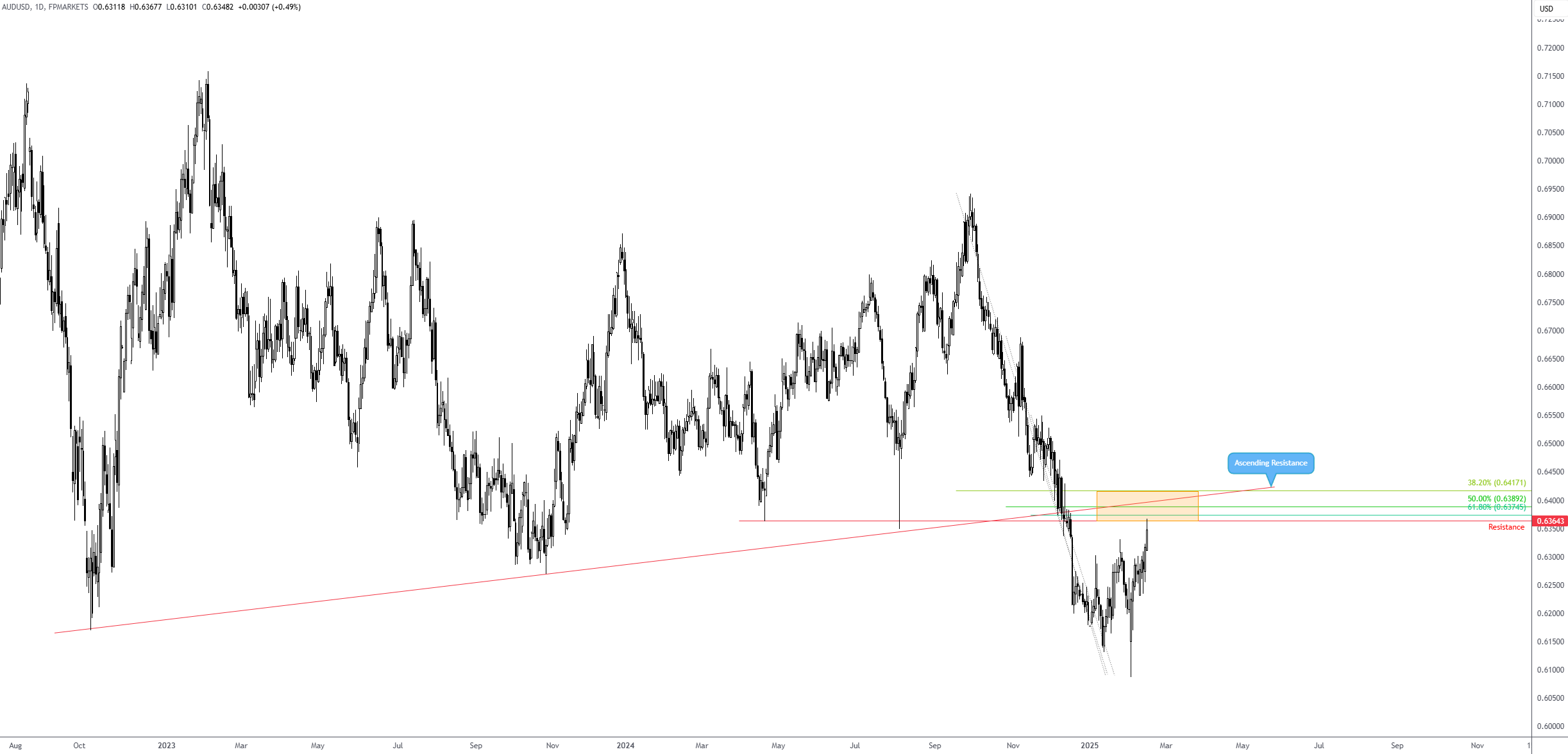
Chart created using TradingView
Author

Aaron Hill
FP Markets
After completing his Bachelor’s degree in English and Creative Writing in the UK, and subsequently spending a handful of years teaching English as a foreign language teacher around Asia, Aaron was introduced to financial trading,