|

Pakistan: Heightened risk despite agreement with IMF

The IMF and the Government of Pakistan have reached an agreement to complete the combined 7th and 8th reviews of Pakistan’s Extended Fund Facility which has been interrupted since March. If the IMF Executive Board approves the deal in the coming weeks, Pakistan will receive the equivalent of almost USD 1.2 billion. An extension of the support programme from September 2022 to June 2023 could allow the country to receive an additional SDR 720 million (i.e. approximately USD 947 million).

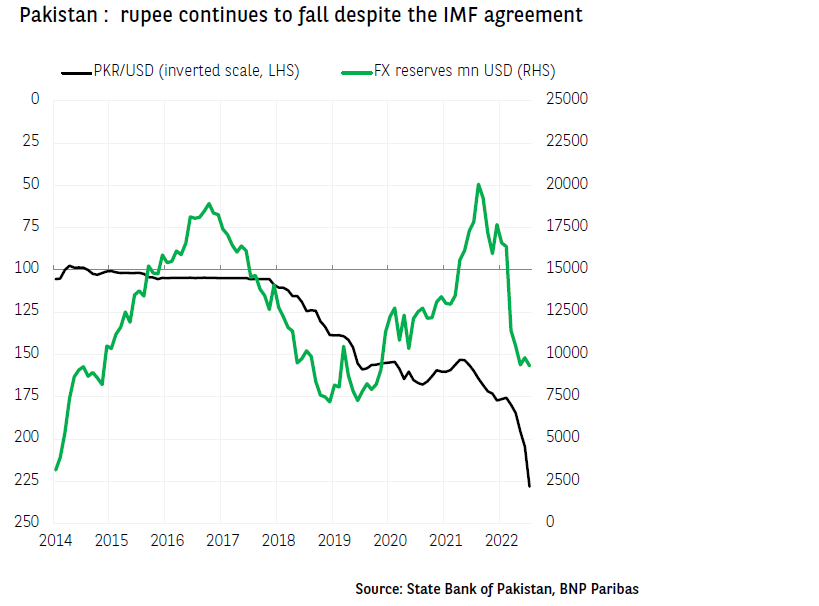
Although this agreement will partially and temporarily ease pressure on the country’s external accounts, the risk of a balance-of-payments crisis remains high. The high pressures on the Pakistani rupee have not eased. Despite increases in the key rate by the central bank (+800 bp since one year ago), the rupee has depreciated by more than 30% against the dollar over the last 12 months. Furthermore, unless the fall in commodity prices seen in recent weeks is sustained, the country’s external position should continue to deteriorate. Foreign exchange reserves amounted to only USD 9.3 billion in mid-July, equivalent to just one month of goods and services imports. To put things into perspective: the repayments of external debt for the 2022/2023 financial year, which will end on 30/06/2023, total USD 21 billion.

However, signing the agreement with the IMF could help to restructure the government’s debt with its main creditors, Saudi Arabia and China.
Chart

Download The Full Eco Flash

Author

BNP Paribas Team

BNP Paribas Team

BNP Paribas

BNP Paribas Economic Research Department is a worldwide function, part of Corporate and Investment Banking, at the service of both the Bank and its customers.


More from BNP Paribas Team
Share:

Editor's Picks

EUR/USD weakens to near 1.1900 as traders eye US data

The EUR/USD pair loses ground to around 1.1905, snapping the two-day winning streak during the early European trading hours on Tuesday. Markets might turn cautious ahead of the release of key US economic data, including US employment and inflation reports that were pushed back slightly due to the recently ended four-day government shutdown.

GBP/USD edges lower below 1.3700 on UK political risks, BoE rate cut bets

The GBP/USD pair trades on a weaker note around 1.3685 during the European session on Tuesday. The Pound Sterling edges lower against the US Dollar amid political risk in the United Kingdom and rising expectations of near-term Bank of England rate cuts. 

Gold drifts lower as positive risk tone tempers safe-haven demand; downside seems limited

Gold drifts lower during the Asian session on Tuesday and snaps a two-day winning streak, though it lacks strong follow-through selling and shows some resilience below the $5,000 psychological mark amid mixed cues. The outcome of Japan's snap election on Sunday removes political uncertainty, which, along with signs of easing tensions in the Middle East, remains supportive of the upbeat market mood.

Bitcoin Cash trades lower, risks dead-cat bounce amid bearish signals

Bitcoin Cash trades in the red below $522 at the time of writing on Tuesday, after multiple rejections at key resistance. BCH’s derivatives and on-chain indicators point to growing bearish sentiment and raise the risk of a dead-cat bounce toward lower support levels.

Follow the money, what USD/JPY in Tokyo is really telling you

Over the past two Tokyo sessions, this has not been a rate story. Not even close. Interest rate differentials have been spectators, not drivers. What has moved USD/JPY in local hours has been flow and flow alone.

Bitcoin Cash trades lower, risks dead-cat bounce amid bearish signals

Bitcoin Cash (BCH) trades in the red below $522 at the time of writing on Tuesday, after multiple rejections at key resistance. BCH’s derivatives and on-chain indicators point to growing bearish sentiment and raise the risk of a dead-cat bounce toward lower support levels.














