Oil prices went up on geopolitical risk


Outlook
In the US, it’s another day of second and third-tier information—the Philly and Kansas City Fed business surveys, existing home sales and the usual weekly jobless claims.
This week (so far) has been full of ridiculousness, not only unqualified cabinet picks that even kingmaker Rove calls “clowns,” but also a focus on a single tech company as the determinant of sentiment across markets. Oil prices went up on geopolitical risk even though the risk was already fully there. The choice to get scared about Russian missiles was a choice, not a necessity. Bitcoin hit another 52-week high. Some hedge fund dude paid $6.2 million for a banana duct-taped to a wall at Sotheby’s.
Consumer stocks are the worst sector despite retail sales being okay, with Target crashing 20% on a bad sales outlook. Chinese retailer Temu also crashed with nobody noticing that Target is hard to shop because they took away all the checkout clerks and Temu is a scam that shows pretty photos but delivers junk if it delivers at all. Analysts think the driver of an Amazon jump will be rolling out its own weight-loss drug in a country that is 75% obese.
The only remotely normal thing in all this is oil traders jumping on any little thing.
Then there is European malaise and uncertainty. The two cable outages now look like sabotage. Iceland is having a volcanic eruption for the tenth time in three years. Finland had two nuclear reactor malfunctions in one week. Natural gas prices jumped on cold weather, not a happy outcome for manufacturing (we get the PMI tomorrow).
Trading economics reports nat gas prices higher in the US, too, but the situation in Europe is fsr more dire. “European natural gas futures extended their increase to over €48 per megawatt-hour, the highest in one year, amid bets of stronger demand and risks of supply disruptions. A looming Arctic air mass is forecasted to bring widespread snowfall, intense winter storms, and below-average temperatures, amplifying the need for heating and electricity generation. Investors are also factoring in the escalating Russia-Ukraine conflict, anticipating further supply uncertainties.”
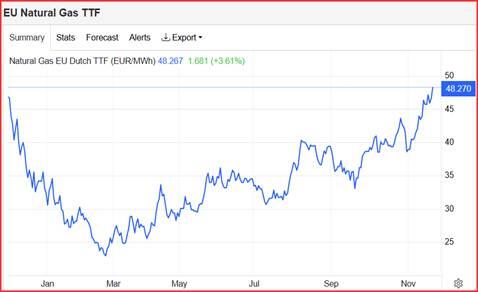
Remember that anxiety was super-high about this very thing when Russia invaded Ukraine and it was almost a miracle that Europe got through it. Can it do it again?
So, where does this leave us? With a big fat mess. So much that is foolish and absurd is Noise that prevents us from seeing what is really going on, which is hard enough to detect under normal conditions. We worry about surprises. China just removed tariffs on mostly raw materials from emerging markets—but plans to raise export controls on some and metals, including tungsten, graphite, magnesium and aluminum alloys. Trump can, of course, make this much worse.
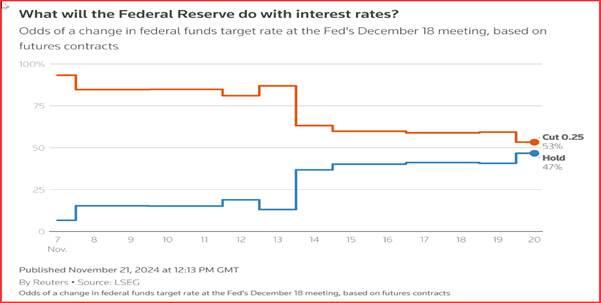
We are falling back on the usual factors—inflation, growth and what will the central banks do. See the chart on the Fed from Reuters. As noted before, we get different numbers every hour from the CME, but this chart is as good as any. It screams uncertainty and that tends to favor the dollar.
Central bank meetings
ECB December 12.
Fed December 18.
BoE December 19.
Bank of Japan Dec 19.
Forecast
What looked like a robust corrective move against the dollar across the board fizzled after only three days. Notice in the Chart Package that New Zealand hasn’t heard the news.
Assuming the false breakout really was false, the big players have to re-position long the dollar… we shall see with how much momentum. Noise is high and that tends to raise risk aversion.
Tidbit
The head of the Richmond Fed got a nice PR boost from the FT, which names Tom Barkin “a top Federal Reserve official.” The Barkin warns the US “is more vulnerable to inflationary shocks than in the past” ahead of the expected Trump polices—but he would not respond preemptively.
Data may show a slowing of inflation, “But he cautioned that businesses were passing on costs to consumers more readily than in the past — although to a much lesser extent than at the height of the coronavirus pandemic — which was having an impact on prices.”
Tariffs and deportations are inflationary, while energy prices being held down on increased output have the opposite effect. But “We shouldn’t try to solve it before it happens.” In other words, the Dec rate cut is still on the table for his vote in the FOMC.
This is an excerpt from “The Rockefeller Morning Briefing,” which is far larger (about 10 pages). The Briefing has been published every day for over 25 years and represents experienced analysis and insight. The report offers deep background and is not intended to guide FX trading. Rockefeller produces other reports (in spot and futures) for trading purposes.
To get a two-week trial of the full reports plus traders advice for only $3.95. Click here!
This is an excerpt from “The Rockefeller Morning Briefing,” which is far larger (about 10 pages). The Briefing has been published every day for over 25 years and represents experienced analysis and insight. The report offers deep background and is not intended to guide FX trading. Rockefeller produces other reports (in spot and futures) for trading purposes.
To get a two-week trial of the full reports plus traders advice for only $3.95. Click here!
Author
Barbara Rockefeller
Rockefeller Treasury Services, Inc.
Experience Before founding Rockefeller Treasury, Barbara worked at Citibank and other banks as a risk manager, new product developer (Cititrend), FX trader, advisor and loan officer. Miss Rockefeller is engaged to perform FX-relat