Oil prices fall, and stocks benefit from peace dividend, as SpaceX is still flying high

Stock markets in Europe are gaining momentum as we move through the morning on Tuesday, after a strong relief rally on Monday triggered by news that the US/ Iran will sign a deal to end the war and reopen the Strait of Hormuz by the end of the week. The oil price is continuing its decline and is lower by more than 1% today, with Brent crude oil trading just above $82 per barrel.
Peace dividend boosts market sentiment
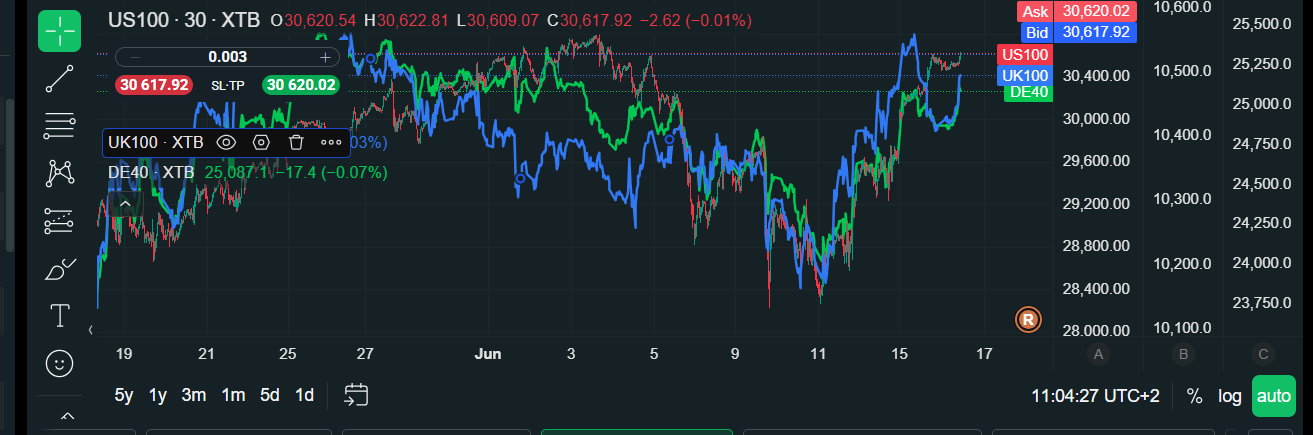
Although the deal has not been formally signed, there already appears to be a peace dividend for markets. US indices closed at record highs on Monday, along with a fresh record high for the Eurostoxx 600 index. The drop in the oil price and a significant decline in bond yields are also boosting the outlook for stocks. We are seeing European markets play catch up with the US, and this could continue, as some European indices remain below their pre-war levels, such as the FTSE 100, which remains about 500 points away from its early January high.
SpaceX makes further gains
There is more good news for SpaceX this morning. Elon Musk’s space conglomerate continued to rally on Monday and rose another 19%. Its stock price is higher by 48% since last week’s IPO and the company is now worth $2.6 trillion. Ahead of the US market open later today, SpaceX’s shares are higher by another 9%, as momentum in the stock price continues to build.
We have mentioned the structural forces that are boosting SpaceX’s share price before, including buying by passive index funds. However, this support could fade in July, which will be a bigger test for SpaceX. For now, it continues to bask in glory and is undoubtedly the hottest stock around.
OpenAI burns through cash
The AI theme remains central to markets today, after OpenAI’s financial details were revealed by journalists overnight. The main takeaway is that the company spent $34bn last year, significantly higher than 2024’s level. According to the FT, $19bn was spent on research and development, with a further $6bn on sales and marketing. Spending is outstripping revenues, which are coming in at approx. $2bn a month, up from $1 bn in 2024. The company is expected to have made $13bn in revenue last year. Although this is significantly lower than costs, revenue is growing quickly, which may placate investors in the lead up to its IPO later this year.
Stripping out costs associated with OpenAI’s restructuring to become a public benefit corporation; the company made an $8bn loss last year. This is more than SpaceX lost in 2025, which means that OpenAI is spending more and valued at a lower level than SpaceX, at approx. $800bn.
Caution about reopening of Strait of Hormuz is ignored for now
The oil price is continuing to fall, even though some oil tanker bosses are expressing caution about the reopening the Strait of Hormuz. Bosses of the world’s biggest shipping companies want to see more than just an agreement in place, mines need to be swept, and all hostilities must end, before tankers with hundreds of millions of dollars’ worth of cargo will be able to traverse the Strait without fear of a flare up in tensions that could close the Strait mid-voyage. Thus, even if a deal is signed to end the US/Iran war, the situation is not without its challenges. Brent crude remains above $80 per barrel, and it is unlikely to fall below this level until we start to see cargo ships successfully get through the Strait.
Central banks in focus as BoJ hikes
The focus will shift to macro developments as we move towards tomorrow’s UK CPI release and the FOMC meeting. The Bank of Japan followed the ECB and hiked rates this morning. Interest rates in Japan are now 1% and are at a 31-year high. This rate hike was well signaled, and the JPY is up only a touch vs. the USD, rising 0.1%. However, USD/JPY is still above 160, which means that he BOJ has more work to do if it wants to boost the yen to dampen domestic inflation pressures. However, looking ahead, the outlook for further rate hikes from the BOJ is not clear cut, as a decline in the oil price could do much to limit future inflation concerns in Japan.
The BOJ and the ECB’s rate hikes were both well signaled, which explains the moderate market reaction, EUR/USD is higher by 0.5% in the past 5 days and is trading around $1.16. However, the bigger outlier is what direction the Federal Reserve will take at its meeting on Wednesday. It is Kevin Warsh’s first meeting as chair. He is not a fan of forward guidance, so how will he direct markets about the Fed’s current stance on monetary policy? With a strong economic backdrop and CPI above 4%, it does not leave the Fed with much room to maneuver. Warsh may not be able to avoid President Trump’s ire, as we do not expect him to signal that rate cuts are coming, instead we expect a prolonged pause from the Federal Reserve in the coming months.
The Nasdaq, the Dax and the FTSE 100, 1 – month chart, European stocks play catch up
Source: XTB
Author

Kathleen Brooks
XTB UK
Kathleen has nearly 15 years’ experience working with some of the leading retail trading and investment companies in the City of London.