AUD/USD: A Hawkish hold, a hesitant Aussie

The Reserve Bank blinked first — But not the way the Aussie wanted
The RBA held the cash rate at 4.35% this morning, snapping a three-meeting hiking streak and delivering exactly what the market had penciled in. Yet the decision arrived wrapped in a familiar warning: this is a pause, not a pivot. Governor Bullock kept the door to further tightening firmly ajar, reminding traders that inflation — still running near 3.4% on the underlying measure — remains the central concern, with higher fuel and commodity costs now bleeding into housing and construction.
Here’s the catch the market is wrestling with: a hawkish hold should support a currency. Instead, short-term rates drifted lower and the Aussie struggled to find a bid. Why? Because for AUD/USD right now, the RBA isn’t the one holding the pen — the Fed is.
With the US central bank settling into a prolonged hold of its own and the dollar reclaiming ground lost after the Iran de-escalation, the rate-differential story that would normally lift the Aussie on a hawkish RBA simply isn’t firing. Bullock can sound as vigilant as she likes; until the Fed narrative softens, the Aussie’s upside stays on a short leash. The second-half bull case — the one that points toward 0.73 — leans almost entirely on US data cracking, not Australian rates climbing.
So the market knows the RBA is on hold. What it might be missing is that the next leg for AUD/USD probably won’t be written in Sydney at all.
The chart
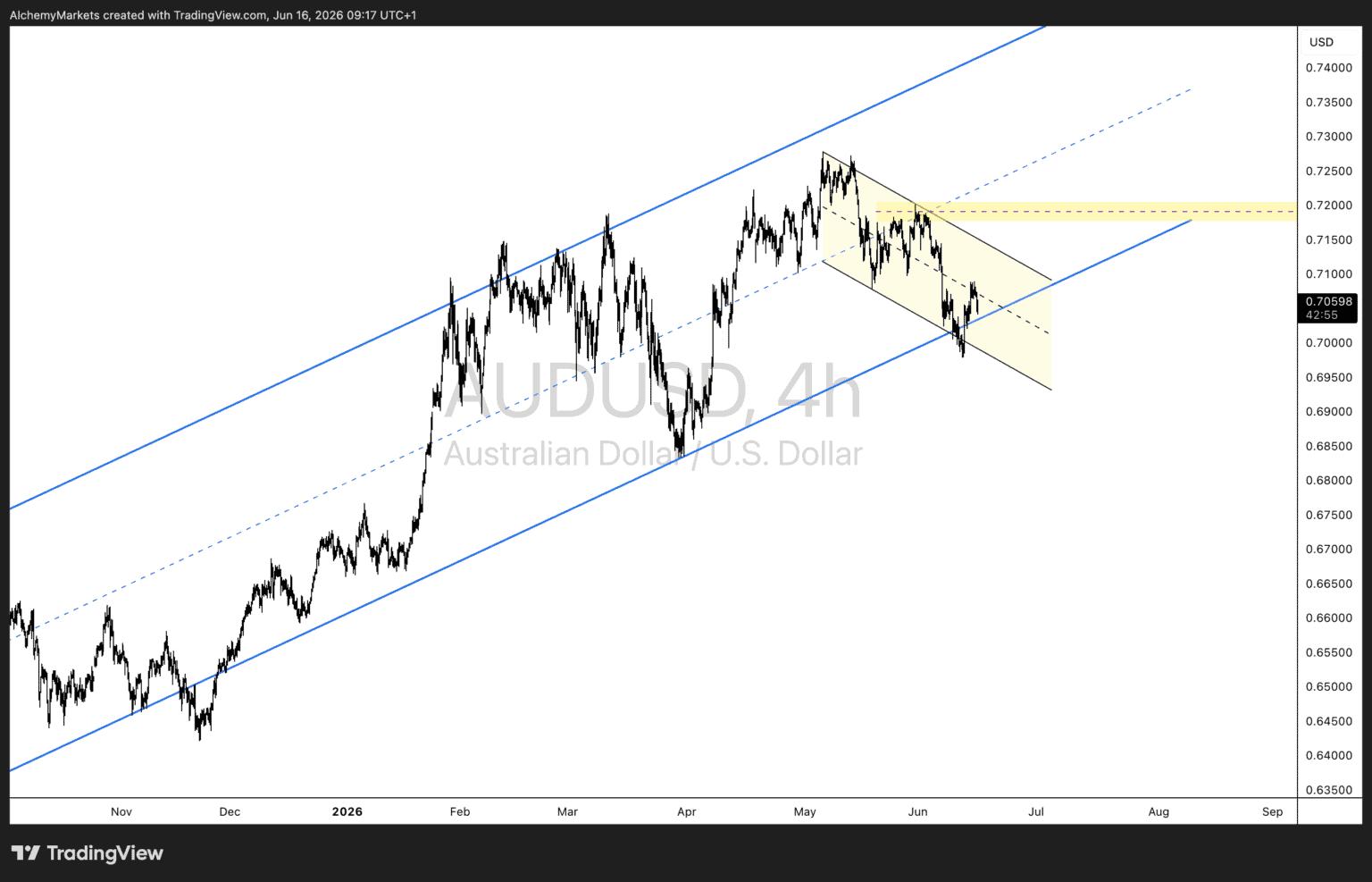
The price action tells the same story of suppressed momentum. On the 4-hour, AUD/USD continues to track inside the broad ascending channel that has framed the entire move higher since November — the structural uptrend is not broken.
But zoom in, and the near-term picture is more cautious. Since topping out near 0.7270 in early May, price has been carving lower inside a descending channel — a corrective drift that has guided the Aussie down toward the 0.7000 handle, where it found support and is now attempting to recover back toward the channel’s midline around current levels near 0.7060.
The level that matters sits overhead. 0.72 is our initial resistance projection — the prior pivot zone and the area where the descending channel’s upper boundary now converges. As long as price trades beneath it, the corrective structure stays intact and rallies are best read as tests rather than breakouts. A clean reclaim of 0.72 would be the first real signal that the May–June drift is over and the broader uptrend is ready to reassert.
Until then, the Aussie is caught between two channels and two central banks — supported by structure, capped by the dollar, and waiting for a catalyst it can’t supply itself.
Author

Zorrays Junaid
Alchemy Markets
Zorrays Junaid has extensive combined experience in the financial markets as a portfolio manager and trading coach. More recently, he is an Analyst with Alchemy Markets, and has contributed to DailyFX and Elliott Wave Forecast in the past.