|

NZD/USD stuck in a rectangle pattern [Video]

  • NZDUSD claims 200-day SMA and descending trendline.

  • But the pair fails to rally, extending sideways move.

  • Oscillators improve but remain in negative territories.


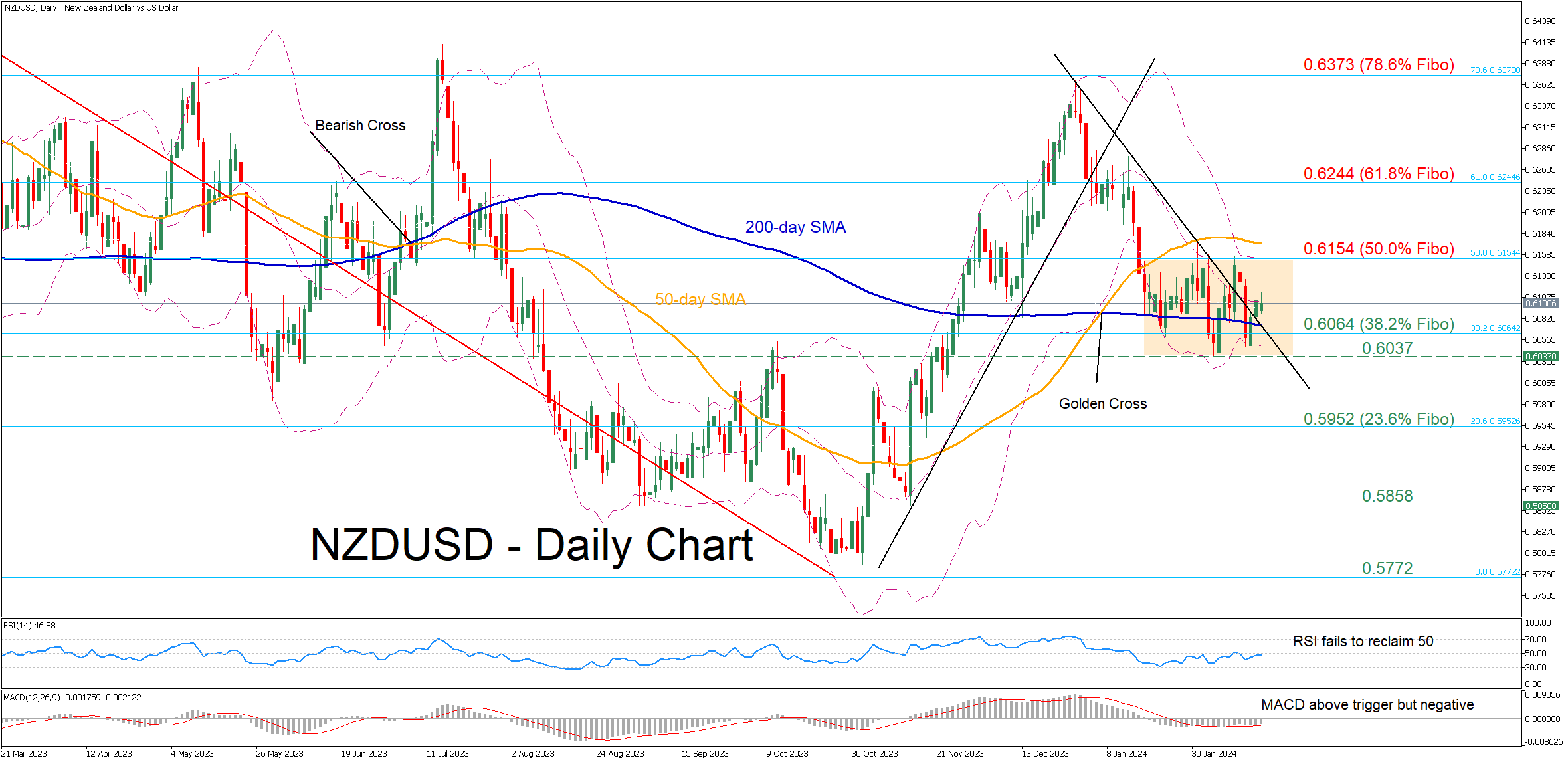
NZDUSD entered a downtrend after getting rejected at the 78.6% Fibonacci retracement of the 0.6536-0.5772 downleg in December. However, the pair has adopted a rangebound pattern around the 200-day simple moving average (SMA) since mid-January, while the latest jump above it has failed to trigger a strong advance.

Given that both the RSI and MACD are within their negative zones, the price might drop again below the 200-day SMA and challenge the 38.2% Fibo of 0.6064. Diving beneath that floor, the pair could descend towards the recent two-month bottom of 0.6037. A violation of that region could set the stage for the 23.6% Fibo of 0.5952.

On the flipside, should the recovery resume, immediate resistance could be found at the 50.0% Fibo of 0.6154. Further advances could then cease around the 61.8% Fibo of 0.6244. Piercing through that hurdle, the price might test the 78.6% Fibo of 0.6373, a region that capped the pair's advance in December.

Overall, despite the break above both the 200-day SMA and the downward sloping trendline, NZDUSD continues to hover within its rangebound structure. Hence, in the case that the rebound resumes, the focus will shift on the 50.0% Fibo of 0.6154.
NZDUSD

Author

Stefanos Oikonomidis

Stefanos joined XM as a Junior Investment Analyst in September 2021. He conducts daily market research on the currency, commodity and equity markets, from a fundamental and a technical perspective.


More from Stefanos Oikonomidis
Share:

Markets move fast. We move first.

Orange Juice Newsletter brings you expert driven insights - not headlines. Every day on your inbox.

By subscribing you agree to our Terms and conditions.

Editor's Picks

EUR/USD steadies near 1.1750 ahead of final Eurozone CPI amid fading USD recovery

The EUR/USD pair steadies around the 1.1750 area during the Asian session on Wednesday, and for now, seems to have stalled the previous day's sharp retracement slide from the highest level since September 24. Meanwhile, the fundamental backdrop remains tilted in favor of bullish traders and suggests that the path of least resistance for spot prices remains to the upside.

GBP/USD gains ground above 1.3400 on UK PMI optimism

The GBP/USD pair gains momentum to around 1.3425 during the early Asian session on Wednesday. The Pound Sterling edges higher against the Greenback on the upbeat UK preliminary S&P Global Purchasing Managers' Index data. Traders will take more cues from the Fedspeak later on Wednesday. 

Gold advances to near seven-week highs amid US labor market cooling

Gold price extends its upside to near seven-week highs above $4,300 during the Asian trading hours on Wednesday. The precious metal gains momentum as the US labor market remains relatively resilient but shows signs of slowing. The mixed US employment report for November reinforces bets of further rate cuts by the US Federal Reserve and weighs on the US Dollar.

XRP dips as bearish pressure persists despite ETF growth

Ripple is finding footing above $1.90 at the time of writing on Tuesday after a bearish wave swept across the broader cryptocurrency market, building on persistent negative sentiment.

Ukraine-Russia in the spotlight once again

Since the start of the week, gold’s price has moved lower, but has yet to erase the gains made last week. In today’s report we intend to focus on the newest round of peace talks between Russia and Ukraine, whilst noting the release of the US Employment data later on day and end our report with an update in regards to the tensions brewing in Venezuela.

BNB Price Forecast: BNB slips below $855 as bearish on-chain signals and momentum indicators turn negative

BNB, formerly known as Binance Coin, continues to trade down around $855 at the time of writing on Tuesday, after a slight decline the previous day. Bearish sentiment further strengthens as BNB’s on-chain and derivatives data show rising retail activity.














