No longer bearish any stocks


Some core view changes
Two decent core equity views I have held for a bit have been to short the crypto treasury fad (first discussed July 21) and to short ORCL, CRWV, and NVDA since October 21/October 30 after META earnings showed cracks in the infinite AI spending narrative. The market is now on the theme with ORCL completing a round trip post OpenAI announcement, CRWV cratering, and NVDA a tiny bit lower, but still strong.
The bearish ORCL, CRWV, and NVDA idea was predicated on weakness in crypto, a big narrative shift in AI, poor price reaction to META and PLTR, and overall late October frothiness as the market piled in on three straight gaps higher in SPX and NDX. Now, the “AI spending math doesn’t add up” narrative is dominant on Twitter, the CNN Fear and Greed Index is still in fear territory, NVDA earnings are coming next week (do people want to be short into that?) and the unprofitable spec football poopcos (e.g., RGTI) have all cratered.
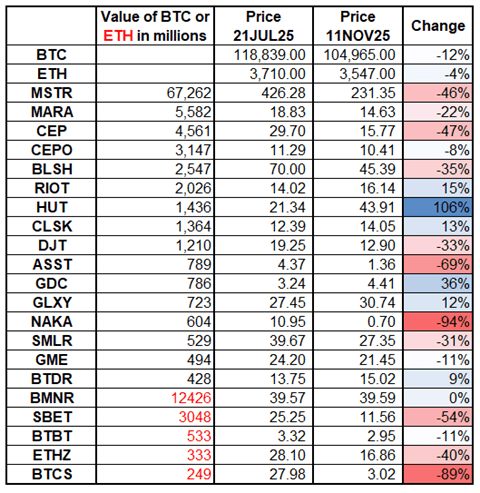
And on the crypto DAT front, the probably inevitable collapse towards NAV has happened. MSTR and many other crypto treasury companies are trading close to NAV or mNAV or EV, depending on how you measure those things, and the issuance craze that plagued us all summer has thankfully ceased. $1 bills have declined in value from $2 and are now selling for around $1. This is happening as BTC holds firm around $100,000 and the critical $98,400 zone holds fast.
Finally, it’s worth remembering that the first dominoes to fall in the momentum trade were silver and gold. They are trading harder, better, faster, stronger now and that could be a sign that liquidity sponges are back in fashion as the US government reopens and the US government will be showering liquidity upon the masses again soon. If the House shocks the world and votes against reopening, everything I have typed here is invalid.
So I am out of the bearish view on the AI capex offenders and now bullish safe beta like GOOG and dabbling long crypto treasury companies like MARA and NAKA.
MARA is speculative and NAKA is absurdly speculative so please use caution. This is not investment advice, at all. If you look at that table on page 1, an interesting aspect is that the bitcoin miners have done OK, especially those with exposure to power demand like RIOT, CLSK, and HUT. That makes sense given part of the selloff in the AI-related stuff has come on fears that there won’t be enough power to get all this AI machinery up and running.
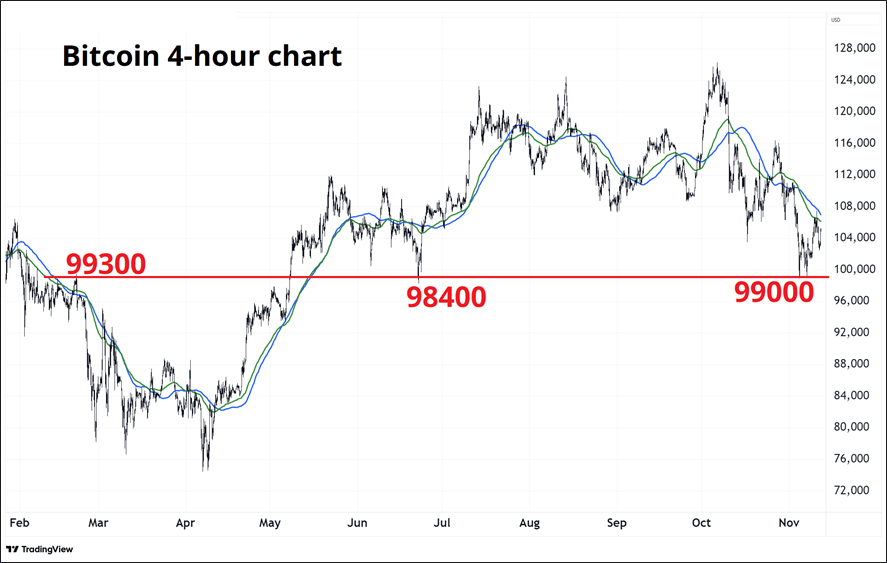
And in case you missed it in previous issues, here’s the BTC chart with the $98,400 level marked. You can see that 98400/99300 has been a critical pivot in both directions all year.
I made a mistake
Thank you to those who told me about my mistake yesterday and apologies to those who read what I wrote and thought they might be taking crazy pills. I published a chart showing the profitability of a simple UP/DOWN strategy where you buy an asset if it’s down on the week and sell it if it’s up. The chart was correct, but the takeaways were wrong. Here is the chart in case you didn’t read yesterday’s am/FX.
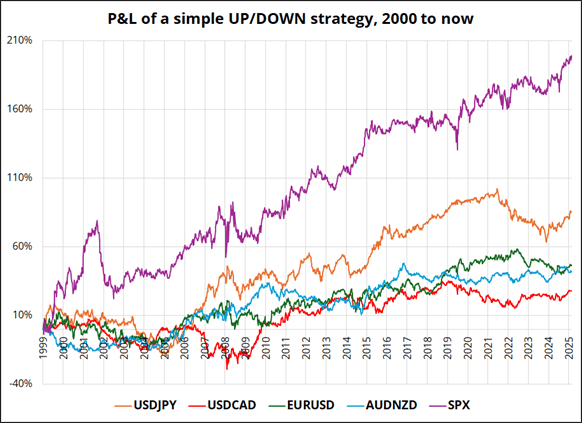
My assertion was that this shows SPX is a trending pair, but the intuition would be the opposite. If you can buy the dip and sell the rally and make money, isn’t that thing mean reverting? The problem is that my methodology was simply wrong. You can’t show the combination of the buys and the sells without mixing everything up into a meaningless soup. You have to split the buys and the sells, and then you will see thmakes much more senseat the reason that purple line goes up and to the right is that it’s just a simple “buy the dip” strategy in stocks. Similar to selling puts, this is a strategy with negative convexity and huge positive EV in bull markets.
Here is the strategy, broken into “buy the dip” and “sell the rally”. Again, I use weekly data and if the thing was down, you buy at the close Friday and hold for a week. If the thing is up this week, you sell at close Friday and hold for a week. This output makes much more sense.
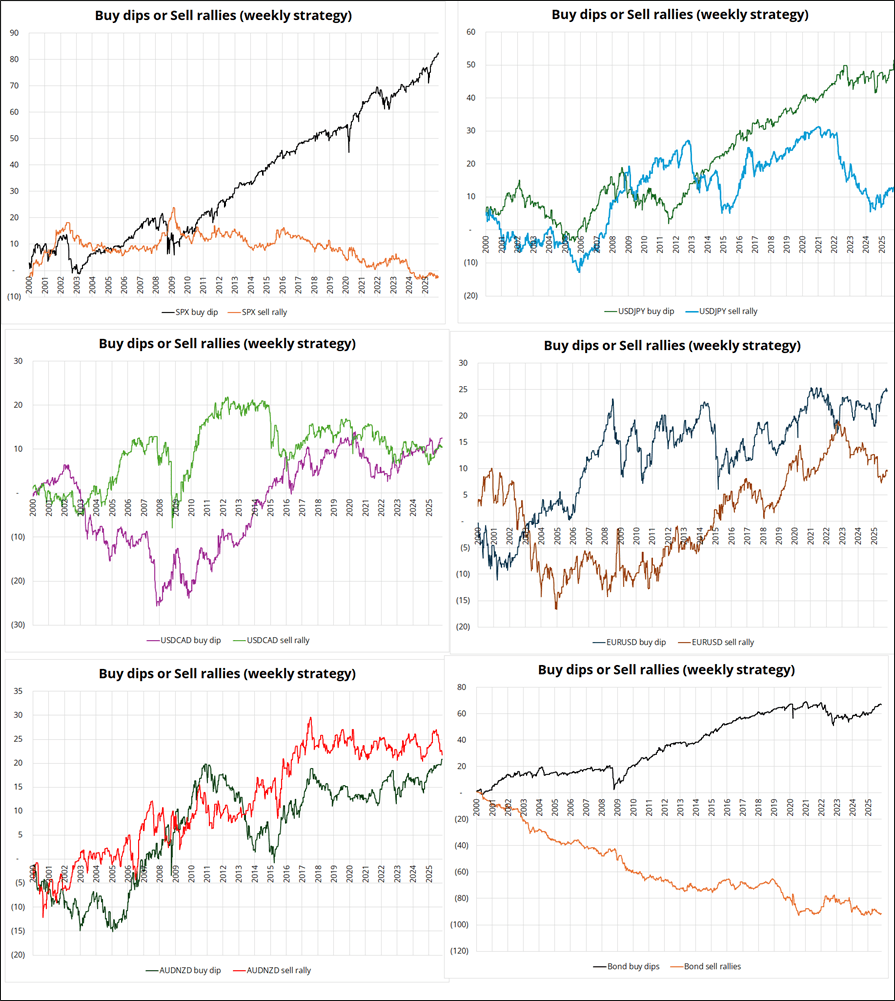
Bonds shows total return, FX does not include carry but I doubt that matters much for 1-week holding periods
So you see stocks and bonds have been incredible buy the dip machines, but you already knew that. Overall, there’s not that much information here and it’s not the correct way to determine whether something is more trending or rangebound. So I apologize for wasting your time.
If you’re wondering: It looks like a simple mean reversion strategy across a whole bunch of currencies might deliver a cool systematic strategy. Maybe? Here are the results of the simple weekly UP/DOWN using EURUSD USDJPY GBPUSD USDCHF AUDUSD NZDUSD USDCAD EURNOK EURSEK EURCHF USDMXN EURAUD CADJPY EURGBP.
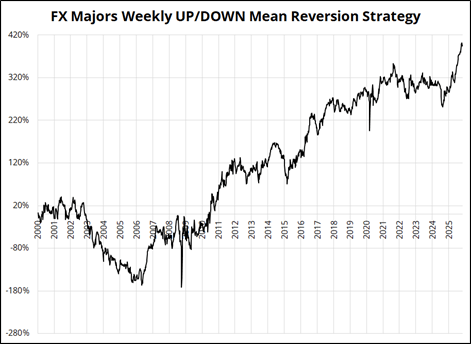
I am not going to do the overlay, but if you are familiar with the history of FX vols, you will see that this is sort of a short vol strategy, which makes sense. Mean reversion is synthetic short vol. Still, while it looks not too shabby overall, it has years-long periods where it doesn’t make money and I can’t really explain why it was so horrendous 2003 to 2006, a time when FX vol wasn’t particularly bid.
TACO Monday
I present here two charts that again probably tell you what you already knew. But in case you didn’t…

Theory: The stock market has been a political utility ever since the TCJA as that was the moment that the US officially abandoned fiscal orthodoxy. So the government is always looking to help the stock market and that frequently comes via weekend announcements. Or, could be random. But I doubt it. Trump yells about stuff mid-week then he, or Bessent, or someone else rolls it back on the weekend. And the big crypto pumps have also been weekend affairs.
The takeaway as more and more people are aware of this Monday effect is that we will start seeing frequent short squeezes from 2 p.m. to 4 p.m. on Fridays.
If you’re wondering why the negative bars for Biden on the left hand chart, the SPX win rate in his term was much lower than average. SPX win rates by president: Bush2 54.2%, Obama1 55.2%, Obama2 53.6%, Trump1 56.8%, Biden 52.8%, Trump 2 58.0%.
Yesterday emphasized once again that there is no such thing as “the stock market” anymore. You can have CRWV and NBIS and NVDA all down on the same day the Dow rallies 500 points. AI is one thing and “other tech” is another thing and “all the rest” is a third thing. And finally, while my equity views have been pretty decent this year, I acknowledge my FX views of late have not. My FX P&L is generally correlated to vol and that’s not been a good thing.
Author
Brent Donnelly
Spectra Markets
Brent Donnelly is the President of Spectra Markets. He has been trading currencies since 1995 and writing about macro since 2004. Brent is the author of “Alpha Trader” (2021) and “The Art of Currency Trading” (Wiley, 2019).