Nasdaq pulls back – But is the bull run over?


NASDAQ has posted weekly gains 11 of the 16 weeks since the lows of March. However, with the recent pullback in the midst of stocks like Tesla returning over 330% since its March lows, many skeptics reference 1999 as a benchmark for NASDAQ’s trajectory. However, are we going to see a repeat of 1999?
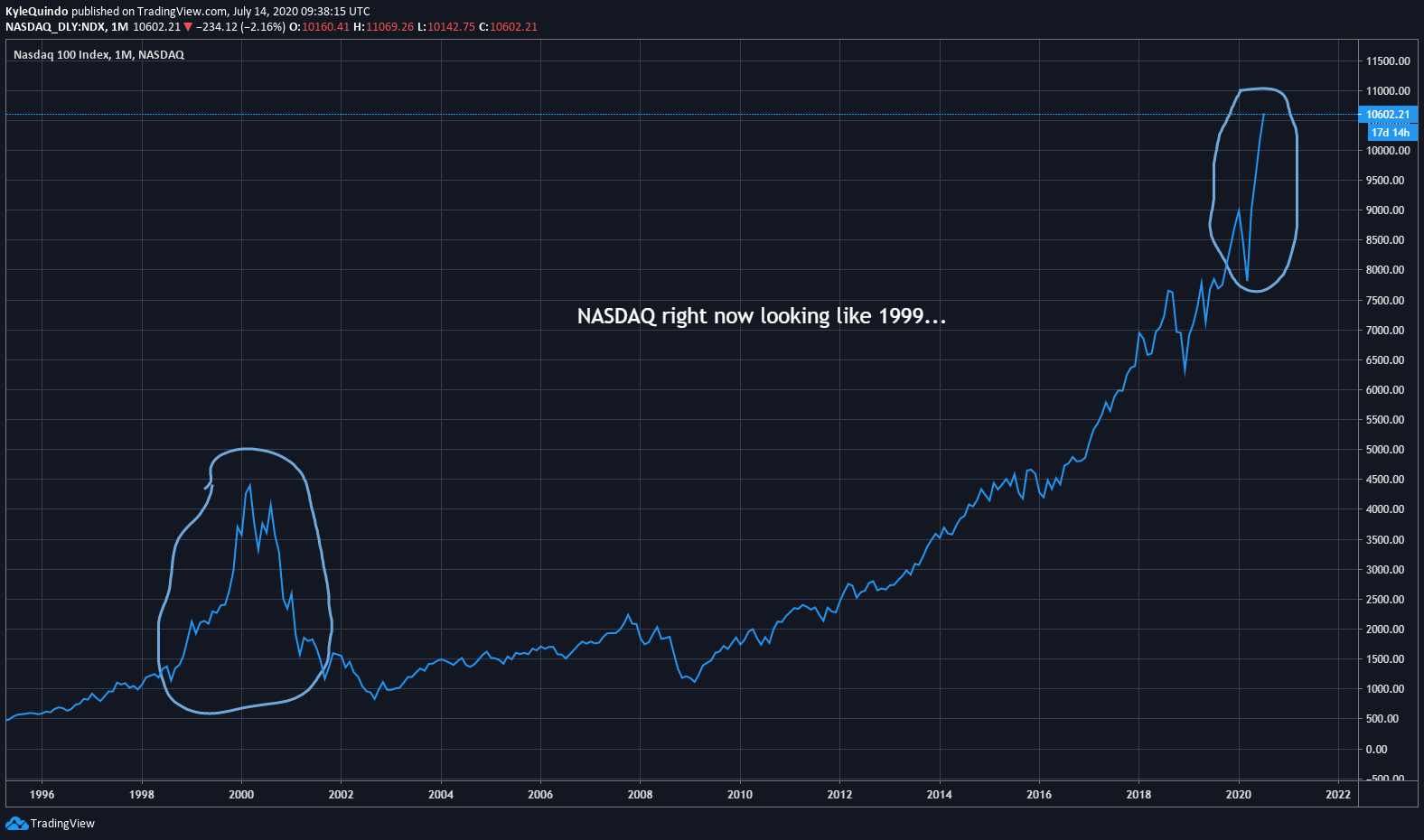
NASDAQ Then vs NASDAQ Now
The NASDAQ in 1999 was filled with companies synonymous with names such as pets.com – many of which were the equivalent of “Tesla” to retail traders. Pets.com was an online retailer that sold pet supplies. They had a successful IPO in 2000, raising $82 million, only to go bust 9 months later. This was similar to many businesses that seemed to fix inefficiencies in markets; however, they fixed them in a way that was not profitable.
This is reminiscent of WeWork – a company that seemed to fix market inefficiencies of empty office spaces and leases it mainly to smaller businesses. However, there is a key difference between what happened with pets.com and WeWork. Softbank, the majority owner of WeWork, attempted to have an IPO for the debt-laden, unprofitable company, only for investors to scoff at their proposed $47 billion valuations. The market accessed the company and deemed it not to be worth its recommended value. This is in comparison to the 2000s, where a venture capitalist at the time stated that “we’re in an environment where the company doesn’t have to be successful for us to make money.” Sure, we may point to the likes of Uber and Lift with their $1b quarterly cash burn. However, this generally highlights the difference between many businsses in the NASDAQ back then vs the now: businesses now intend to be in business in the future. (Or as accountants call it, “Going Concern”)
Morgan Stanley tracked 199 internet stocks in 1999, with a market cap of $450b ($692b accounting for inflation). Those 199 stocks generated $21b in sales ($32.32b accounting for inflation), however, they generated a net loss of $6.2b ($9.54). Compare that to the “FAANG” stocks now – which in total account for $5.18 Trillion in market value, with $197 Billion in revenues. While tech stocks during the bubble, whereas Christian Wolmar’s words, “little more than optimism feeding on itself,” tech stocks are now fully fledged businesses that print money like there is no tomorrow.
NASDAQ breaking records
Interestingly, after the 79% crash in 2000, it took the NASDAQ 15 years to regain its former high in 2015. It only took 4 years to 2019 to double.
-637303228908599822.png)
Should you go long the NASDAQ?
It depends on your time horizon. There is still a good chance there is a massive reversal due to negative investor sentiment. However, it is hard to tell, especially due to Coronavirus threats, where these types of stocks thrive relative to other stocks such as consumer retailers or luxury. However, it may be that Coronavirus proof business models that push these stocks higher.
Author
Kyle Quindo
Blackbull Markets Limited
Kyle is a Research Analyst with BlackBull Markets in New Zealand. He writes articles on topical events and financial news, with a particular interest in commodities and long term investing.

















