|

Mortgage delinquencies rise in march, first time since 2000

March is typically a very strong month performance-wise, but not this year due to Covid-19.

Blank Knight reports "March Sees First Ever Mortgage Delinquency Increase in Early Sign of COVID-19 Impact "

Key Points 

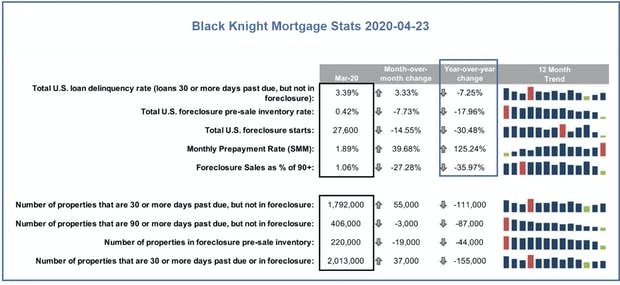
  • In what’s typically the strongest month of the year for mortgage performance, delinquencies rose by 3.33%, the first March increase since the turn of the century, an early sign of COVID-19’s impact on the market
  • Both the national foreclosure and 90-day delinquency rates set new record lows in March, a lingering reminder of the strength of the mortgage market heading into the pandemic
  • At just 27,600 for the month, foreclosure starts also fell to their lowest level on record, as COVID-19-related moratoriums began to impact foreclosure inflows
  • Prepayment activity jumped by nearly 40% in March, driven by record-low 30-year mortgage rates
  • Note: For the purposes of this report going forward, the millions of homeowners who have since entered into forbearance will be counted as past due, but should not be reported as such to the credit bureaus by their servicers

Black Knight Mortgage Stats 
fxsoriginal

Year-over-year trends on delinquencies and foreclosures has been impressive. 

That will end in April or May.

Author

Mike “Mish” Shedlock's

Mike “Mish” Shedlock's

Sitka Pacific Capital Management,Llc

Mike “Mish” Shedlock is a registered investment advisor for SitkaPacific Capital Management.

More from Mike “Mish” Shedlock's

Share:

Editor's Picks

GBP/USD: Downward-sloping trendline near 1.3470 remains key barrier

The British pound faces selling pressure against its major currency peers, trading 0.1% lower at around 1.3420 against the US Dollar during the European trading session on Tuesday.

EUR/USD flatlines above 1.1500, awaits US jobs data

EUR/USD holds steady around 1.1505 in European trading hours on Tuesday. Markets remain cautious ahead of a slew of US jobs data, starting with the JOLTS Job Openings Survey later today. However, the downside appears capped by hot Eurozone inflation in July, bolstering the case for a European Central Bank rate hike at the next meeting.

Gold holds steady above $4,050; hawkish Fed bets favor bearish traders

Gold remains confined in a range below the $4,100 mark through the early European session as traders opt to wait for further developments surrounding the Middle East crisis. Meanwhile, the uncertainty over US-Iran peace talks continues to act as a tailwind for the safe-haven US Dollar.

Aave: Bearish RSI divergence risks a 20% drop despite steady DeFi deposits

Aave (AAVE) extends a mild near-term recovery on Tuesday, holding above its 50-day Exponential Moving Average at $90.80. Aave protocol’s V3 deployment on Monad blockchain recorded over $500 million in deposits over the last month, reflecting increased user adoption.

US JOLTs report in focus
In the US, the June JOLTs report will be in the spotlight. Job openings have increased modestly this year, which has historically predicted rising wage cost pressures ahead. June trade balance data will also be released in the afternoon and the preliminary reading pointed towards a stable trade deficit from May. The Fed's Schmid (non-voter, hawk) will be on the wires overnight.
9-3: Is the Federal Reserve’s vote tally Warsh's new forward guidance?
The rate did not move. Neither did the statement, and that’s the more interesting fact. Set the July 29 Federal Open Market Committee (FOMC) statement beside the one issued on June 17, and the two documents are identical apart from a single verb and a paragraph at the bottom naming three dissenters.