Michigan Consumer Sentiment Index Preview: Regaining trend
- Michigan Consumer Sentiment Index expected to stabilize at the high side of its two year range
- Confidence supported by robust job market, rising wages, economic expansion
- Sentiment, current conditions and expectations have returned to trend

The University of Michigan will issue its preliminary Survey of Consumers for March on April 12, at 10:00 am EDT, 14:00 GMT. The monthly poll consists of three indexes—the Index of Consumer Sentiment, the Index of Current Economic Conditions and the Index of Consumer Expectations. The monthly result for each index is revised once. The survey began in January 1978.
Forecast
The Consumer Sentiment index is expected to decline to 98.0 in March from 98.4 in February. The Current Conditions Index is predicted to drop to 112.5 in March from 113.3 the prior month. The Expectations Index is thought to decrease to 88.5 from 88.8.
FXStreet
Consumer Sentiment returns to trend
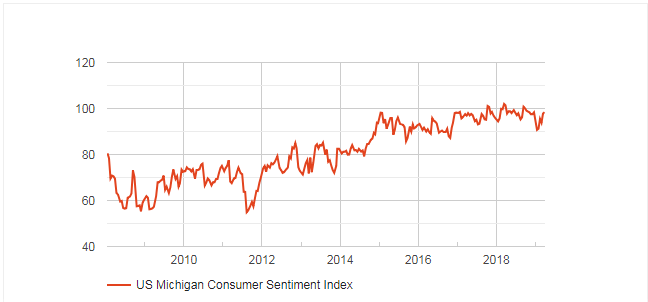
The American consumer has been on a two-year sentiment binge. From a low of 87.2 in October 2016 the sentiment index soared as high as 102.00 in March 2018 and never, post-election, fell below 93.1, its score in July 2017. Never, that was until the outlook plunged to 91.2 in January of this year pummeled by the partial government shutdown that began in late December and did not end until January 25th, after the polling for this survey had finished.
The index for current conditions moved from 105.9 in November 2016 to 122.8 in March of last year the second highest score in the 41 year history of the series. The January slide to 110.0 was much milder than drop in the overall sentiment. The index had fallen to 107.80 in August 2018.
The expectations index performed in a similar fashion. Starting at 76.6 in October 2016 it peaked at 91.3 a year later after subsiding to 80.2 in July 2017. That had been the post-election low until this January when it skidded to 78.3.
All three indexes have recovered to the upper part of their two year range. The 24 month moving average in the consumer sentiment survey was at 97.338 in March. That month’s reading off 98.4 and the forecast of 98.0 for April puts sentiment slightly above its two year average.
The current conditions 24-month moving average was 113.068 in March. The monthly score of 113.30 that month at the estimate for April of 112.5 scores, are coincident.
The expectations index 24-month moving average was 86.896 in March. Its 88.8 March result and 88.5 April prediction are also a bit above their two year average.
The attitude and outlook of the American consumer have clearly recovered from the emotional effect of the January government closure.
Employment, economic growth and consumer sentiment.
Job prospects, wages and the overall labor market have more impact on consumer attitudes that any other factors. If people feel secure in their employment or in their ability to find new work then their view of the economy and of their own situation is likely to be positive.
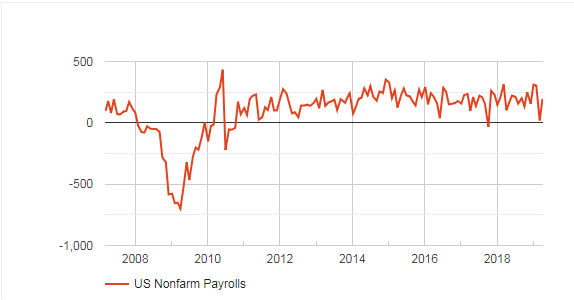
The US labor market has had its best performance in over three years in the past 12 months.
The February plummet to 33,000 new positions proved to be a one month anomaly as March returned with 196,000 new posts. Two of the last five years have seen similar one month declines, to 18,000 in September 2017 and 15,000 in May 2016. As this year, the subsequent months returned to trend.
FXStreet
With unemployment stable (U-3) at 3.8% in March, wages rising at 3.2%, down from 3.4% in February but at the top of the range for the last decade, the under-employment rate (U-6) at 7.3% and labor force participation at 63.0% , 0.2% points below the five year high, the American worker and consumer has much to be optimistic about.
As long as the job market and wages continue to provide employment and gains in income the attitudes and outlook of the US consumer sentiment is under no threat.
Author

Joseph Trevisani
FXStreet
Joseph Trevisani began his thirty-year career in the financial markets at Credit Suisse in New York and Singapore where he worked for 12 years as an interbank currency trader and trading desk manager.