|

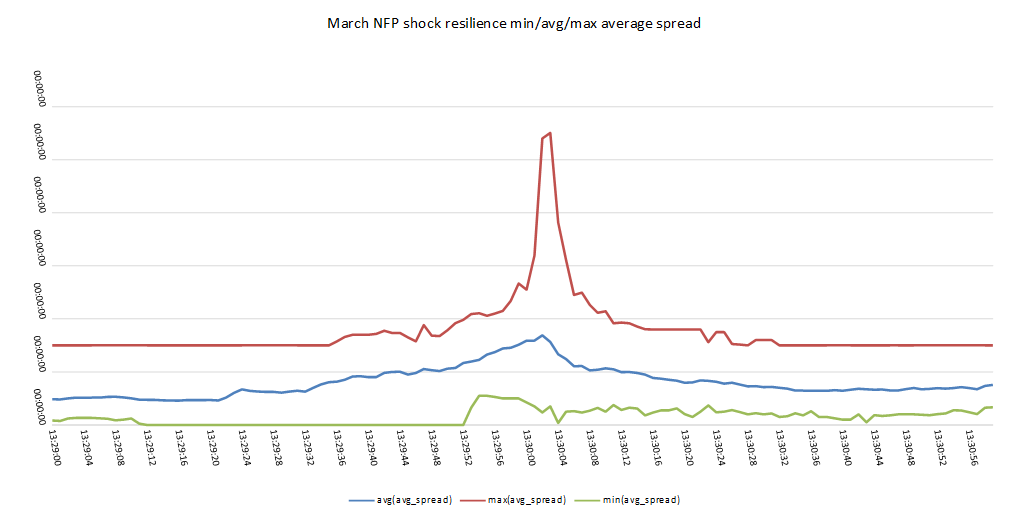
March NFP Shock Resilience

Timeline

13:29:00-13:29:50: Business as usual

13:29:50 - 13:29:58: Brokers start to get defensive, spreads double

13:29:58 - 13:30:11: The Rage! Even minimum average spreads go as high as 1, or even more. Some brokers simply "step aside" and quote a 10+ pips spread. 

12:30:11 - 12:31:00: The dust is settling, spreads recover relatively fast to normal levels when compared to earlier NFP events
Why is this information useful?

One thing you will need to know when preparing to trade the Employment Situation report is the difficulties there are to trade the NFP release through broker platforms. We constantly hear about the increase in bid/ask spreads and prices not being accessible for seconds after the release. This is simply due to the lack of interest liquidity providers have to supply broker platforms with prices during the heated seconds around the release. Liquidity providers give priority to their own volume clients and could not care less about retail traders over these critical seconds.

Most Forex brokers now use Non-Dealing-Desk and ECN business models. They are not market makers. This means you receive the retail market price for your trades. During high volatility situations the market is either very thin or has a glut of orders that needs to be processed. In either case, the BID/ASK spread can widen, sometimes dramatically. Its not your broker's fault... that is the market price at that moment.

The information contained in this report allows you to place your stops adequately so you can minimise the risk of being stopped out at the release It also allows you to calculate your profit potential more realistically taking into account the higher trading costs derived from higher spreads.

TradeProofer.com is a Forex traders' community monitoring Forex broker spreads realtime. Its systems monitor dozens of Forex brokers' spreads moved around economic releases, such as the NFP announcement under the U.S. Employment Report.

Author

TradeProofer Team

TradeProofer Team

TradeProofer

More from TradeProofer Team
Share:

Editor's Picks

AUD/USD flatlines near 0.6965 as less hawkish RBA counters USD weakness

AUD/USD holds steady above a two-week low, trading near 0.6965 in the Asian session on Wednesday as early midterm election results heighten political uncertainty and weigh heavily on the US Dollar. Moreover, reviving safe-haven demand triggers a fresh leg down in US bond yields, offsetting Fed hike bets and exerting additional pressure on the buck. However, a less hawkish RBA caps the Aussie.

USD/JPY declines below 158.00 as USD weakens on midterm election results

USD/JPY comes under heavy selling pressure on Wednesday, dropping below 158.00 during the Asian session as the US Dollar slumps to a one-month low amid heightened political uncertainty after early US midterm vote counts. Moreover, the prospect of gridlock in Washington drives safe-haven flows, triggering a fresh leg down in US bond yields and further weighing on the buck.

Gold ticks lower while early trend points to Democrats victory in House

Gold trades with caution at around $3,930 in the Asian trading session on Wednesday. The precious metal struggles to gain direction as investors shift their focus to United States Midterm elections where early trend shows that Democrats would have a clear majority in House of Representatives.

Bitcoin tests critical support, Ethereum struggles below resistance, XRP extends losses
Bitcoin (BTC), Ethereum (ETH) and Ripple (XRP) remain under pressure on Wednesday as bearish momentum continues to weigh on prices. BTC approaches key support around $76,466, and a decisive close below could open the door to deeper losses. Meanwhile, ETH struggles below key resistance while XRP faces rejection at the upper trendline of a falling channel pattern, all hinting at deeper losses.
US Dollar Index dives to late September lows near 101.25 on US election results

The US Dollar Index, which tracks the Greenback against a basket of currencies, comes under intense selling pressure during the Asian session on Wednesday, dropping to its lowest level since late September as early US midterm election results heightened political uncertainty.

The 2% inflation target came from a throwaway remark. It now moves trillions
The Federal Reserve's 2% inflation goal grew out of an off-the-cuff remark by a New Zealand politician in 1988. Bond investors still price long-term US debt as if 2% holds, so a change in how the Fed measures inflation would move markets.