Major averages plummet to start 2021

Quick Update
In a quick update to kick off 2021, I wanted to summarize my correct calls, and what I profited on since beginning to publish these updates. While nobody can predict the future, the major calls I am most proud of since writing these letters are calling the short-term downturn in small-cap stocks, adding emerging market exposure, and hedging or selling the U.S. dollar.
I switched my call on small-caps, specifically the Russell 2000 from a HOLD to a short-term SELL on December 16th. The iShares Russell 2000 ETF (IWM) surged to unprecedented record gains since November 2020, however, I believed then and still believe that the index has overheated by many measurements. Since December 16th, the IWM ETF is largely flat. However, since peaking on December 23rd, the IWM has underperformed ETFs tracking the larger indices and has declined by nearly 3%. While I am still bullish on small-caps in the long run and maintain my STRONG BUY call on the Russell for the long-term, it is contingent on a pullback . I believe that pullback may have begun. I am hoping for a minimum 10% decline before jumping back in for the long-term.
Emerging markets have been some of the best performers in 2020, and I have made some bullish calls on specific regional markets for 2021 as well. I have been touting emerging markets since my first report, but when I switched my focus to specific regions, my calls became even more correct. I called Taiwan ( EWT ETF) the best bet for emerging market exposure while avoiding the risks and baked in profits of China on December 3rd. Since then, the EWT ETF which tracks Taiwan has gained over 7% while the MCHI ETF which tracks China has barely gained over 1.4%. The Taiwan ETF has also outperformed the SPY S&P 500 ETF and the IEUR ETF which tracks Europe.
In conjunction with my bullish calls on emerging markets, my bearish calls on the U.S. dollar were also correct. Since I started doing these newsletters about a month ago, I consistently said that the dollar should be hedged or avoided because of the Fed’s policies, effect of interest rates this low for this long, government stimulus, strengthening of emerging markets, and inflation. I also said that any minor rally the dollar would experience would be fool’s good. Since the dollar briefly pierced the 91-level on December 9th, it has fallen nearly 1.4%. Despite it experiencing another mini-rally and nearly piercing the 91-level again on December 22, I remained steadfast in my bearish outlook of the dollar. Since the open on December 23rd, the U.S. Dollar has declined another 0.77%. I believed it would drop back below 90 before the new year, and here we are to start off 2021, with the dollar at 89.85.
Markets kicked off the first trading day of 2021 with a dud, due to further concerns of COVID-19 cases and the Georgia Senate run-off elections.
News Recap
- Monday (Jan.4) marked the first negative start to a year for the Dow Jones since 2016. The Dow Jones closed 382.59 points lower, or 1.3%, at 30,223.89. The Dow at one point fell more than 700 points.
- The S&P 500 also fell 1.5% to 3,700.65, the Nasdaq fell 1.5%, and the small-cap Russell 2000 fell 1.47%.
- This was the biggest one-day sell-off since Oct. 28 for the Dow and S&P 500, and the Nasdaq’s worst sell-off since Dec. 9.
- While the sell-off to start the year could be due to natural consolidation, the growing number of COVID-19 cases around the world and its potential impact on the global economic recovery weighed on investors. To start the year off, U.K. Prime Minister Boris Johnson announced a national lockdown to slow the spread of a new, more contagious, coronavirus strain. With this lockdown, people are only allowed to leave their homes for essentials, work if they can’t from home, and exercise. Most schools, including universities, will also move to remote learning.
- According to data compiled by Johns Hopkins University , more than 85 million COVID-19 cases have been confirmed globally, including 20.7 million in the U.S. and 2.7 million in the U.K.
- Pay very close attention to the Georgia Senate run-offs on Tuesday (Jan. 5). The balance of power in the Senate is hanging on the vote and markets could be volatile due to the results. If the Democrats gain a majority, it could impact market performance and leave Biden’s powers largely unchecked. If the Republicans keep just one seat, it could likely check Biden’s more progressive ambitions.
- Coca-Cola (KO) and Boeing (BA) were the laggards on the Dow, falling 3.8% and 5.3%, respectively. Real estate stocks were the worst performing on the S&P and fell 3.2%. Utilities also declined 2.6%.
- About 4.6 million people in the U.S. have now gotten a COVID-19 vaccine.
Stocks dropped sharply on Monday (Jan. 4), to kick off 2021. It was the first time since 2016 that the Dow Jones started a year off with declines and was the biggest one-day sell-off since Oct. 28 for the Dow and S&P 500. It was also the Nasdaq’s worst one-day decline since Dec. 9.
Several catalysts can be blamed for the gloomy start to the year: natural consolidation, COVID-19, and the Georgia Senate runoff elections.
First and foremost, a decline like this was bound to happen, and I called this happening in the early part of the year. I still believe that there will be a short-term tug of war between good news and bad news, and that these moves are manic and based on sentiment. There was no pullback to end 2020 as I anticipated, but I still believe that markets have overheated in the short-term. Was Monday (Jan. 4) the start of a correction? Possibly. But either way, I think that between now and the end of Q1 2020, a correction could happen.
Carl Icahn seemingly agrees with me, and told CNBC on Monday (Jan. 4), “in my day I’ve seen a lot of wild rallies with a lot of mispriced stocks, but there is one thing they all have in common. Eventually they hit a wall and go into a major painful correction.”
I believe, though, that corrections are healthy and could be a good thing. Corrections happen way more often than people realize. Only twice in the last 38 years have we had years WITHOUT a correction (1995 and 2017). I believe we are overdue for one since there has not been one since the lows of March 2020. This is healthy market behavior and could be a very good buying opportunity for what I believe will be a great second half of the year.
Meanwhile, COVID-19 continues surging and there are very real fears of new strains discovered in the U.K. and South Africa that could be more contagious. U.K. Prime Minister Boris Johnson announced a national lockdown that could potentially last until mid-February. With this lockdown, people are only allowed to leave their homes for essentials, work if they can’t from home and exercise. Most schools, including universities, will also move to remote learning. This could be an ominous sign for stricter lockdowns to be implemented in other regions across the world.
Outside of COVID-19, political uncertainty has returned to the markets. The balance of power in the U.S. Senate is at stake, with Georgia run-off Senate elections set to occur on Tuesday (Jan. 5). Investors are likely to prefer a divided Senate. If the Democrats win both elections and wrestle away Senate control from the Republicans, it could leave President Biden’s powers largely unchecked, and enable him to pass more of his ambitious and progressive policies. Many investors do not anticipate these to be very market friendly. As results start to come in Tuesday evening, markets could react in a volatile manner.
According to John Stoltzfus , chief investment strategist at Oppenheimer Asset Management, the S&P 500 could fall by 10% if the Democratic candidates win the Georgia runoffs.
“It is thought by not just a few folks on Main Street as well as on Wall Street that if tomorrow’s run-off results in a sweep for the Democrats — providing them with control of the Senate as well as the House — that it would bode ill for business with the likelihood that corporate tax rates could rise substantially,” Stoltzfus said.
This will also be a busy week for economic data with the manufacturing PMI report said to be released Tuesday (Jan. 5) and the non-farm payrolls report set to be announced Friday (Jan. 8).
Monday's sell-off (Jan. 4) serves as a very painful reminder that markets will still have to weigh the near-term risks against some of the more positive mid-term and long-term hopes on vaccines and re-opening.
The general consensus is that 2021 could be a strong year for stocks, despite short-term headwinds. According to a CNBC survey which polled more than 100 chief investment officers and portfolio managers, two-thirds of respondents said the Dow Jones will most likely finish 2021 at 35,000, while five percent also said that the index could climb to 40,000.
Therefore, to sum it up:
While there is long-term optimism, there are short-term concerns. A short-term correction between now and Q1 2021 is very possible. But I do not believe, with conviction, that a correction above ~20% leading to a bear market will happen.
Does the Dow Approach 31,000 or 29,000 Before Mid-2021?
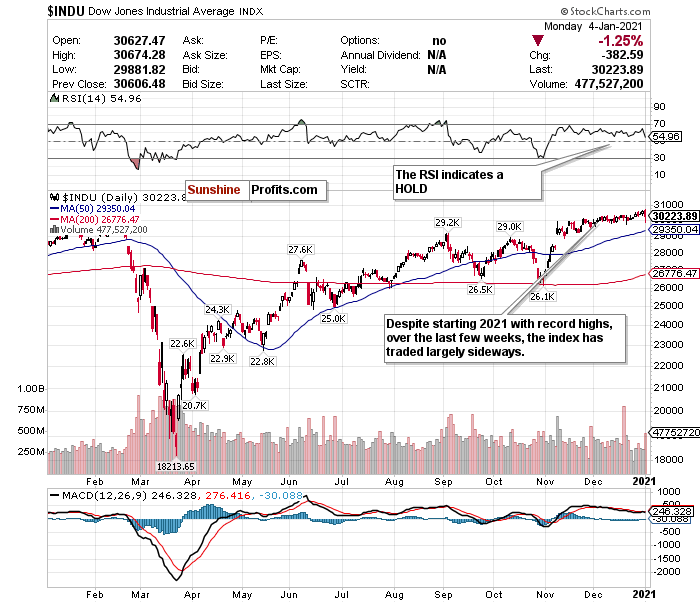
I have too many short-term questions for the Dow Jones. I believe it’s just as likely for the Dow to touch 29,000 again as it is to touch 31,000 before March.
After trading as low as around 29,650 at one point before the new year (Dec. 21), the Dow has remained firmly above 30,000. However, it has traded largely sideways over the last few weeks, despite opening Jan. 4 with a record high.
Despite some long-term optimism, for now, my short-term questions take precedence. I don’t like how COVID-19 is trending (who does?), I am disappointed in the vaccine roll-out, and I am concerned about the Georgia election. In the short-term, I am not convinced that the Dow will stay above 30,000 for more than a week at a time and I am also not convinced that it will hit more all-time highs before March.
In the short-term, I believe it is just as likely for the Dow to approach 29,000 as it is to approach 31,000 in the early months of 2021.
While I think a 35,000 call to close out 2021 is a bit aggressive, I do believe that the second half of 2021 could show robust gains for the index.
With so much uncertainty and the RSI still firmly in hold territory, the call on the Dow stays a HOLD.
This is a very challenging time to make a call on the Dow with conviction. But one thing I do believe is that if and when there is a drop in the index, it will not be strong and sharply relative to the gains since March 2020. I believe that it is more likely than not that we will be in a sideways holding pattern until vaccines are available to the general public by mid-2021.
For an ETF that attempts to directly correlate with the performance of the Dow, the SPDR Dow Jones ETF (DIA) is a strong option.
Want free follow-ups to the above article and details not available to 99%+ investors? Sign up to our free newsletter today!
Want free follow-ups to the above article and details not available to 99%+ investors? Sign up to our free newsletter today!
Author
Matthew Levy, CFA
Sunshine Profits
After graduating with a Bachelor of Science in Economics from the University of Victoria in 2010, Matthew developed a passion for helping clients meet their financial freedom through strong, risk-adjusted portfolios.