Let’s just say Draghi herded the cats


Outlook:
We will be digesting the ECB policy change for some time to come until the Fed's meeting next week grabs all the attention. Let's not lose sight of the fact that the ECB policy change is an easing while the Fed's move is a tightening. The ECB injected some confusion into the mix by cutting the monthly purchases, which may seem hawkish, but widening the scope of purchases to 1-year and taking paper yielding less than the deposit rate is easing no matter how you jigger it. Some are throwing around terms like "dovish taper" and "hawkish ease," which are inherently contradictory and therefore not useful. Let's just say Draghi herded the cats.
Mr. Draghi was masterful in the press conference. He rejected the word "tapering" as applicable to the new reduction in the size of ECB purchases, saying the board did not discuss tapering at all. Pressed by reporters, Draghi defined tapering as a gradual decline to zero purchases. Draghi said the ECB will be active in the market for a long time to come and can increase the size if needed. Draghi also admitted that reaching the goal of near 2% inflation is not really going to happen, even if the risk of deflation has mostly disappeared.
On the political front, Draghi said Brexit and Trump, plus the election calendar in Europe next year, create rising uncertainty that we don't know how to judge. He arrives at a different political statement from the fiscal question. Countries need to obey the rules but redirect fiscal spending to areas that in-crease productivity. But obeying the rules is not optional. It creates confidence within a country but also builds trust across the membership, and that trust is critical to continuation of integration. This was quite inspirational and the first time we have heard anything inspiring about the eurozone in many a moon.
We shouldn't neglect the ECB staff projections of GDP growth over the next three years at 1.6-1.7%. The Atlanta Fed GDPNow forecast is OIL not really comparable because it addresses only the current quar-ter, but we get a revision today and that may remind analysts and traders that the US is surpassing Eu-rope and by a mile. The most recent GDPNow estimate was 2.6% on Dec 6 from 2.9% on Dec 1. Over long periods of time, GDP leads the currency. That implies dollar strength might wobble but has a solid underpinning.
Inflation forecasts count, too, as a leading indicator of central bank attitudes and actions. In the euro-zone, inflation will not come close to meeting the 2% target. In the US, we have a new factor that might well prove inflationary—Trump's tax and fiscal plans. House Speaker Ryan asserts that a new tax re-gime and fiscal plans pertaining to various social programs will be revenue-neutral. While Ryan has quite a lot of credibility, Trump is the elephant in the china shop. We are right to be afraid. Government spending programs are not inherently inflationary—that would be to accept "crowding out," a discredited concept from the Reagan years. But many, if not most, people continue to believe that higher gov-ernment spending inhibits private sector investment and is therefore inflationary, and what people be-lieve is what drives prices, not deep economic analysis.
Expectations of higher growth and higher inflation, and thus a more aggressive Fed next year—the ex-pected hike count in now up to two—are dollar-supportive. We don't worry much about the effect on exports, but instead look to capital inflows that will seek higher yields, greater variety if investment choices, and real direct investment, as well. The demise of the dollar is not true.
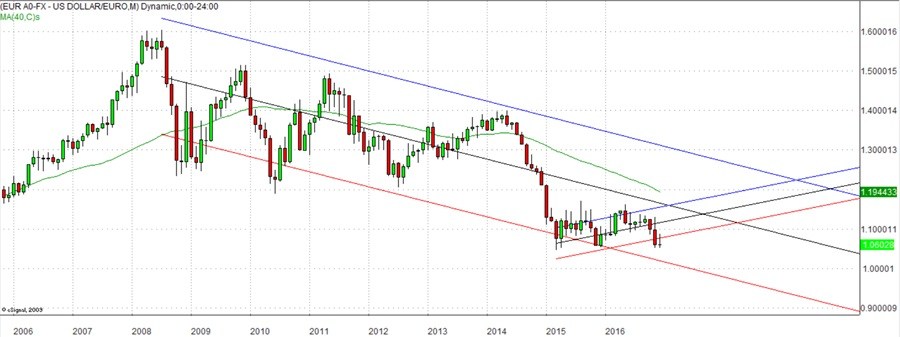
See the monthly euro chart:
Politics: In the US, Trump picked a guy who hates the minimum wage as Labor Secretary. He thinks the minimum wage inhibits job growth (it doesn't). He also picked a guy to head the Environ-mental Protection Agency who is supported by giant old-energy companies and is suing the EPA over emission controls. Fortunately, the law trumps leadership foibles but that's not the point. The point is that Trump doesn't really care about these issues—what he cares about is getting attention by shaking up the Establishment. Populism has nothing to do with it. At some point this will be recognized. Or so we can hope.
| Current | Signal | Signal | Signal | |||
| Currency | Spot | Position | Strength | Date | Rate | Gain/Loss |
| USD/JPY | 114.44 | LONG USD | STRONG | 11/10/16 | 106.47 | 7.49% |
| GBP/USD | 1.2610 | LONG GBP | WEAK | 12/05/16 | 1.2717 | -0.84% |
| EUR/USD | 1.0622 | LONG EURO | WEAK | 12/06/16 | 1.0769 | -1.37% |
| EUR/JPY | 121.54 | LONG EURO | STRONG | 11/03/16 | 114.30 | 6.33% |
| EUR/GBP | 0.8423 | SHORT EURO | STRONG | 11/14/16 | 0.8598 | 2.04% |
| USD/CHF | 1.0159 | LONG USD | WEAK | 11/10/16 | 0.9678 | 4.97% |
| USD/CAD | 1.3185 | SHORT USD | STRONG | 12/06/16 | 1.3259 | 0.56% |
| NZD/USD | 0.7180 | LONG NZD | STRONG | 12/06/16 | 0.7173 | 0.10% |
| AUD/USD | 0.7475 | LONG AUD | WEAK | 12/06/16 | 0.7438 | 0.50% |
| AUD/JPY | 85.57 | LONG AUD | STRONG | 10/06/16 | 78.48 | 9.03% |
| USD/MXN | 20.3557 | LONG USD | STRONG | 10/31/16 | 18.9054 | 7.67% |
This is an excerpt from “The Rockefeller Morning Briefing,” which is far larger (about 10 pages). The Briefing has been published every day for over 25 years and represents experienced analysis and insight. The report offers deep background and is not intended to guide FX trading. Rockefeller produces other reports (in spot and futures) for trading purposes.
To get a two-week trial of the full reports plus traders advice for only $3.95. Click here!
Author
Barbara Rockefeller
Rockefeller Treasury Services, Inc.
Experience Before founding Rockefeller Treasury, Barbara worked at Citibank and other banks as a risk manager, new product developer (Cititrend), FX trader, advisor and loan officer. Miss Rockefeller is engaged to perform FX-relat